
Reviewed · HISTORICAL TOURS
Pula: Historic Walking Tour with Local Guide & City Views
Pula’s Roman amphitheatre is only the starting point on this 1.5-hour walking tour. With Marina, a licensed guide born in Pula, you move from the arena to old city gates, the farmers market, and Forum Square while connecting Roman remains with daily life in modern Istria. I like the local angle and the chance to ask about food, customs, and the meaning of the goat on the regional flag. The main consideration is that entrance fees are not included, so this is primarily an outdoor city walk rather than a full arena visit.
I also like the tour’s clear focus on German-speaking visitors and Marina’s long experience guiding in Istria. The 28-dollar price is fair if you want orientation, context, and practical local tips in a short visit. Just remember that the advertised route is broad, so anyone hoping for a long, detailed interior tour of the amphitheatre may want to add a separate visit.
Key points at a glance
- Roman Pula beyond the arena: Learn why the amphitheatre had uses beyond gladiator contests.
- Three surviving city gates: See the Twin, Hercules, and Sergii gates and examine their preserved details.
- A true local guide: Marina was born in Pula, has guided in Istria for more than 18 years, and speaks German.
- Farmers market stop: See where local products from Istrian soil are bought and sold.
- Forum Square and the goat flag: Connect Roman trade and civic life with Pula’s Venetian town hall and regional identity.
- Flexible conversation: Ask about local lifestyle, culture, nature, or food during a wheelchair-accessible walk.
Starting beneath Pula’s wooden roof
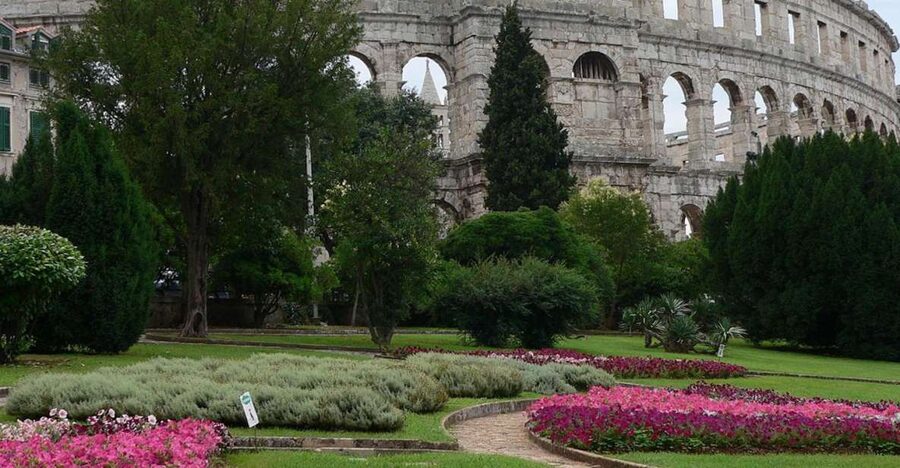
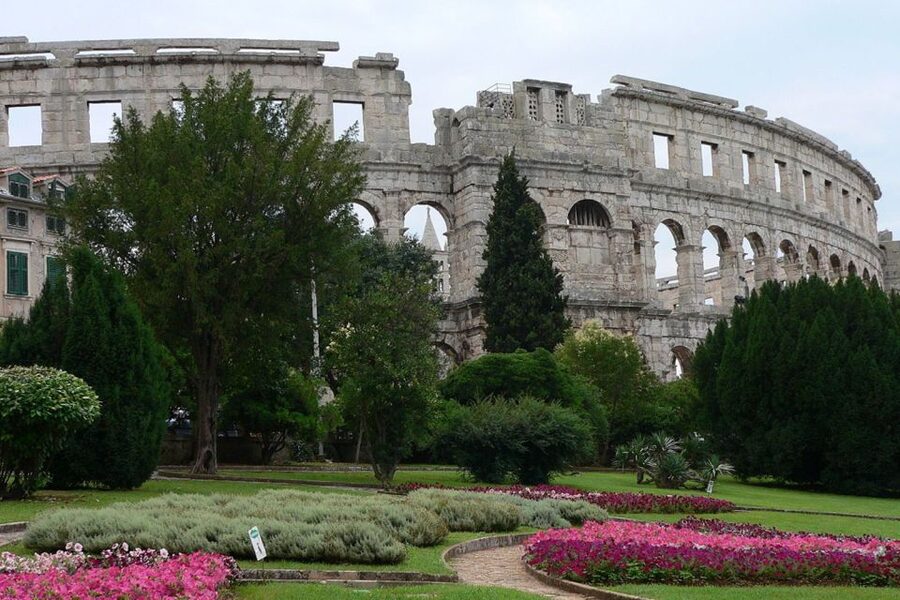
The tour begins in front of Pula’s best-known sight, the Roman Amphitheatre. You meet Marina at the entrance under the wooden roof, then use the arena as your first lesson in the city’s long public life.
The amphitheatre is an obvious meeting point, but it also gives the walk a strong opening. You do not begin with a general city introduction or a long transfer. You begin beside the structure that made Pula’s ancient importance easy to see.
Marina explains what the building was made for and how it was used. The useful point here is that the story goes beyond gladiator games. That broader explanation helps you see the amphitheatre as part of the city, not just as a dramatic stone shell for photographs.
Because admission is not included, the walking tour does not promise a full interior visit. You should treat the arena stop as an outdoor introduction and decide separately if you want to pay for entry. That keeps the tour price down, but it also means the experience is best for people who want a city walk with context rather than a dedicated monument tour.
Other guided walks in Pula:
- Pula walking tour
★ 5.0 · 96 reviews - Pula: Historic Sites Guided Walking Tour
★ 4.8 · 78 reviews - Pula Essentials Walking Tour
★ 4.8 · 64 reviews
Three Roman gates in the old streets
From the amphitheatre, the route leads into older parts of Pula. The city’s streets reflect the many cultures that have claimed and shaped the place over several centuries, and the route gives you a practical way to read those layers.
The three Roman gates are a particular strength:
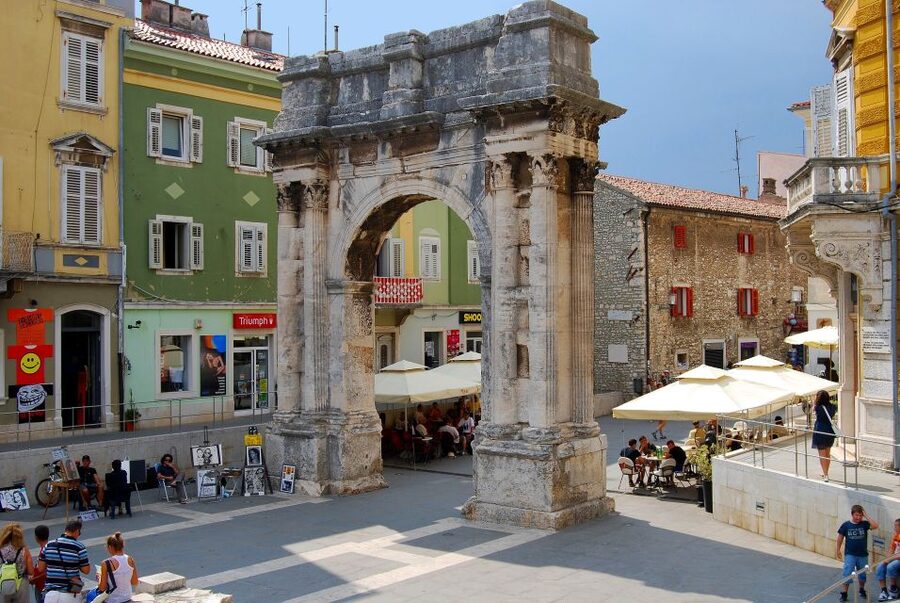
- The Twin Gates
- The Hercules Gate
- The Sergii Gate
Marina uses the surviving details of these gateways to explain their stories. That matters because old gates can blur together when you see them alone. A guide gives you a reason to stop, look closely, and understand how each one fits into the city’s earlier layout.
The route is also a good choice if you enjoy alternative facts rather than a simple list of dates and rulers. The tour promises fun details and local explanations, so you can expect the conversation to move between major monuments and smaller points that may not be obvious on your own.
I would pay attention to the preserved stonework. You do not need specialist knowledge to appreciate it, and the gates make the ancient city feel more tangible than a distant story. At the same time, the 1.5-hour limit means the tour cannot give every street equal attention. Marina can cover the main sights and respond to your interests, but this is not an all-day archaeological survey.
The farmers market and Istrian food
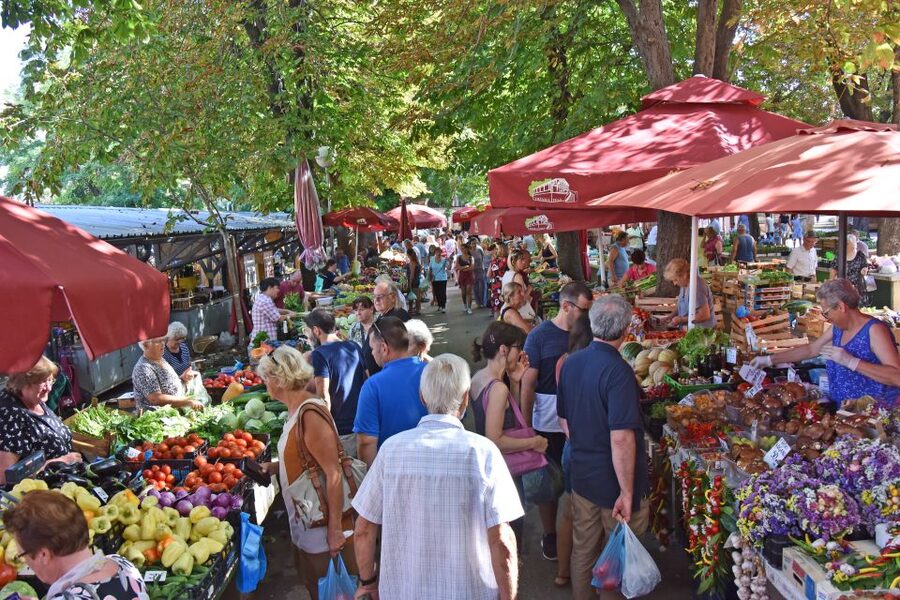
The Pula farmers market adds a welcome change of pace. After Roman stone and city gates, you reach the place where local people buy and sell products native to Istrian soil.
This is where Marina’s personal interests become especially useful. She describes herself as a foodie and passionate cook, so the market stop is not just a quick look at stalls. You can use it to ask about local ingredients, cooking, and the role food plays in everyday life.
The supplied information does not promise tastings or purchases included in the price, so plan to browse rather than expect a food workshop. Still, the stop has real value. Markets show how a city lives now, while monuments show how it lived before. Putting both on one short route gives you a more rounded picture of Pula.
If you are planning to eat elsewhere in Istria, this is also a sensible time to ask Marina for ideas. The tour allows discussion of local cuisine, and her cooking interest should make that conversation more useful than a generic restaurant list. You may find the market stop particularly helpful if you want food guidance grounded in local habits.
Forum Square, the August Temple, and a Venetian town hall
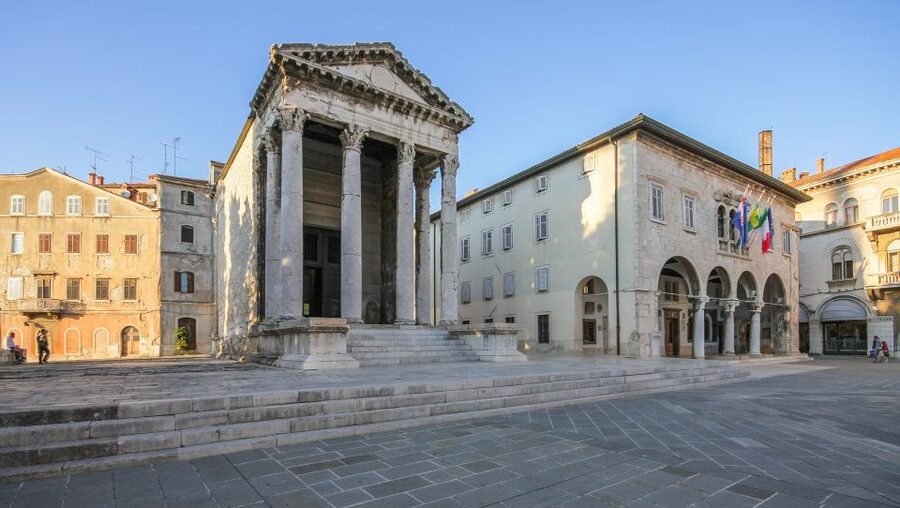
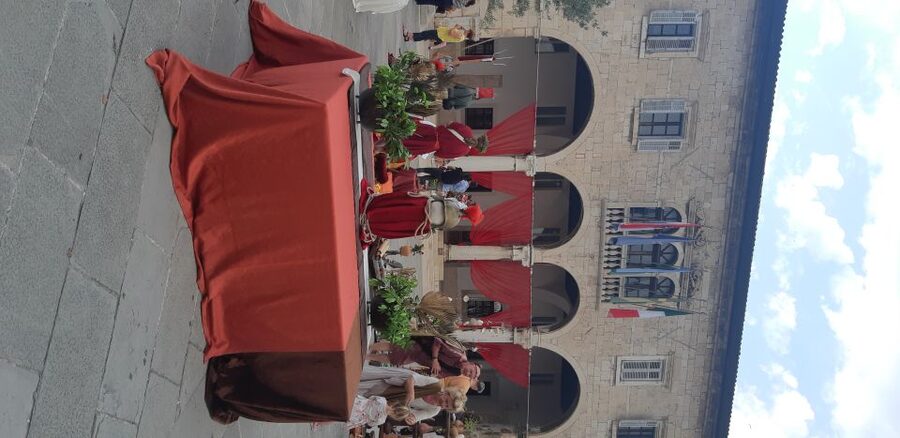
The next major point is Forum Square, described as the Roman version of the farmers market. It was also the heart of the Roman city, which makes it an important stop for understanding how trade and public life once came together.
Here you see remains of the August Temple. You also admire the Venetian city hall, giving the square a clear contrast between Roman and later periods. The value of this stop is not simply that it contains two old buildings. It lets Marina show how Pula changed hands and functions while remaining a civic center.
The goat on the regional flag gives the conversation a memorable local detail. It is the sort of small question you might never think to ask while walking alone, yet it opens a path into regional identity. Pula is not presented as a collection of ruins. You get a chance to connect the stonework, the flag, the market, and the people who live in Istria today.
I like this part of the route because it rewards curiosity. If you ask about culture, local life, or food, the Forum is a natural place to widen the discussion. If you prefer architecture, you can focus on the temple and town hall. The activity is described as individualized, so the best use of the time is to tell Marina what interests you early on.
Same base, a different kind of day out:
- Pula: Arena Entrance Ticket
★ 4.3 · 2,590 reviews - Medulin -Kamenjak 5h boat trip with lunch & drinks on Sandra Boat
★ 5.0 · 1,621 reviews - Full-Day Boat Tour of the Medulin Archipelago from Medulin
★ 5.0 · 1,389 reviews - 3hours all inclusive Sunset&Dolphin Tour from Medulin on Sandra
★ 5.0 · 1,130 reviews
Marina’s local perspective and German-language guiding
Marina was born in Pula and has worked as a licensed guide in Istria for more than 18 years. She specializes in German-speaking visitors, and German is the stated tour language.
That combination matters if you want more than translation. A local guide can explain how the city feels and functions, not just repeat dates attached to buildings. Marina’s background also gives you an opportunity to ask about things that are difficult to answer from a guidebook, such as local lifestyle, cuisine, nature, and cultural habits.
The strongest praise associated with this experience focuses on how much people learn about Pula and its people, and on the walk being easygoing rather than dry. That matches the structure of the tour. The route has serious ancient monuments, but the conversation can include food, local stories, and unusual details.
You should still be clear about the language before booking. The activity is offered in German, not as a multilingual tour with several language choices. For German-speaking visitors, that is a major advantage. For anyone who does not speak German, this particular experience is not the right fit.
What the 1.5-hour length means
Ninety minutes is long enough to get your bearings and short enough to fit into a busy day in Pula. You cover the arena, several Roman gates, the farmers market, and Forum Square without committing half a day to a formal tour.
I would schedule it near the beginning of your stay if possible. The market, Forum, gates, and amphitheatre give you a useful mental map, and Marina can point you toward subjects worth returning to. The tour also ends back at the starting point, which makes it easier to continue sightseeing or return to your accommodation afterward.
The short length requires realistic expectations. You will receive a focused introduction, not an exhaustive account of every period in Pula. The individualized format helps because Marina can adjust the conversation to your interests, but there is still only so much ground to cover in 90 minutes.
Starting times vary, so you need to check availability for the date you want. The meeting point is specific: the entrance to the arena under the wooden roof. Arrive with enough time to locate that spot, especially if you are unfamiliar with the amphitheatre complex.
Price, value, and what is not included
At 28 dollars per person, this tour sits in a sensible range for a short guided city walk. I consider it good value if you want a local voice, German-language service, and a route that combines major monuments with everyday Pula.
The price pays for the 1.5-hour walking tour and local guide. It does not cover entrance fees, so budget separately if you want to enter the amphitheatre or any other paid site. That arrangement is common for orientation walks and gives you freedom to decide which monuments deserve extra time.
The value is strongest for first-time visitors, people with limited time, and anyone who prefers conversation to a fixed lecture. It is also useful for returning visitors who want a fresh look at local food and daily life. If you only want interior access to the arena, the price will feel less attractive because admission is separate and the main focus is the route through the city.
The activity offers free cancellation up to 24 hours before the start for a full refund. You can also reserve and pay later, which is useful when your Istrian schedule is still changing.
Accessibility and walking considerations
The tour is listed as wheelchair accessible, an important practical point for anyone checking routes in an old European city. The information provided does not specify the exact surface conditions or every curb along the way, so you may want to discuss particular mobility needs when booking.
This is a walking activity from the amphitheatre through historic streets, the market area, and Forum Square. Wear comfortable shoes and expect the experience to be conducted on foot for the full 90 minutes. Since the end is back at the meeting point, you do not need to arrange a separate return transfer.
There is no transport included or needed. The route is designed to connect central sights in Pula directly, which keeps the tour focused and avoids losing time in a vehicle.
Who will enjoy this Pula walk most
I would recommend it to German-speaking visitors who want a personal introduction rather than a large, standardized sightseeing circuit. Marina’s connection to Pula and her long guiding career are the main reasons to choose this particular walk.
It also suits:
- First-time visitors who want a quick orientation
- Couples and families interested in Roman remains and local food
- People who enjoy asking questions during a tour
- Visitors who want market and cooking tips alongside monuments
- Anyone with only a short window in Pula
- Wheelchair users looking for an activity listed as accessible
You may want another option if your priority is an in-depth visit inside the amphitheatre, a long archaeological lecture, or a tour in a language other than German. This walk covers several important places, but its appeal comes from the connections between them and from Marina’s local perspective.
Should you book Marina’s Pula tour?
Book it if you want to understand Pula through both its Roman remains and its present-day life. The amphitheatre, three city gates, farmers market, Forum Square, August Temple, and Venetian town hall give the walk a strong route, while the regional goat flag and food discussion add the personal details that help a place stick in your mind.
At 28 dollars, the tour offers good value for a compact introduction, especially with a licensed local guide who was born in Pula and has more than 18 years of experience. Go in knowing that entrance tickets cost extra and that 90 minutes will give you highlights, not every corner of the city.
FAQ
What language is the tour conducted in?
The tour is conducted in German, with Marina as the live guide.
How long does the Pula walking tour last?
The tour lasts 1.5 hours.
Where does the tour begin?
The meeting point is at the entrance to Pula’s arena, under the wooden roof.
Where does the tour end?
The activity ends back at the meeting point.
Are entrance fees included?
No. Entrance fees are not included in the tour price.
Can I cancel for a full refund?
Yes. You can cancel up to 24 hours in advance for a full refund.
More Historical Tours in Pula
- Dubrovnik Old Town History Walking Tour
★ 5.0 · 1,684 reviews - Walking Tour of Split with a ‘Magister’ of History
★ 5.0 · 1,122 reviews - Split Walking Tour with Professor of History
★ 5.0 · 926 reviews - Split: History and Heritage Walking Tour
★ 4.9 · 650 reviews
Just added in Pula
- Pula Essentials Walking Tour★ 4.8 · 64 reviews
- Pula: Historic Sites Guided Walking Tour★ 4.8 · 78 reviews
- Pula walking tour★ 5.0 · 96 reviews
- Pula: Introduction to Scuba Diving★ 4.9 · 190 reviews
- Brijuni National Park Boat Excursion from Pula. With a visit to the island★ 4.0 · 179 reviews
- Medulin: Boat Cruise to Kamenjak/Ceja with Lunch and Drinks★ 4.4 · 221 reviews
- Pula Highlights Bike Adventure★ 5.0 · 254 reviews
- Pula: Brijuni National Park Cruise, Lunch and Fažana Beach★ 4.1 · 229 reviews
Historical Tours, compared.
Walking Tour of Split with a ‘Magister’ of History
Read our review →
Split History and Gastro Small-Group Tour with Food and Drinks
Read our review →
PREMIUM Emperor’s Walking Tour for History Lovers + Museum
Read our review →
Browse the lists this tour appears in