
Reviewed · HISTORICAL TOURS
Dubrovnik Old Town History Walking Tour
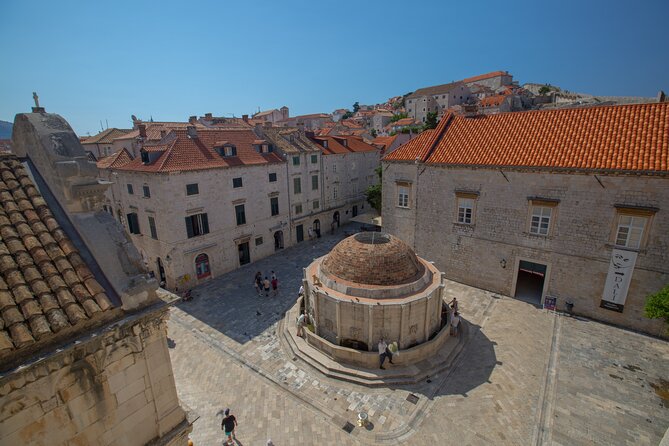
Dubrovnik’s Old Town is compact, but its story is not. This 90-minute walking tour gives you a quick, useful map of the city, linking grand churches and palaces with tales of trade, quarantine, war, and daily life. You begin at Large Onofrio’s Fountain and finish near the eastern end of Stradun.
I like the route for two reasons: it covers the major sights without requiring admission tickets, and local guides such as Ivana, Jelena, Sara, Joseph, and Pero add personal stories rather than reciting dates alone. The main consideration is pace. With up to 30 people and many stops in a busy stone-paved town, this is an overview, not a slow visit inside every building.
Key things to know before booking
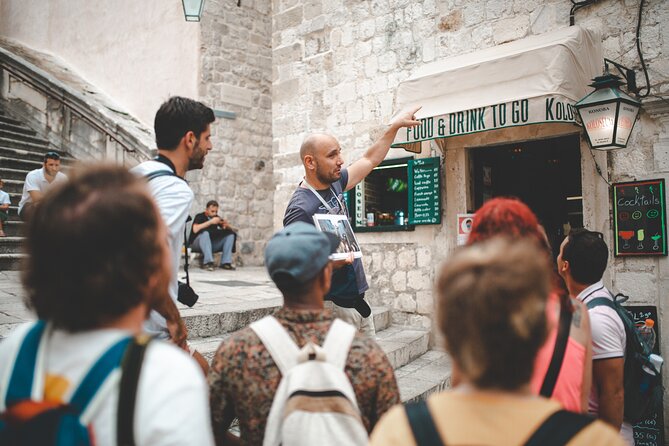
- See the essential Old Town sights in 90 minutes: The route includes Stradun, the Franciscan Monastery, Rector’s Palace, the Cathedral, Old Port, and Orlando Column.
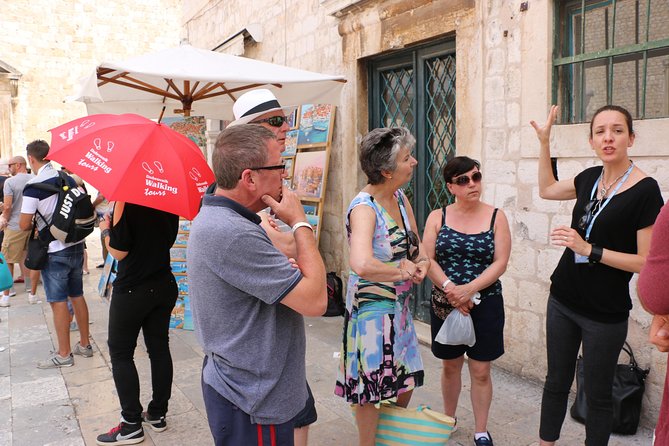
- Start beside Large Onofrio’s Fountain: Look for the red umbrella near the Hard Rock Cafe at Poljana Paska Miličevića.
- Hear more than medieval dates: The guide covers Ragusa’s trading power, religious communities, the 1990s Homeland War, and present-day Dubrovnik.
- Expect an English-language group tour: The maximum group size is 30 people, and mobile tickets are accepted.
- Use it as an orientation walk: The tour ends back at the meeting point, leaving you free to revisit places or continue exploring.
- Book ahead in busy periods: It is booked about 37 days ahead on average, and departure times can be chosen to fit your schedule.
Starting at Large Onofrio’s Fountain

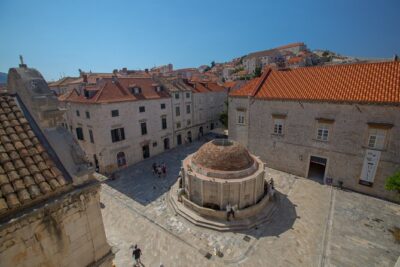
Large Onofrio’s Fountain is an excellent place to begin because it introduces Dubrovnik’s practical side before the grand monuments take over. The guide explains how Ragusa, the old name for Dubrovnik’s republic, developed into a small maritime trading state. The fountain also forms part of the city’s old aqueduct system, a reminder that Dubrovnik’s success depended on clever engineering as much as sea trade.
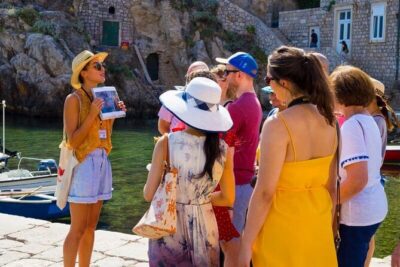
Your meeting point is next to the red umbrella, near the Hard Rock Cafe. The guide briefly introduces the group, then leads everyone onto the main street. Allow a few minutes to locate the fountain, especially if you are arriving through the Pile Gate and seeing the Old Town for the first time.
The tour does not include hotel pickup or drop-off. That is not much of a handicap in Dubrovnik, since the walk begins and ends inside the historic center. It does mean you need to arrange your own way to the Old Town.
Other guided walks in Dubrovnik:
- Dubrovnik: Old Town Walking Tour
★ 4.8 · 5,174 reviews - Dubrovnik Discovery Old Town Walking Tour
★ 5.0 · 4,458 reviews - Dubrovnik: Game of Thrones Walking Tour
★ 5.0 · 1,732 reviews
The first steps along Stradun
The opening stretch takes you past the Church of Holy Savior and onto Stradun, Dubrovnik’s broad central street. Its official name is Placa, but most people call it Stradun. It divides the Old Town into northern and southern sections and serves as the city’s main promenade, business street, and stage for public processions and celebrations.
This is where the tour starts giving you a useful sense of direction. Instead of seeing a collection of polished stone buildings, you begin to understand how the city is laid out and why Stradun has mattered for centuries.
The Church of Holy Savior is a small stop, but it helps explain the place of religion in public life. The guide connects the church to the way Dubrovnik developed, rather than treating it as a quick photo stop. That kind of context is useful because many of the Old Town’s buildings look similar at first glance.
The street is level compared with the steep lanes that climb away from Stradun. Still, expect hard paving and some crowding. If you have limited mobility, the main route is more manageable than Dubrovnik’s upper streets, but the town can be difficult to move through when busy.
Franciscan Monastery and one of Europe’s oldest pharmacies
The Franciscan Church and Monastery is one of the most rewarding early stops. The complex includes a church, monastery, library, and pharmacy. Its first monastery was built outside the walls in the 13th century, while the pharmacy dates from 1317 and is described as the third-oldest still-functioning pharmacy in the world.
The guide discusses the pharmacy, old manuscripts, and local traditions connected with the monastery. The library, built in the 17th century, holds more than 20,000 books, including 1,200 valuable old manuscripts.
Do not expect a full interior visit as part of this walking tour. The itinerary allows about ten minutes here, and the admission listed for the tour is free. The value comes from the explanation and from knowing what deserves a closer look if you return on your own.
I like this stop because it shows how practical and spiritual life overlapped in old Dubrovnik. A monastery was not just a place for prayer. It also preserved books, supplied medicine, and helped shape local customs.
Stradun, Ragusa, and the city’s harder chapters
The walk continues along Stradun, where the guide expands the story beyond the medieval republic. You hear about the end of the Republic of Ragusa, the later history of Yugoslavia, and the damage Dubrovnik suffered during the Homeland War in the 1990s.
This part gives the tour needed balance. Dubrovnik is often presented as a postcard city of walls, red roofs, and polished limestone. Its modern story is more painful. The guide’s discussion of the war helps you see the city as a living place that endured serious damage and rebuilt itself.
The tour’s history is not limited to rulers and monuments. Several guides bring in personal details about local life. Ermina, for example, has family ties to the Old Town, with a grandmother who still lives there and walks its steps. Stories like this help connect the grand republic of Ragusa with the ordinary city of today.
The group pauses for about ten minutes on Stradun, so this is a listening stop rather than a long photo break. If you want quiet photographs of the street, return early in the morning or later in the day after the walk.
Same base, a different kind of day out:
- Blue Cave Small-Group Boat Tour from Dubrovnik
★ 5.0 · 9,360 reviews - Full-Day Dubrovnik Elaphite Islands Cruise with Lunch and Drinks
★ 5.0 · 8,823 reviews - Dubrovnik: Epic Game of Thrones Tour + Lokrum & Saver Option
★ 4.9 · 5,995 reviews - Dubrovnik: Elaphiti Islands Full-Day Cruise with Lunch
★ 5.0 · 5,938 reviews
Orthodox, Jewish, and Muslim influences

The route leaves the main street and heads toward the port through narrower inner lanes. At the Church of the Holy Annunciation, the guide explains the role of Orthodox Christians and discusses how Jewish and Muslim communities also influenced Dubrovnik.
This is an important part of the tour because the Old Town’s identity was never shaped by one group alone. Dubrovnik’s position as a trading republic brought people, beliefs, and customs through its gates and harbor.
The lanes here feel different from Stradun. They are narrower and can be busy, so stay close to the guide. The route is not built around entering every place of worship. Instead, you get a short explanation of the city’s religious mix and its place in Dubrovnik’s story.
Gundulic Square and Rector’s Palace
At Gundulic Square, the route reaches the Monument of Poet Ivan Gundulic and the Green Market. The market offers a glimpse of everyday Dubrovnik through local produce and long-held customs. This is one of the more grounded stops on the walk, since it shifts attention from palaces to food, family routines, and the daily use of public squares.
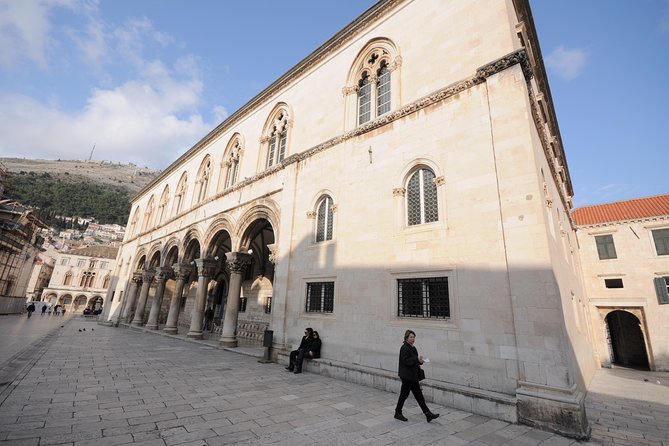
Next comes Rector’s Palace, one of the most important buildings in the old republic. The palace served as the seat of the Rector of Ragusa from the 14th century until 1808. It also housed the Minor Council and state administration, along with an armoury, powder magazine, watch house, and prison.
That mix tells you something about how government worked in a small maritime state. The palace was not simply a fine residence. It was an administrative center, security post, and place of confinement.
The tour allows about ten minutes around this part of the route. If you want to see the palace museum, plan a separate visit. This walking experience gives you the setting and the story, but it does not include a museum ticket.
The Cathedral and the Richard the Lionheart legend
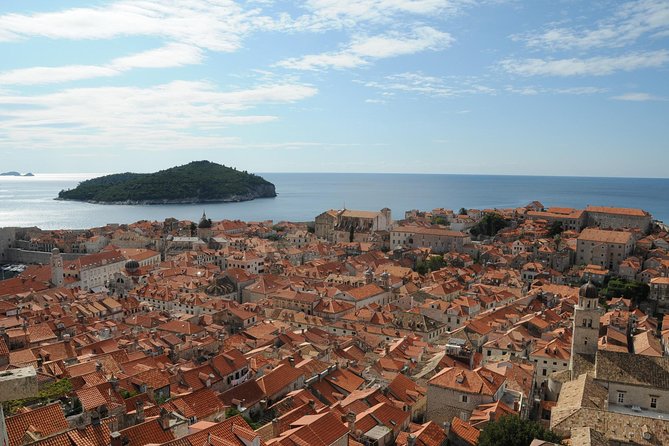
The Cathedral of the Assumption of the Virgin Mary is the next major stop. The guide introduces the cathedral and shares the local legend that Richard the Lionheart was shipwrecked near Dubrovnik on his return from the Crusades in 1192, coming ashore on nearby Lokrum Island.
The story adds a good note of legend to the tour, but the guide also places the cathedral in the broader religious and civic life of the city. The stop lasts about five minutes, so you should think of it as an introduction rather than a detailed art or architecture visit.
That distinction matters if you are choosing between tours. This experience is best for orientation and storytelling. It is less suited to anyone seeking an in-depth examination of one cathedral, monastery, or palace.
Old Port, quarantine, and Dubrovnik’s ships
The route then reaches City Harbor, where Dubrovnik’s maritime identity comes into focus. Ships from the republic sailed across the Mediterranean, and its galleons served in naval fleets far beyond the Adriatic. The guide explains how ships were built and loaded at the Arsenal.
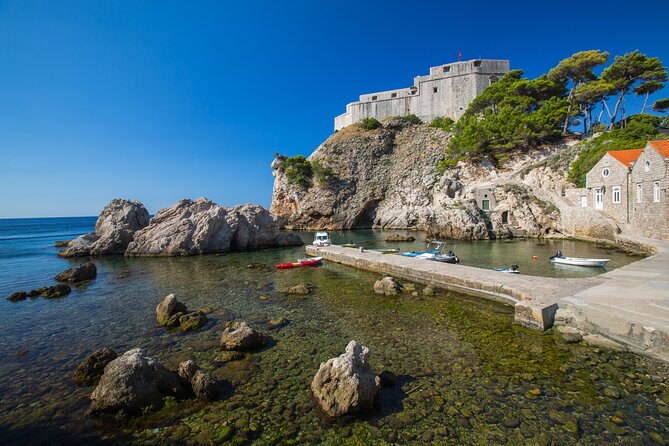
At the Old Port, you hear about the famous quarantine system and the nearby fortresses of St. Luke and St. John. Quarantine was a serious tool for a trading city exposed to disease arriving by sea. It also shows the practical side of Dubrovnik’s independence: the republic had to protect its people while keeping commerce moving.
This is the longest stop, at about 15 minutes. It is a good place to pause, look across the water, and connect the city’s walls with the ships that made its wealth possible.
The harbor can feel exposed to weather, and the tour requires good weather. If poor conditions force a cancellation, you are offered another date or a full refund. Bring sensible footwear and be ready for sun, wind, or wet stone depending on the day.
Orlando Column and the eastern end of Stradun
The final section leads back toward Luza Square, under the City Bell Tower and near the eastern end of Stradun. Here the guide covers the Church of St. Blaise, Orlando Column, Sponza Palace, Small Onofrio’s Fountain, and the high bell tower.
Orlando Column recalls the medieval knight Orlando and has long carried civic meaning for Dubrovnik. Sponza Palace adds another piece of the republic’s commercial and administrative story, while Small Onofrio’s Fountain echoes the larger fountain where the tour began.
This final cluster is dense with sights. Fifteen minutes is enough to explain the main points, but not enough to study each facade or monument at leisure. I see that as a strength for a first walk, since you leave with a list of places worth revisiting instead of spending the entire morning on one building.
The activity ends back at the original meeting point. That makes it easy to continue on your own, return to the Franciscan Monastery, visit Rector’s Palace, walk the harbor again, or stop for food near Stradun.
What the $24.19 price gives you
At $24.19 per person, the tour is priced as a low-cost introduction rather than a full museum experience. You are paying for an English-speaking local guide, the route, and the context that connects the sights. There are no separate admission charges included because the walking tour itself visits the locations from the outside or discusses them briefly.
I think the price makes sense if you are new to Dubrovnik and want to avoid spending your first day guessing which lane leads where. The 4.9 rating from 1,684 ratings and 99 percent recommendation rate point to a consistently strong experience, especially for the guide’s delivery and local perspective.
Group discounts are available, and the maximum group size is 30. That is not a private walk, so you should not expect every question to receive a long answer. The upside is the low cost. Some departures may be smaller, and one booking even resulted in a private history walk, but you should not count on that.
The tour is offered in English, accepts mobile tickets, and can be booked at different departure times. Since it is booked around 37 days in advance on average, I would reserve it early if your dates are fixed.
Who will get the most from this walk
I would choose this tour for a first visit, especially if you are staying in Dubrovnik for only a few days. It gives you the city’s basic structure, points out the major buildings, and supplies enough background to make later exploring more rewarding.
It also suits families. The length is manageable, and the guides are praised for keeping a friendly pace, adding humor, and making the material accessible. History-minded visitors will appreciate the coverage of Ragusa, trade, religion, the Homeland War, and quarantine.
You may want something else if you prefer long interior visits, photography stops, or a private guide. The 90-minute format moves along. You will see many places, but you will not spend much time inside them.
Most people can take part, and service animals are allowed. The route has a relatively step-free introduction, but Dubrovnik has many steps beyond the main streets, and the stone paving and crowds can challenge anyone with limited mobility. Ask about the current route before booking if that is a serious concern.
Booking, weather, and cancellation details
Confirmation is provided at booking, and the tour requires good weather. Cancel at least 24 hours before the start time for a full refund. Cancellations or changes made within 24 hours are not refunded or accepted.
The meeting point is Large Onofrio’s Fountain at Poljana Paska Miličevića 2000, near the red umbrella and Hard Rock Cafe. The walk finishes at the same meeting point, and you arrange your own transport to and from the Old Town.
Should you book the Dubrovnik Old Town History Walking Tour?
Book it if you want a well-paced first look at Dubrovnik, clear bearings, and local stories that link monuments with daily life. It is particularly useful on your first day, since guides such as Ivana, Jelena, Sara, Joseph, and Pero are praised for making history lively and offering suggestions for the rest of your stay.
Skip it if you already know the Old Town well or want a slow, specialist visit inside the churches and palaces. For most first-time visitors, though, $24.19 is a sensible price for 90 minutes of orientation, history, and practical advice. Plan to use the walk as your introduction, then spend the rest of your day returning to the places that caught your interest.
FAQ
How long is the Dubrovnik Old Town History Walking Tour?
The tour lasts approximately 1 hour and 30 minutes.
Where does the tour start?
It starts at Large Onofrio’s Fountain at Poljana Paska Miličevića 2000 in Dubrovnik. Look for the red umbrella near the Hard Rock Cafe.
Where does the tour finish?
The activity ends back at the original meeting point.
What language is the tour offered in?
The tour is offered in English.
What sights are included on the route?
The route includes Large Onofrio’s Fountain, the Church of Holy Savior, the Franciscan Church and Monastery, Stradun, the Church of the Holy Annunciation, Gundulic Square, Rector’s Palace, the Cathedral of the Assumption of the Virgin Mary, City Harbor, Orlando Column, Sponza Palace, Small Onofrio’s Fountain, and the City Bell Tower.
Is hotel pickup included?
No. Hotel pickup and drop-off are not included.
What is the cancellation policy?
You can cancel at least 24 hours before the start time for a full refund. Cancellations or changes made less than 24 hours before the start time are not accepted, and the amount paid is not refunded. If poor weather causes the tour to be canceled, you are offered another date or a full refund.
More Historical Tours in Dubrovnik
- Game of Thrones & History of Dubrovnik Tour
★ 5.0 · 628 reviews - Dubrovnik: Old Town History Walking Tour
★ 4.9 · 474 reviews - Early Bird Dubrovnik History Tour – 7:30 Start
★ 5.0 · 198 reviews - Walking Tour of Split with a ‘Magister’ of History
★ 5.0 · 1,122 reviews
Just added in Dubrovnik
- Explore Mostar, Ston and Kravice Waterfalls ( Small Group )★ 4.5 · 166 reviews
- Wine Lover’s Tour of Peljesac Peninsula★ 5.0 · 150 reviews
- Traditional Dalmatian Cooking Class from Dubrovnik★ 5.0 · 49 reviews
- From Dubrovnik: Split Day Trip and City Tour with Transfers★ 4.5 · 70 reviews
- Dubrovnik airport transfer★ 5.0 · 116 reviews
- Dubrovnik to Split Private transfer up to 8 pax (Door to Door any location)★ 5.0 · 151 reviews
- Jet Ski Rent 1h★ 5.0 · 147 reviews
- Luxury private transfer: Dubrovnik airport to Dubrovnik★ 5.0 · 111 reviews
Historical Tours, compared.
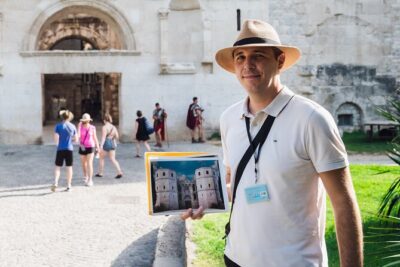
Walking Tour of Split with a ‘Magister’ of History
Read our review →
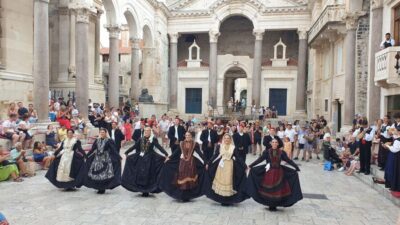

Split History and Gastro Small-Group Tour with Food and Drinks
Read our review →
PREMIUM Emperor’s Walking Tour for History Lovers + Museum
Read our review →
Browse the lists this tour appears in