
Reviewed · HISTORICAL TOURS
Walking Tour of Split with a ‘Magister’ of History
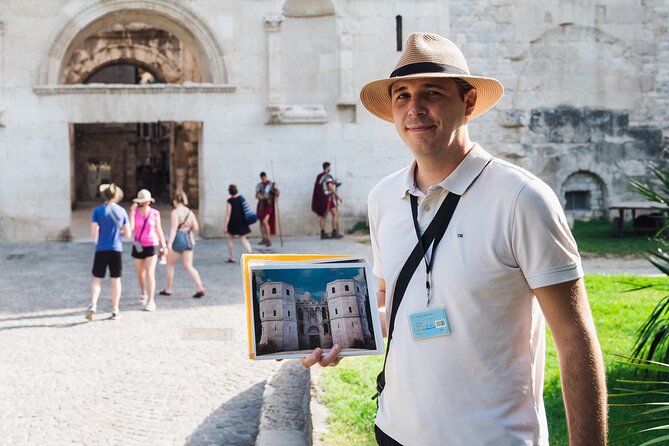
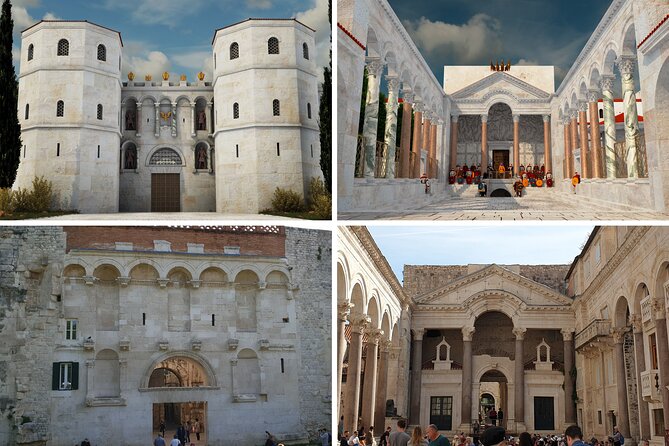
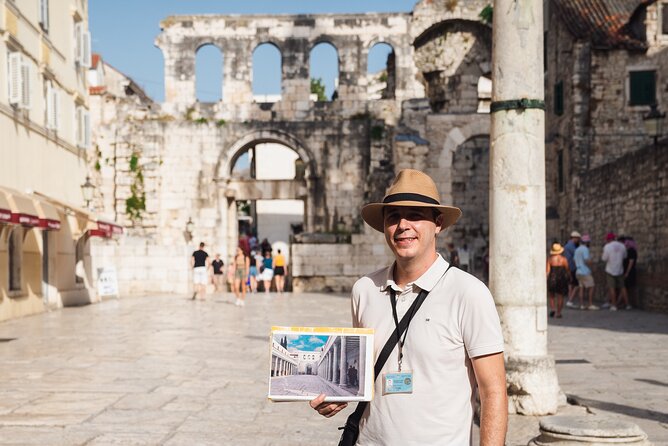
Split makes more sense when you can see the city that once occupied Diocletian’s Palace, not just the walls that remain. Toni Šare uses his own 3D reconstructions to show how the Roman complex looked before later residents built homes, churches, and palaces into it.
I like the tour’s clear route from the harbor to the old town square, and I like Toni’s local perspective as someone born and raised in Split who studied and taught history. The main drawback is simple: you do not enter the cathedral, Temple of Jupiter, museums, or other paid sites, so you’ll need separate visits if you want to see their interiors.
Key points to know before you book
- Toni Šare leads the walk: He is the owner of DiocleSpot Tours and brings local knowledge, historical context, and plenty of time for questions.
- The 3D reconstructions make Roman Split easier to picture: You see the present ruins beside visual explanations of the original buildings.
- The route covers more than Roman ruins: Medieval, Renaissance, Venetian, and early modern Split all appear along the way.
- The tour lasts about 1 hour 40 minutes to 1 hour 50 minutes: That makes it a useful first activity before exploring on your own.
- The group can include up to 18 people: A private upgrade is available, while group discounts can help keep the cost down.
- The price is $34.83 per person: It is a fair price for a focused history walk, especially if you want context rather than only photographs.
Seeing Split through Diocletian’s original plan
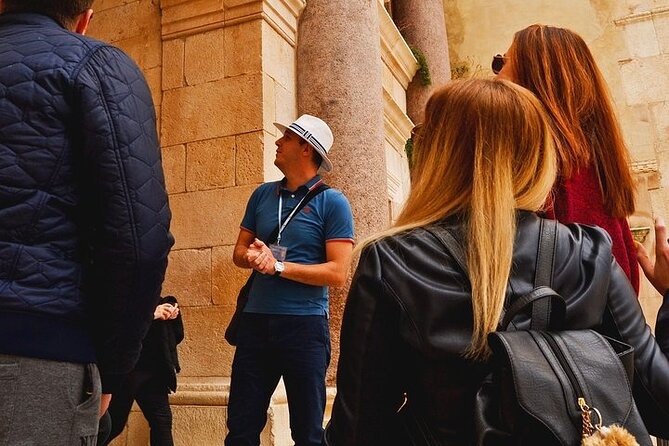
The strongest part of this tour is the way Toni connects scattered remains. Split’s old town is not a single open-air Roman monument. It is a living city built inside and around the palace, with apartments, shops, churches, courtyards, squares, and narrow lanes occupying the old imperial complex.
That can make independent sightseeing confusing. You may look at a column, a gate, or a stretch of wall without knowing its original purpose. Toni’s explanations and 3D images help you picture the palace as a working imperial residence rather than a collection of attractive stones.
The walk begins at the Brass Gate, also called Porta Aenea, beside the Riva harbor. This is a handy meeting point if you are arriving from the waterfront or ferry area. Toni starts with the southern wall of Diocletian’s Palace, seen across the promenade, and uses models and graphic material to explain what you will encounter inside.
I like this opening because it gives you a map in your head before the streets become tight and crowded. You get a sense of the palace’s scale and its position beside the sea. The harbor itself is also important to local life, so the introduction begins with Split as a working city, not only as an archaeological site.
Other guided walks in Split:
- Split: Old Town and Diocletian Palace Walking Tour
★ 4.9 · 4,727 reviews - Walking Tour of Split and Diocletian’s Palace
★ 5.0 · 2,588 reviews - Krka Waterfalls tour with Trogir Walking tour and Krka panoramic boat cruise
★ 5.0 · 1,659 reviews
The Peristyle and the heart of Roman Split
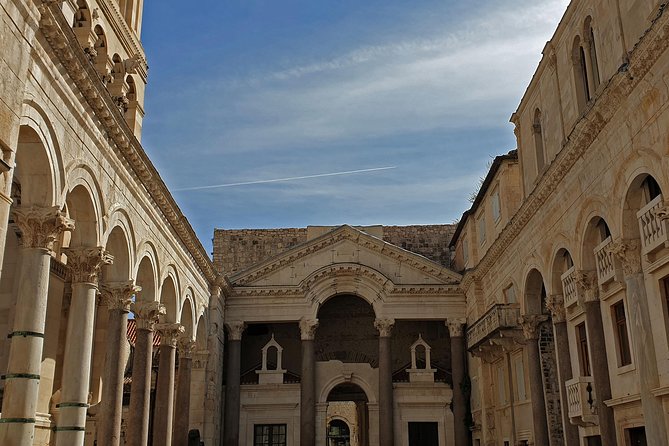
The Peristyle is the central square of Diocletian’s Palace and one of the most memorable places on the route. Here, you can look at well-preserved Roman structures while Toni explains which parts belong to the original design and how later generations altered the space.
The square can be visually impressive but historically hard to read. Columns, stone walls, stairways, and later buildings all sit close together. Toni’s reconstructions are particularly useful here because they show how the area looked in the palace’s prime, when it served an imperial purpose rather than functioning as a public square in the modern sense.
You spend about 10 minutes at the Peristyle. That is enough for a clear explanation, but not enough for long personal sightseeing. I would treat this as an orientation stop, then return later if you want time for photographs or a quiet look at the details.
Saint Domnius and a Roman mausoleum turned cathedral
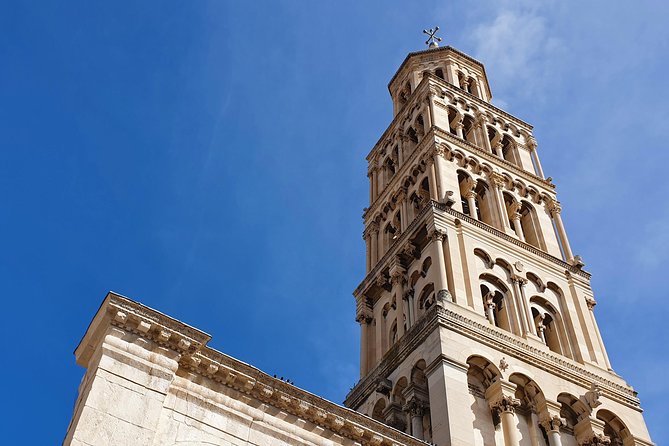
The Cathedral of Saint Domnius began as Diocletian’s mausoleum. Its continued use is one of the clearest examples of how Split changed from an imperial Roman residence into a Christian medieval city.
Toni explains the original tomb, the later conversion into a cathedral, and the role of the bell tower. You do not enter the cathedral on this walk, and admission is not included. That keeps the tour moving, but it also means you will need another visit if you want to see the interior or climb the tower.
This outside explanation still has real value. The building is not simply an old church. It began as part of the emperor’s private complex and was later given a very different religious purpose. That shift helps explain much of Split’s character: Roman structures were not cleared away and replaced. They were reused.
The Temple of Jupiter and small Roman mistakes
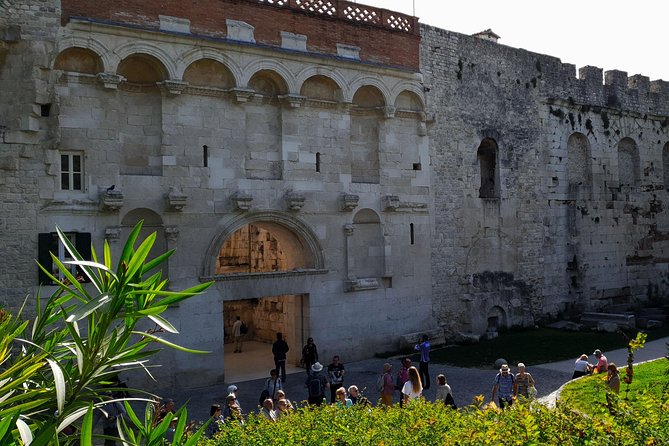
The Temple of Jupiter is another short but worthwhile stop. Toni points out construction details, including anomalies and mistakes made by the Roman builders. That kind of observation adds life to the story. It reminds you that major ancient projects were made by working people solving practical problems, not by an abstract civilization called Rome.
Again, you view the temple from outside. The tour does not include entrance to the site, and Toni focuses on the details that can be understood from the street. If you enjoy architecture, this stop should appeal to you because the emphasis is not only on dates and emperors. You are encouraged to look closely at how the building was put together.
The stop lasts about 15 minutes. That is generous for a small structure and gives Toni room to answer questions.
Same base, a different kind of day out:
- Split: Krka Waterfalls Trip with Boat Cruise and Swimming
★ 4.8 · 10,519 reviews - From Split: Krka Waterfalls, Food & Wine Tasting Tour
★ 5.0 · 9,326 reviews - Blue cave, Mamma Mia and Hvar, 5 islands speedboat tour
★ 5.0 · 7,150 reviews - From Split: Krka Waterfalls, Food & Wine Tasting Tour
★ 4.9 · 6,598 reviews
The Silver Gate and the view down an ancient road
At the Eastern, or Silver, Gate, you get one of the better views of the palace remains. The Cathedral of Saint Domnius sits to one side, the gate to the other, and below is the only preserved part of the original road.
This is the sort of stop that rewards patience. The gate itself is easy to photograph, but the road helps you understand how the palace was organized. Toni also explains the relationship between the Roman structure and later defenses.
Split’s old town often feels irregular because centuries of building and rebuilding have changed the original plan. At the Silver Gate, you can still read more of the earlier arrangement. I find that useful because it gives the ruins a practical purpose: roads moved people, gates controlled access, and walls protected the settlement.
From Grgur Ninski to medieval Croatian identity
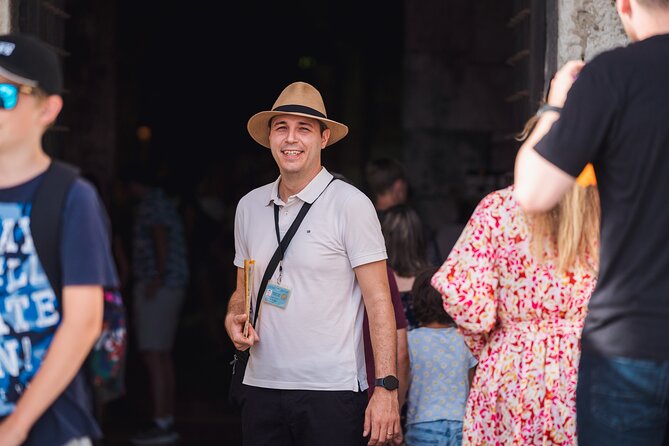
The statue of Grgur Ninski is a quick stop, lasting about five minutes, but it adds a different period to the walk. Toni explains what the figure represents and why he matters to Croatian language and culture during the early medieval period.
This is a good reminder that Split’s story does not end with Rome. The city became part of a changing Croatian and Venetian world, and its monuments reflect those shifts. The statue is also an easy landmark to remember when you explore on your own afterward.
The stop may be less important to you if your main interest is ancient architecture. Still, it broadens the tour beyond the usual emperor-and-ruins story.
The Vestibule and Diocletian’s private residence
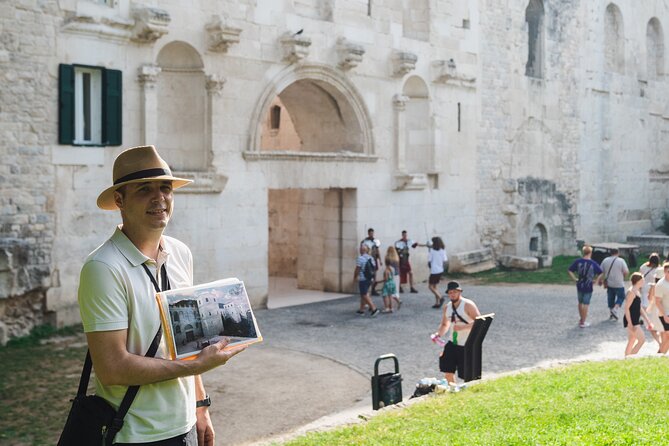
The Vestibule was an entrance to Diocletian’s private residence. From here, Toni leads you around the remaining parts of the emperor’s personal area and explains how the palace was divided between public and private functions.
This is where the 3D reconstructions can be most helpful. Modern Split has grown into the old complex, so you need some imagination to understand which spaces belonged to the imperial residence. The images give you a visual reference rather than asking you to accept a long verbal description.
You also pass several noble family palaces along the route. These later buildings show how powerful local families adapted the old Roman setting for their own use. The tour does not treat the palace as frozen in antiquity. Instead, you see it as a place that kept changing as new residents claimed old spaces.
Noble palaces and Split’s Venetian chapter
The walk includes several palaces connected with noble families, including a Renaissance palace courtyard used by the City Museum of Split. You do not enter the museum itself, but the courtyard lets you see the palace from within.
Toni uses this setting to explain Split’s Venetian period and the architectural changes that came with it. This is one of the tour’s better features for anyone who wants more than Roman history. Renaissance and early modern details can be easy to miss when the Palace of Diocletian gets all the attention.
The route also passes places linked with Game of Thrones filming in Split. Toni can point them out if the group is interested, and you pass the fan shop. This is an optional layer rather than the main purpose of the walk. If you enjoy the series, it adds a bit of fun. If you do not, the historical route still works without it.
The Golden Gate and the medieval city above Rome
The Golden Gate is the most preserved and decorated of the palace’s four entrances. It is also one of the easiest places to understand how the medieval town used the Roman walls for its own defense.
Toni points out the northern wall and explains how later residents removed some Roman features while keeping others. That practical reuse is central to Split. The city did not simply preserve the palace as a museum. People used its walls, rooms, and foundations because they were already there.
You spend about 15 minutes at the gate. It is a good place to pause, take photographs, and ask questions. The gate also makes a strong visual ending to the Roman portion of the walk before you continue toward the later city center.
Ending at Piazza Square and the Old Town Hall
The tour ends at Narodni trg, commonly called Piazza Square or Pjaca. This has been the main city square since medieval times, and it is a practical place to finish because you can easily continue in several directions.
The 14th-century Old Town Hall is here, along with other buildings that show Split after the Roman period. Ending at this square helps tie together the different eras you have seen. The route begins with the imperial palace and finishes in the civic center of the later city.
You spend about five minutes at the final stop. That is enough for an explanation, but I would plan to linger afterward if you want to examine the square, eat nearby, or use it as your next navigation point.
What $34.83 buys you
At $34.83 per person, this is a mid-priced walking tour rather than the cheapest way to see Split. I think the cost is justified if you value explanation, visual material, and a local guide who can answer questions. The 3D reconstructions are the feature that makes this walk different from a basic route through the old town.
The value is also tied to timing. In roughly 105 minutes, you cover the Riva, the central palace spaces, several gates, the cathedral, the Temple of Jupiter, noble palaces, and the medieval square. You would see many of these places on your own, but you would likely miss the connections between them.
The tour offers group discounts, and the maximum group size is 18 people. That is not a private walk, but it is still small enough for questions and for moving into tighter corners of the old town. If you want a more personal pace, a private upgrade is available.
Keep in mind that the price does not include entry to museums or paid sites. Since the route stays outside the cathedral, Temple of Jupiter, and City Museum, budget separately if you want to visit interiors.
Practical advice for a smoother walk
I would take this tour early in your Split stay. It gives you a useful framework for the old town, and you can return afterward to places that caught your attention. Several people also choose an evening departure to avoid the strongest summer heat, while a morning tour leaves the afternoon open for independent sightseeing.
Meet at the Brass Gate on Obala Hrvatskog narodnog preporoda 22. The walk ends at Narodni trg, not back at the harbor, so plan your onward route from Piazza Square. Since the tour is outdoors and requires good weather, cancellation or a date change may occur if conditions are poor.
The tour is offered in English and is suitable for most participants. Service animals are allowed, and the meeting area is near public transportation. Confirmation arrives when you book. Free cancellation is available up to 24 hours before the start time, but changes made inside that window are not accepted.
Who will get the most from Toni’s tour
I would choose this walk if you want history explained in plain language and enjoy asking questions. Toni’s enthusiasm is a major part of the experience. He combines ancient, medieval, Venetian, and modern local context, and he is willing to keep talking after the formal route if you need help understanding what you have seen.
The tour also suits first-time visitors who want a clear introduction before exploring alone. Families and mixed-interest groups may appreciate the choice of subjects: Roman engineering, church history, Croatian culture, noble palaces, and optional filming locations.
I would choose something else if your main goal is to go inside every paid attraction. This is an exterior walking tour, not a museum visit. It also moves through an active old town, so anyone wanting a slow photography session may prefer to return to the sites afterward.
Should you book the Walking Tour of Split with a Magister of History?
Book it if you want Split to feel understandable, not just attractive. Toni Šare’s use of personal 3D reconstructions, local experience, and careful explanations gives the Roman ruins a clear shape and shows how later residents adapted them.
The strongest reason to go is the connection between eras. You move from Diocletian’s waterfront wall to the Peristyle, from a Roman mausoleum to a Christian cathedral, from palace gates to medieval defenses, and finally to the later civic square.
Skip it only if you already know Split well or want a tour built around interior visits. For most first visits, $34.83 is a fair price for a focused walk that helps you see more in the hours that follow.
FAQ
How long does the tour last?
The walk lasts approximately 1 hour 40 minutes to 1 hour 50 minutes.
Where does the tour begin?
It begins at the Brass Gate, or Porta Aenea, at Obala Hrvatskog narodnog preporoda 22 in Split.
Where does the tour end?
The tour ends at Narodni trg, also called Piazza Square or Pjaca.
Is admission to the cathedral or museums included?
No. The tour does not enter museums or paid sites, and admission fees are not included.
Is the tour offered in English?
Yes. The experience is offered in English.
How far in advance can I cancel for a full refund?
You can cancel at least 24 hours before the local start time for a full refund. If poor weather cancels the tour, you will be offered another date or a full refund.
More Historical Tours in Split
- Split Walking Tour with Professor of History
★ 5.0 · 926 reviews - Split: History and Heritage Walking Tour
★ 4.9 · 650 reviews - Split History and Gastro Small-Group Tour with Food and Drinks
★ 5.0 · 375 reviews - SPLIT-PREMIUM Emperor’s Walking Tour for History Lovers + Museum
★ 5.0 · 333 reviews
Just added in Split
- Discover The Old Town Split 1.5h walking Small group tour★ 4.8 · 93 reviews
- Blue Cave, Komiža, Stiniva Bay, Budikovac, Hvar Split Island Boat Tour★ 5.0 · 53 reviews
- Split to Dubrovnik Private transfer 1-8 pax (Door to Door any location)★ 5.0 · 118 reviews
- From Split: Zagreb Transfer & Plitvice Lakes Tour★ 4.7 · 131 reviews
- From Sinj: 1.5-Hour Private Flight over Kornati & Šibenik★ 4.1 · 11 reviews
- From Sinj: Panoramic Flight over Split★ 5.0 · 14 reviews
- **Private Door to Door Airport Split Transfer up to 15 People**★ 5.0 · 136 reviews
- Sinj: Panoramic Flight over Peruca Lake and Dinara mountain★ 5.0 · 9 reviews
Historical Tours, compared.
Split History and Gastro Small-Group Tour with Food and Drinks
Read our review →
PREMIUM Emperor’s Walking Tour for History Lovers + Museum
Read our review →
Local History and Culture 90-Minute Walking Tour
Read our review →Browse the lists this tour appears in