
Reviewed · HISTORICAL TOURS
Pula: Historic Sites Guided Walking Tour
Pula’s ancient center is compact, but its story is layered: Roman emperors, Venetian rulers, churches, markets, and modern city life all share the same streets. This 90-minute walk starts at the famous Arena and connects the main sights in a sensible route, so you get your bearings quickly.
I like the way the tour mixes major monuments with smaller clues, including Roman mosaics and traces tucked into ordinary streets. I also like the castle stop, where you get broad views over Pula instead of seeing the city only at pavement level.
The main drawback is that entry tickets are not included, so this is primarily an orientation and outdoor sightseeing tour. The route is also not suitable for people with mobility impairments, and it runs rain or shine.
Key points to know before you book
- The Roman Arena begins the story: You get a short introduction to Pula’s best-known monument before setting off.
- The route covers the historic center efficiently: Castle, Cathedral, Forum, Augustus Temple, City Hall, mosaics, market, and ancient gates fit into 90 minutes.
- Sini is a guide to look for: Several comments identify the guide as Sini, with Sinisha and Sinsije appearing as spelling variations, and praise his clear English, humor, and command of ancient history.
- The castle adds a change of perspective: The Venetian fortress brings panoramic views and a look at Pula’s later rulers.
- You finish at the Twin Gate: The walk begins at the Arena entrance and ends near the ancient city defenses, making it useful before further independent exploring.
- Plan for outdoor conditions: Video recording is not allowed, and the tour operates in rain as well as sunshine.
Starting beside Pula’s Roman Arena
Meet your guide in front of the Amphitheater entrance at Istarska ul. 50. Look for the blue card around the guide’s neck and an umbrella. That detail matters because the Arena is a busy meeting point, and a clear marker saves time at the start.
The opening talk gives you a quick reading of the monument before you walk away from it. Pula’s Arena is not just a photo stop. It sets up the Roman story that continues through the Forum, the temple, the gates, and the remains scattered around town.
I like this opening because you begin with a site you can recognize at once, then move into less obvious pieces of the city. The guide’s job here is to give you a framework, not bury you in dates. Several people singled out Sini for making the past easy to follow in English, with enough humor to keep the walk from feeling like a lecture.
You do not enter the Arena on this tour, and entry tickets are not included. That is important if the amphitheater is your main reason for coming to Pula. You can still see it from outside and learn about its place in the city, but you would need to arrange any interior visit separately.
Other guided walks in Pula:
- Pula: Historic Walking Tour with Local Guide & City Views
★ 4.8 · 143 reviews - Pula walking tour
★ 5.0 · 96 reviews - Pula Essentials Walking Tour
★ 4.8 · 64 reviews
Climbing to the Venetian castle
From the Arena, the route continues to Pula Castle. The fortress was built by the Venetians in the 17th century, giving you a clear shift from Roman Pula to the city’s later political and military story.
The castle is valuable for two reasons. First, the guide explains its past and the people who used it. Second, you get panoramic views that help you understand Pula’s layout. After walking among stone walls and narrow streets, a higher viewpoint makes the city easier to read.
I like this pause in the route. A tour focused only on Roman remains can make Pula feel like a single-period museum. The castle reminds you that the city continued to change long after Rome. It also gives your eyes a break from close-up ruins and carved stone.
The castle stop may require walking on uneven or sloping surfaces. The activity specifically says it is not suitable for people with mobility impairments, so consider that before booking. The route is not described as a strenuous hike, but it is still a walking tour through an old city rather than a flat, step-free museum visit.
The Cathedral and the layers of Pula’s old center
After the castle, you continue to the Cathedral. This stop adds a religious layer to the route and shows how Pula’s center developed around more than Roman public buildings.
The useful part of seeing the Cathedral with a local guide is the connection between the building and the surrounding streets. You are not simply ticking off another church. You are learning how the city’s religious life fits beside Roman monuments and later civic buildings.
The walk keeps moving, which is a strength if you have only a short time in Pula. In 90 minutes, you get a broad introduction rather than one long visit inside a single structure. I would choose this tour early in a stay, then return later to the places that deserve more time.
The timing also suits a port stop or a short visit. It is long enough to give you a useful map of the old center, but short enough to leave room for lunch, independent sightseeing, or a separate Arena visit.
The Roman Forum, Augustus Temple, and City Hall
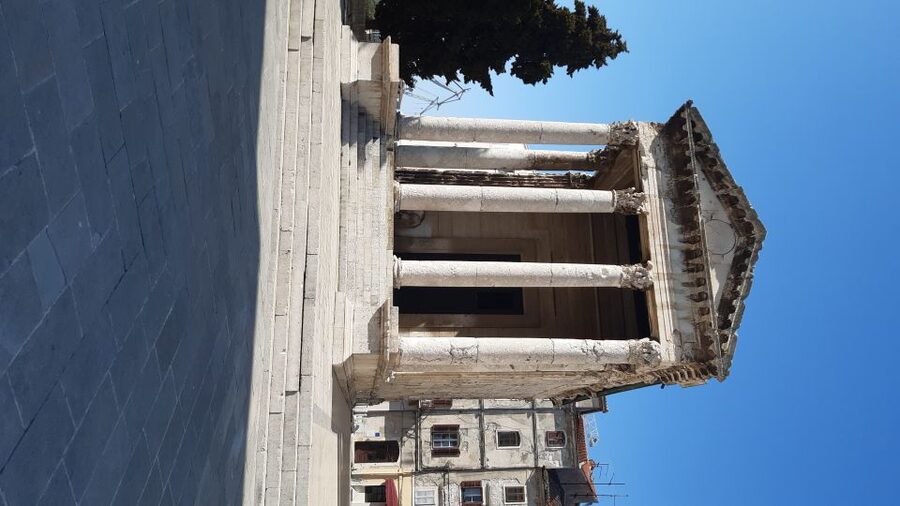
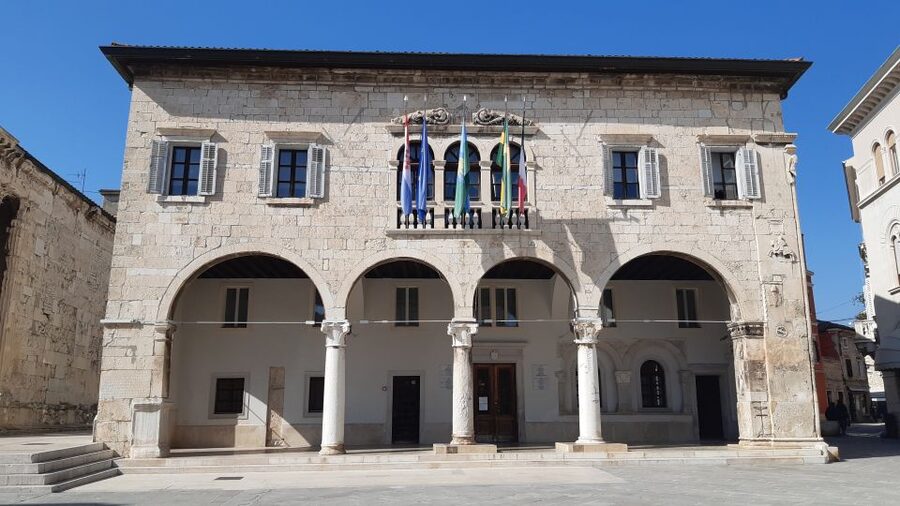
The Roman Forum is one of the central moments of the walk. This was a major public space in Roman Pula, and the tour places the Augustus Temple and City Hall side by side in the same part of town.
The Augustus Temple is roughly 2,000 years old, and it gives you a strong sense of how much Roman material survives in the middle of a living city. The building is not isolated in a remote archaeological park. It shares the square with later architecture and present-day city life.
City Hall adds another useful contrast. You see how the same civic center continued to matter across different periods, even as its buildings and political systems changed. A guide can point out those changes in a way that is easy to miss if you walk through on your own.
This is also where the tour’s broad coverage pays off. You are not seeing the temple as a disconnected ancient object. You are linking it with the Arena, the castle, the Cathedral, and the city gates. I find that kind of route more helpful than a list of unrelated monuments because it gives you a working mental map.
Do not expect a long archaeological lecture at each stop. The tour has several major sites to cover, so explanations need to stay focused. If you enjoy asking questions, the guide’s willingness to answer them is a real advantage. Sini is repeatedly praised for handling questions about ancient history, architecture, and Pula’s wider story.
Same base, a different kind of day out:
- Pula: Arena Entrance Ticket
★ 4.3 · 2,590 reviews - Medulin -Kamenjak 5h boat trip with lunch & drinks on Sandra Boat
★ 5.0 · 1,621 reviews - Full-Day Boat Tour of the Medulin Archipelago from Medulin
★ 5.0 · 1,389 reviews - 3hours all inclusive Sunset&Dolphin Tour from Medulin on Sandra
★ 5.0 · 1,130 reviews
Roman mosaics and the Arch of Sergii
Along the route, the guide points out Roman mosaics. These smaller remains are easy to overlook because they do not have the visual impact of the Arena or temple. That is precisely why they are worth seeing with someone who knows where to look.
I enjoy this part of the walk because it shifts your attention from grand monuments to small surviving details. Pula’s Roman past is not confined to one impressive amphitheater. It appears in fragments built into the urban fabric, and the guide helps you notice them.
The Arch of Sergii adds another recognizable Roman landmark. It is a good example of how Pula’s public spaces preserve monumental entrances as well as religious and entertainment buildings. Your guide can explain the names, purpose, and setting instead of leaving you with a quick photograph and no context.
The route between stops is part of the experience. You are walking through the old center at a leisurely pace, with the next monument appearing as part of the street plan. One comment described the sites as close together, which is useful to know if you are concerned about covering too much ground in a short time. The tour is designed around a compact center, not long transfers.
Pula Market and the Gate of Hercules
The Pula Market brings the walk into a more ordinary, working part of the city. Established in the early 1900s, it shows a different period from the Roman sites and the Venetian castle.
I like including a market in a historic walking tour. It prevents the city from feeling like a row of preserved monuments with no daily life around them. Here, the guide can connect the market’s age and function with the way Pula developed in the modern era.
The final historic stop is the ancient Gate of Hercules. Like the Arch of Sergii, it helps you understand the defensive and ceremonial entrances that shaped movement through the old city. The gate also leads naturally toward the tour’s finish at the Twin Gate.
Ending there gives the walk a clear sense of direction. You begin at one of Pula’s biggest Roman landmarks and finish near another reminder of the old city walls. You can then continue exploring on your own, using the route as a rough plan for returning to places that caught your interest.
What the guide adds to the experience
The guide is the heart of this tour. The activity is in English, and the strongest praise centers on clear explanations, friendly delivery, humor, and answers to questions. Sini is the name that appears most often, while one comment uses Sinisha and another Sinsije, possibly reflecting different spellings of the same name.
The best guide on a short city walk knows when to explain and when to keep moving. The comments point to a good balance: plenty of ancient history, but also a comfortable pace and an approachable manner. You can expect information about history, architecture, culture, and Istria, rather than only a string of monument dates.
I especially value the use of a town diorama at the beginning, which one person described as helping show the route and monuments. That kind of visual overview can make the walk easier to follow, especially when several Roman sites appear within a small area.
You should still ask questions if something catches your attention. The guide is described as encouraging questions, and that can turn a standard overview into a more useful conversation about Pula’s past.
Is $20 a good value for 90 minutes?
At $20 per person, this is good value if you want a compact introduction to Pula’s main historic sights. You are paying for a local English-speaking guide who connects the Arena, castle, Cathedral, Forum, temple, City Hall, mosaics, arch, market, and gates into one route.
The value is strongest when you are new to Pula. Without guidance, it is easy to see the Arena, take a few pictures, and miss the smaller Roman remains or the relationship between the Forum and later buildings. A local guide gives you the city’s basic structure in an hour and a half.
The price is less attractive if you want extended time inside each monument. Entry tickets are not included, and the walk itself is mainly an outdoor overview. If your priority is sitting inside the Arena or spending a long time examining one site, you will need to add separate visits.
For most people, I would treat this as a starting point rather than the whole Pula experience. Use the tour to learn what matters, then decide where to spend your remaining time.
Practical details that affect your day
The tour lasts 90 minutes and runs in rain or sunshine. Wear shoes suited to city walking and check the forecast, but do not assume poor weather cancels the activity.
The meeting point is in front of the Amphitheater entrance at Istarska ul. 50. Find the guide wearing a blue card and holding an umbrella. The tour finishes at the Twin Gate, not back at the Arena, so plan your next stop from that end of the old center.
Video recording is not allowed. You can still take in the monuments and make your own notes, but this is worth knowing if filming is part of your sightseeing plan.
Free cancellation is available up to 24 hours before the start for a full refund. You can also reserve now and pay later, which helps if your Pula schedule is still changing.
Who will get the most from this walk?
I would recommend it to a first-time visitor who wants the main historic points explained without spending half a day on a formal tour. It also suits anyone who likes Roman sites but wants to understand the Venetian, religious, civic, and modern layers of Pula too.
It is a good choice for a short stop because the route is compact and the major sights are close together. Families and mixed-interest groups may also appreciate the variety: arena, castle views, temple, mosaics, market, and gates keep the walk moving.
You should think twice if you have mobility impairments, since the activity is not suitable for you. You may also prefer independent sightseeing if you want to record video, spend long periods inside individual monuments, or set your own pace.
Should you book the Pula Historic Sites Guided Walking Tour?
I would book this tour if you want an efficient first look at Pula and value a guide who can explain the small details as well as the famous monuments. The route covers an unusually useful spread of the city, and $20 is reasonable for 90 minutes of local interpretation.
Book it early in your visit if possible. The Arena, castle, Forum, Augustus Temple, Cathedral, mosaics, Arch of Sergii, market, and gates will give you a clear plan for the rest of your time.
Skip it only if you need a fully accessible route, want a private pace, or already know Pula’s ancient center well. For most first-time visitors who can manage an outdoor city walk, it is a practical and well-priced introduction.
FAQ
How long does the Pula historic sites walking tour last?
The tour lasts 90 minutes, or one and a half hours.
Where does the tour begin?
It begins in front of the Amphitheater entrance at Istarska ul. 50.
How do I recognize the guide?
The guide will have a blue card around their neck and hold an umbrella.
Where does the tour finish?
The tour finishes at the Twin Gate.
What language is the tour conducted in?
The tour is conducted in English with a live guide.
Are entry tickets included?
No. Entry tickets are not included in the tour price.
Does the tour run in bad weather?
Yes. The tour takes place rain or shine. Video recording is not allowed, and the activity is not suitable for people with mobility impairments.
More Historical Tours in Pula
- Dubrovnik Old Town History Walking Tour
★ 5.0 · 1,684 reviews - Walking Tour of Split with a ‘Magister’ of History
★ 5.0 · 1,122 reviews - Split Walking Tour with Professor of History
★ 5.0 · 926 reviews - Split: History and Heritage Walking Tour
★ 4.9 · 650 reviews
Just added in Pula
- Pula Essentials Walking Tour★ 4.8 · 64 reviews
- Pula walking tour★ 5.0 · 96 reviews
- Pula: Historic Walking Tour with Local Guide & City Views★ 4.8 · 143 reviews
- Brijuni National Park Boat Excursion from Pula. With a visit to the island★ 4.0 · 179 reviews
- Pula: Introduction to Scuba Diving★ 4.9 · 190 reviews
- Medulin: Boat Cruise to Kamenjak/Ceja with Lunch and Drinks★ 4.4 · 221 reviews
- Pula: Brijuni National Park Cruise, Lunch and Fažana Beach★ 4.1 · 229 reviews
- Dolphins Watching in the National Park Brijuni from Pula★ 4.5 · 233 reviews
Historical Tours, compared.
Walking Tour of Split with a ‘Magister’ of History
Read our review →
Split History and Gastro Small-Group Tour with Food and Drinks
Read our review →
PREMIUM Emperor’s Walking Tour for History Lovers + Museum
Read our review →
Browse the lists this tour appears in