
Reviewed · WALKING TOURS
Pula walking tour
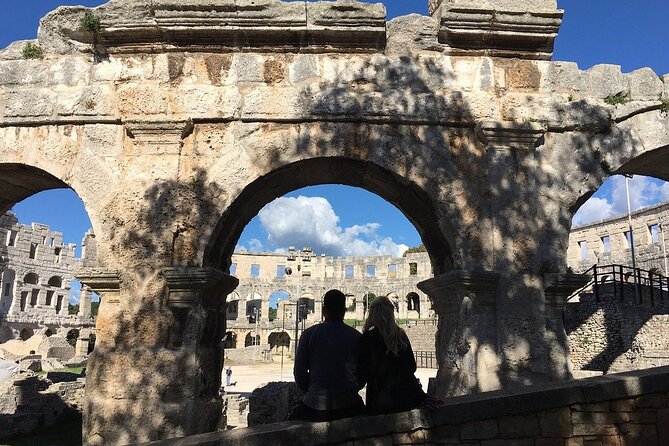
Pula’s story is written in stone, and this 90-minute walk gives you a quick, useful way to read it. You’ll start beside the Roman Arena, climb toward Kastel for harbor views, then trace the old center through the cathedral, Temple of Augustus, Sergii Arch, market, and ancient gates.
I like the careful mix of Roman, Venetian, Austro-Hungarian, and modern Pula. I also like the pace: long enough to cover the main sights, yet short enough to leave you time for lunch or a museum. The guide’s local knowledge, clear English, and willingness to answer questions are major strengths.
The trade-off is simple: the historic buildings are explained from outside. The Arena and other sites do not form part of the tour admissions, so you’ll need separate tickets and extra time if you want to go inside.
Key points to know before you book
- A compact route through Pula’s main sights: The tour covers eight stops in about an hour and a half.
- The Arena is the opening act: You get an explanation outside the Roman amphitheatre, but entry is not included.
- Kastel gives the best broad view: The fortress stop adds a look toward Pula’s harbor and helps explain the city’s position.
- Guides bring local perspective: Sini is one guide associated with the experience, and the tour is offered in English.
- Small groups keep things personal: The maximum is 15 people, with private-tour attention highlighted in the experience details.
- It works well as a first look: You’ll finish near the Twin Gates with time left to explore on your own.
Starting beside Pula’s Roman Arena
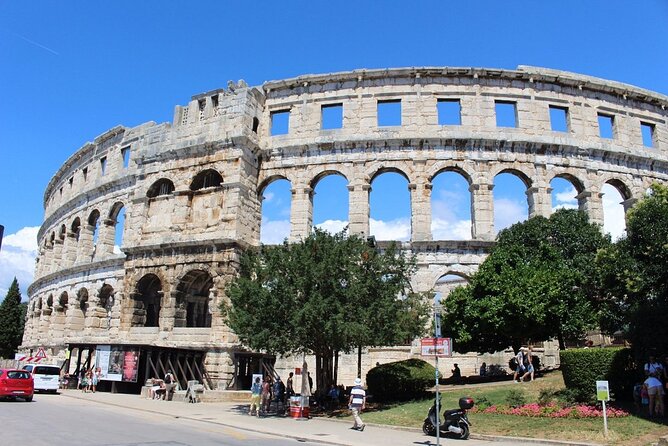
Meet at Pula Arena on Flavijevska ul. The meeting point is at the arena entrance, a useful detail because map applications can sometimes place you somewhere less clear. Arrive with enough time to locate the entry area rather than relying on a last-second phone pin.
The Arena gets about 20 minutes, making it the longest stop on the route. Your guide explains the building from outside, so you can study its vast oval walls while hearing how Roman public entertainment shaped the city.
Pula’s amphitheatre is the obvious star of the walk. It gives you a strong sense of scale before you even enter. The pale stone, multiple levels, and position close to the modern city make the old Roman world feel unusually present.
Still, keep your expectations in check. You will not tour the interior as part of this experience, and admission is not included. If walking through the Arena matters to you, plan a separate visit before or after the guided route. The advantage of beginning here is that you learn what to look for before exploring it on your own.
The guide’s job at this point is not just to recite dates. The strongest accounts of the tour describe clear storytelling about Pula from ancient times to the present, including details that help make the ruins easier to understand. Families and teenagers appear to fit the pace well, especially when the guide keeps the history lively rather than turning it into a lecture.
Other guided walks in Pula:
- Pula: Historic Walking Tour with Local Guide & City Views
★ 4.8 · 143 reviews - Pula: Historic Sites Guided Walking Tour
★ 4.8 · 78 reviews - Pula Essentials Walking Tour
★ 4.8 · 64 reviews
Kastel and the view toward Pula’s harbor
From the Arena, the route continues to Kastel, where you spend about 10 minutes. The fortress is explained from outside, and the stop includes a view toward the harbor.
This is a smart early stop because it changes your view of Pula. The Arena shows the city’s Roman past at street level. Kastel helps you understand its defensive side and its relationship to the water.
You should not expect a long fortress visit or a full interior tour. The attraction here is the setting, the explanation, and the outlook. If your guide points out how Pula’s location shaped its military and civic life, this short stop can give the rest of the walk more meaning.
A few people have found that the route includes some uphill walking, but the overall walk is described as fairly easy. You should still bring sensible shoes. The tour is not designed for someone who wants to avoid walking or standing, and the stated requirement is a moderate level of physical fitness.
Pula Cathedral and a possible look inside
The cathedral receives about five minutes. Your guide explains it from outside, and if the church is open, you may enter without an admission charge.
That conditional wording matters. You should treat interior access as a possibility, not a promise. The tour remains useful even if you stay outside, but church hours and access can change.
This brief stop also shows how the route moves beyond Roman monuments. Pula is not only an ancient Roman site. Its center carries layers of religious, civic, military, and commercial history, and the cathedral helps shift the focus from imperial Rome to the city’s later life.
Because the stop is short, this is more of an orientation than a full church visit. If you want time for quiet viewing, photography, or close architectural study, return independently after the walk.
Temple of Augustus and the Roman forum area
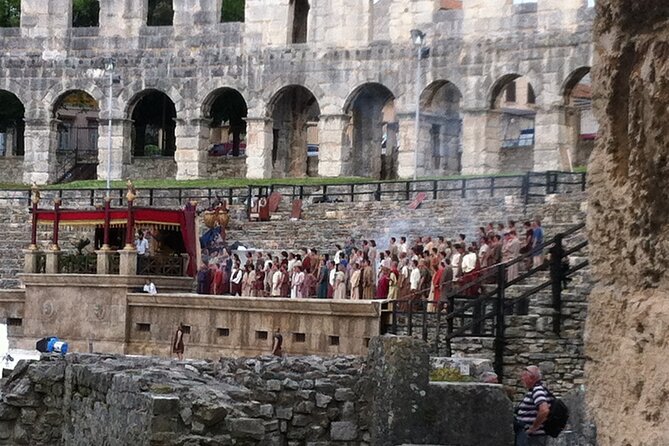
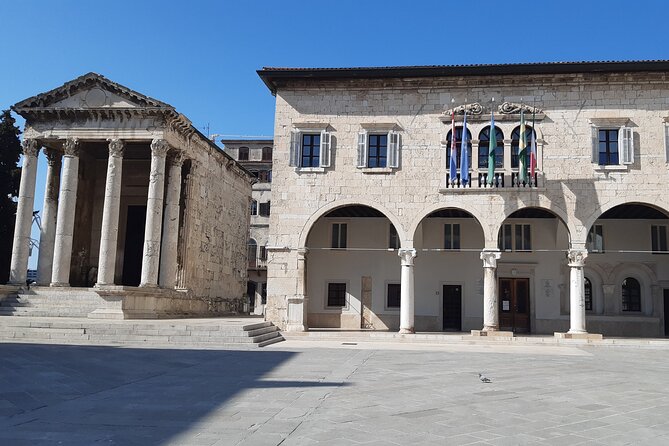
The Temple of Augustus gets 10 minutes and is explained from outside. It is one of the clearest places to see Pula’s Roman identity in the middle of the modern city.
I like this part of the route because it makes the old center feel practical rather than remote. You are not looking at ruins isolated in a park. The temple sits within the town you are walking through, alongside everyday streets and later buildings.
The guide can also place the Roman remains in the larger story of Pula and Istria. The route is not limited to one period. It touches Byzantine and Venetian influences, later Austro-Hungarian changes, and the city’s present-day character.
Again, the tour does not include an admission ticket here. The outside explanation is enough for a first orientation, but anyone who wants a detailed study of the monument should allow separate time. The stop is best understood as part of a connected walk through the old center.
Same base, a different kind of day out:
- Pula: Arena Entrance Ticket
★ 4.3 · 2,590 reviews - Medulin -Kamenjak 5h boat trip with lunch & drinks on Sandra Boat
★ 5.0 · 1,621 reviews - Full-Day Boat Tour of the Medulin Archipelago from Medulin
★ 5.0 · 1,389 reviews - 3hours all inclusive Sunset&Dolphin Tour from Medulin on Sandra
★ 5.0 · 1,130 reviews
Sergii Arch and the pleasure of walking between ruins
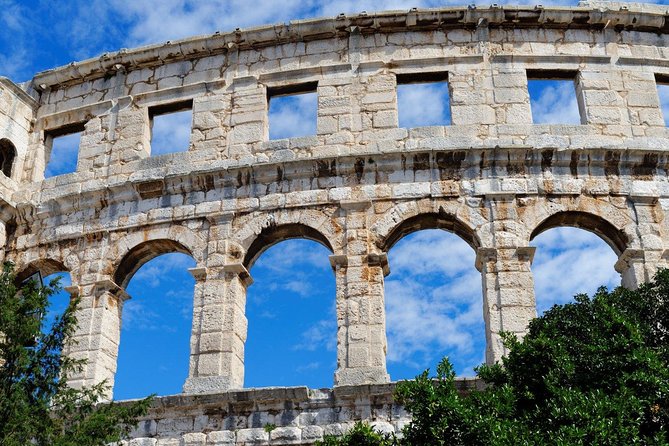
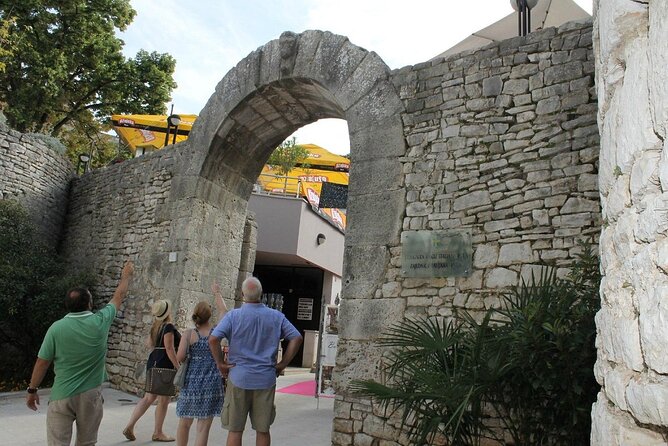
The Arco dei Sergi, also called the Arch of the Sergii, takes about 10 minutes. Your guide explains it from outside, and no paid admission is listed.
This is where the walking format earns its price. You are not being moved from one isolated attraction to another. You pass through the city and encounter the arch in its urban setting, which helps show how Roman structures were absorbed into later Pula.
The route’s Roman monuments also include mosaics and smaller remains that can be easy to miss if you use only a standard guidebook. You might find that the most useful part of the tour is not a major landmark but the explanation of what sits just off the main path.
The arch stop can also be a good moment for questions. Several descriptions of the guiding style emphasize that the guide is happy to explain local history, Croatian culture, and the wider Istrian region. Sini is specifically praised for communicating well with families and handling questions in a friendly way.
Pula’s market and the modern city
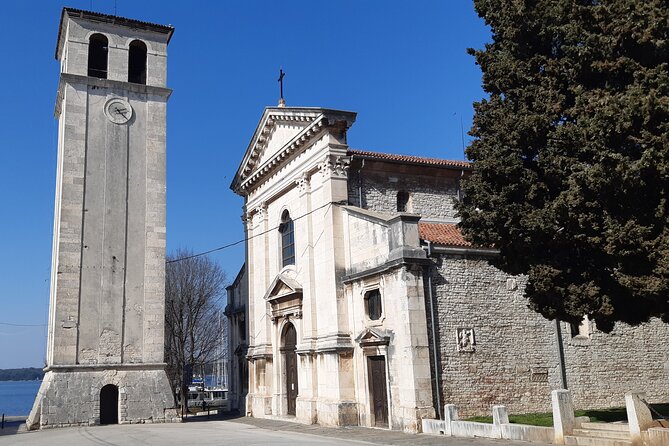
Gradska Trznica Pula, the city market, receives about 10 minutes. The guide explains it from outside, and there is no admission charge.
This stop keeps the experience from becoming a march through ancient stones. A market gives you a glimpse of how Pula functions now, not only how it looked two thousand years ago. The walk connects the old monuments with shopping streets, food, and ordinary city life.
You will not have a scheduled food tasting, and food and drinks are not included. If local produce or market browsing interests you, return after the tour with time to look around at your own pace.
The market also makes the route useful for lunch planning. Guides have offered restaurant recommendations at the end of the walk, so you can ask for practical suggestions while the streets and dining areas are still fresh in your mind.
Hercules Gate and the Twin Gates finish

The Gate of Hercules takes about five minutes, followed by five minutes at the Twin Gates. Both are explained from outside, and both are free to view.
These short stops work as historical punctuation marks. The Gate of Hercules is an early entrance to the old city, while the Twin Gates help close the route near Carrarina ul. 8. The end point is different from the Arena meeting point, so you should plan your next move from the Twin Gates rather than expecting to return to the start.
Finishing here is convenient if you want to continue exploring on foot. You can also use the remaining part of your day for the Arena interior, additional Roman remains, shopping, or lunch. A first-time visitor can leave the tour with a clear mental map instead of a loose collection of monuments.
The route is not a museum visit and does not linger at every stop. That is a strength if you want a city introduction. It is a limitation if your main goal is detailed architecture at each site.
What the $20.16 price buys you

At $20.16 per person, the price is reasonable for a 90-minute orientation led by a local English-speaking guide. You are paying for context, route planning, and the chance to ask questions, not for admissions, food, or a long inside visit.
I think the value is strongest on a first day in Pula. A guide can help you understand why the Arena matters, how the fortress relates to the harbor, and where the later city fits around the Roman core. You then have better information for choosing which sites deserve your own ticket.
The value drops if you already know Pula well or have spent several days studying its monuments. One rating of the experience notes that half a day is more than enough for Pula, which supports using this walk as a short introduction rather than the main event of a long stay.
Group discounts are available, and the maximum group size is 15. The details also describe private-tour attention, but you should confirm the exact format of your departure when booking. A small group can make a major difference at busy street corners and during question time.
Pace, weather, and practical planning
The walk lasts approximately 1 hour and 30 minutes. The route is mostly an easy city walk, though you should expect a moderate amount of walking and some movement toward the fortress.
The experience operates in all weather. Bring clothing suited to the forecast, and do not assume that a sunny morning will last. Comfortable shoes matter more than dressing up, since you will be on foot for the full route.
Children must be accompanied by an adult. The tour has worked well for families, including teenagers, because it combines major landmarks with stories about Roman life and Croatian history. Very young children may find the standing and listening less engaging, especially since most stops are outside.
The tour is offered in English. Confirmation is sent within 48 hours of booking, subject to availability. If you are arriving by cruise ship, allow a generous buffer. A missed tour caused by a late or absent ship does not qualify for a refund.
Free cancellation is available up to 24 hours before the start time. Cancellations or changes made within that final 24-hour window are not refunded or accepted.
Who will get the most from this walk
I would choose this tour for a first visit, a short stay, or a morning when you want to get your bearings fast. It suits families, couples, solo visitors, and anyone who prefers stories and local explanation to reading every sign alone.
It is also a good match for a history-minded visitor who wants to connect Roman, Venetian, Byzantine, and Austro-Hungarian influences in one route. The guide can provide a sense of how those periods overlap rather than treating them as separate textbook chapters.
I would be more cautious if you need step-free sightseeing, dislike outdoor tours in uncertain weather, or expect admission to the Arena and fortress. The supplied details do not promise full interior access, and most explanations take place outside.
Should you book the Pula walking tour?
Yes, if you want a friendly, well-paced introduction to Pula at a modest price. The 4.8 rating from 96 reviews and 99 percent recommendation figure match the main strengths of the experience: clear English, strong local knowledge, good pacing, and guides who keep answering questions.
Book it early if your schedule is fixed, since it is often reserved about 28 days ahead. Then leave time afterward for the Arena interior and any building that catches your eye.
Skip it only if you already know the old center well or want a full inside tour of Pula’s monuments. For most first-time visitors, this is a useful way to connect the city’s major sights before exploring them more deeply on your own.
FAQ
Where does the Pula walking tour start?
The tour starts at Pula Arena, on Flavijevska ul., 52100 Pula, Croatia. The meeting point is at the arena entrance.
Where does the tour end?
The tour ends at the Twin Gates, Carrarina ul. 8, 52100 Pula, Croatia.
How long does the tour last?
The tour lasts approximately 1 hour and 30 minutes.
What language is the tour offered in?
The tour is offered in English.
Is admission to the Arena included?
No. The guide explains the Amphitheatre of Pula from outside, and the admission ticket is not included.
Are other attraction entry fees included?
No. Entry fees are not included. The cathedral may be entered if it is open, and the listed admission for that stop is free.
How many people can join the tour?
The tour has a maximum of 15 participants. Group discounts are available.
Is the tour suitable for children?
Yes, but children must be accompanied by an adult. Participants should also have a moderate level of physical fitness.
Can I cancel for a refund?
You can cancel up to 24 hours before the experience begins for a full refund. Cancellations or changes made less than 24 hours before the start time are not refunded or accepted.
More walking tours in Pula
- Dubrovnik: Old Town Walking Tour
★ 4.8 · 5,174 reviews - Split: Old Town and Diocletian Palace Walking Tour
★ 4.9 · 4,727 reviews - Dubrovnik Discovery Old Town Walking Tour
★ 5.0 · 4,458 reviews - Walking Tour of Split and Diocletian’s Palace
★ 5.0 · 2,588 reviews
Just added in Pula
- Pula: Historic Walking Tour with Local Guide & City Views★ 4.8 · 143 reviews
- Pula Essentials Walking Tour★ 4.8 · 64 reviews
- Pula: Historic Sites Guided Walking Tour★ 4.8 · 78 reviews
- Brijuni National Park Boat Excursion from Pula. With a visit to the island★ 4.0 · 179 reviews
- Pula: Introduction to Scuba Diving★ 4.9 · 190 reviews
- Medulin: Boat Cruise to Kamenjak/Ceja with Lunch and Drinks★ 4.4 · 221 reviews
- Pula: Brijuni National Park Cruise, Lunch and Fažana Beach★ 4.1 · 229 reviews
- Dolphins Watching in the National Park Brijuni from Pula★ 4.5 · 233 reviews
Walking Tours, compared.
Walking Tour of Split and Diocletian’s Palace
Read our review →
Krka Waterfalls tour with Trogir Walking tour and Krka panoramic boat cruise
Read our review →
City Walls Early Morning or Sunset Walking Tour
Read our review →
Browse the lists this tour appears in