
Reviewed · WALKING TOURS
Pula Essentials Walking Tour
Pula’s past is packed into a small, walkable center, and this 90-minute tour gives you the main story without turning the afternoon into a history lecture. You’ll move from the Roman Arena through old gates, the Forum, the cathedral, and the waterfront while your guide connects the city’s Roman, Venetian, Austrian, Italian, Yugoslav, and modern Croatian chapters.
I like two things in particular: the tour gives you useful local advice about eating, nightlife, and things to do after the walk, and guides such as Stefano and Ana are praised for making complicated history easy to follow. The main consideration is that the Arena is viewed from outside only, and the experience is offered in English.
Key points at a glance

- Roman Arena from the outside: See Pula’s 2,000-year-old amphitheater, but entrance tickets are not included.
- A compact history of Pula: The route links Roman ruins with Venetian, Austrian, Italian, Yugoslav, and Croatian history.
- Strong guide focus: Stefano and Ana are noted for clear explanations, friendly conversation, and helpful local suggestions.
- Useful first-day orientation: Dining, nightlife, nearby activities, and wider Istrian options are part of the conversation.
- Easy central route: The walk begins at Tito’s Park and ends at either Tito’s Park or the Forum.
- Good booking flexibility: You can cancel up to 24 hours before departure, and private groups are available.
Why this short walk works well in Pula
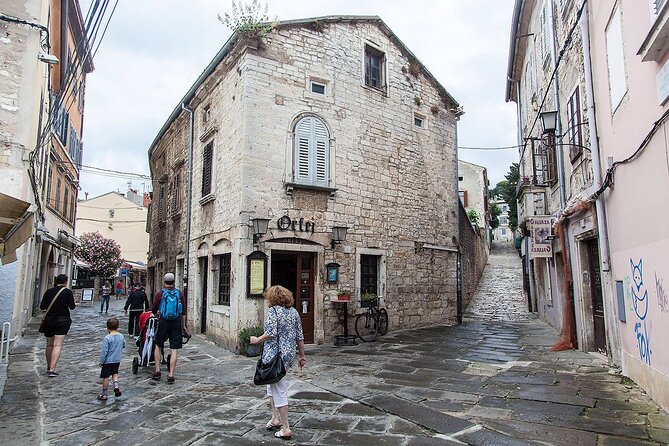
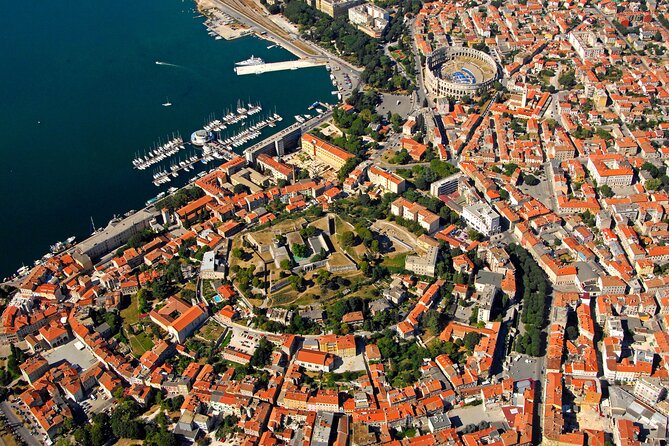
Pula is not a city you need to cross by bus to understand. Its main sights sit close together, but the story behind them is not always obvious. A Roman arch may lead into a medieval street, a Venetian-era building may sit beside an Austrian one, and the harbor reflects more recent military and industrial chapters.
This tour makes those connections as you walk. It begins outside the old town at Tito’s Park, then heads toward the Arena before turning into the historic center. That order makes sense. You see the city’s largest ancient monument first, then follow the streets toward smaller details that are easy to miss on your own.
I would take this walk early in your stay. The guide does more than identify monuments. You’ll also get suggestions for where to eat, what to do at night, and which activities may suit your time in Pula and the wider area. That practical advice can be more useful than another list of dates.
The tour is public and priced at $34 per person. For an hour and a half with a certified local guide, that is a fair rate if you want orientation and historical context rather than only photographs. The value drops slightly if you already know Pula well or mainly want to enter the Arena, since the amphitheater is seen from the outside and admission is not included.
Other guided walks in Pula:
- Pula: Historic Walking Tour with Local Guide & City Views
★ 4.8 · 143 reviews - Pula walking tour
★ 5.0 · 96 reviews - Pula: Historic Sites Guided Walking Tour
★ 4.8 · 78 reviews
Starting at Tito’s Park beside the old town
The meeting point is at the top of Tito’s Park, across the street from the large Anchor. Look for a cast model of the city with a small fountain. That detail matters because the park has several possible approaches, and a precise landmark is easier to spot than a general address.
The park itself is used for about ten minutes of sightseeing. Expect the guide to set the scene before you enter the old town. This is where the tour begins to explain Pula as a city shaped by several ruling powers, rather than treating the Roman era as the whole story.
The walk is wheelchair accessible, according to the activity details. Still, you should expect a city-center walking route with several stops and changing surfaces. The supplied information does not specify rest facilities or the exact surface conditions, so ask the operator if you need more detail before booking.
The Arena: Pula’s Roman calling card
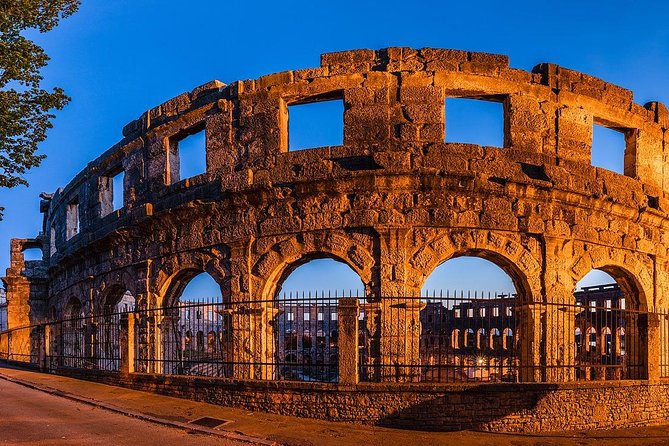
The Pula Arena receives the longest stop, about 20 minutes. It is the visual anchor of the tour, a 2,000-year-old Roman amphitheater that immediately shows the scale and importance of ancient Pula.
The key limitation is clear: you see the Arena from outside only. Entrance tickets to sights along the route are not included. If entering the amphitheater is important to you, plan a separate visit and check its opening arrangements independently.
Even without going inside, the exterior gives your guide plenty to explain about Roman building, public entertainment, and the place of Pula in the ancient world. This is also a good point to ask questions, since the Arena is the monument most people associate with the city.
I would not book this walk expecting a full Arena visit. I would book it because the exterior becomes more meaningful when someone explains how it fits into Pula’s wider story. Then, if you have time and interest, return later for the interior.
Ancient gates and the shape of the old town
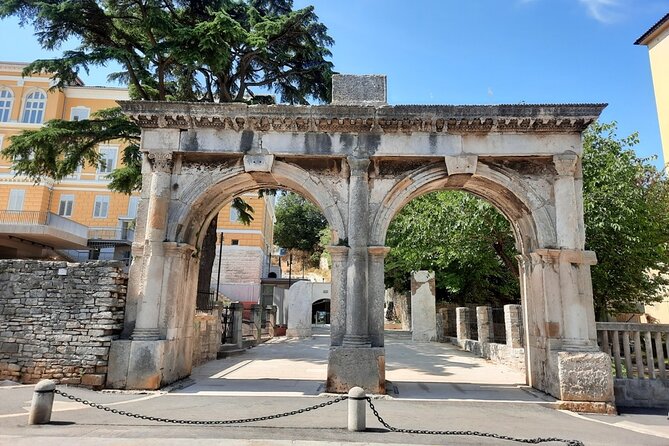
The Twin Gate is next, with about ten minutes for sightseeing. Gates are easy to hurry past, but they help you understand how the old town was organized. Here, the focus shifts from one giant monument to the smaller pieces of Roman Pula that still guide movement through the center.
The Gate of Hercules follows. This stop adds another layer to the Roman story and shows how ancient structures survive as part of an ordinary city street. You are not walking through an isolated archaeological park. You are moving through a living center where old stone and daily life share the same space.
The walking sections are short, around ten minutes each. That keeps the pace active without making the tour feel like a march. One past participant praised the balance of the pace, while another appreciated being able to ask questions throughout. That is the right expectation here: a steady stroll with frequent pauses, not a long-distance walk.
Same base, a different kind of day out:
- Pula: Arena Entrance Ticket
★ 4.3 · 2,590 reviews - Medulin -Kamenjak 5h boat trip with lunch & drinks on Sandra Boat
★ 5.0 · 1,621 reviews - Full-Day Boat Tour of the Medulin Archipelago from Medulin
★ 5.0 · 1,389 reviews - 3hours all inclusive Sunset&Dolphin Tour from Medulin on Sandra
★ 5.0 · 1,130 reviews
Giardini and the Arch of the Sergii
At Giardini, the route passes from the older Roman core into one of the city’s public urban spaces. The ten-minute walk gives the guide room to explain how Pula changed over time and how the old center functions today.
The Arch of the Sergii is one of the most important stops after the Arena. This Roman triumphal arch is tied to the Sergii family and gives you a more intimate monument than the amphitheater. Its setting also helps show how Roman remains have been absorbed into the later city.
The arch leads naturally onto Ulica Sergijevaca, a ten-minute walk along one of Pula’s central streets. This part is less about standing in front of one object and more about reading the city as you go. Your guide may point out how different periods sit beside one another and offer suggestions for places to eat or spend your free time.
The route is especially useful here if you are visiting without a strict plan. The tour does not end with the last monument. It also gives you ideas for the hours afterward, which is one reason I see it as a good first-day activity.
The Forum and Temple of Augustus
The Forum is one of the strongest stops on the route. Allow about ten minutes for sightseeing, followed by a shorter five-minute look at the Temple of Augustus.
The Forum shows Pula as a Roman public center, but it also helps explain the city’s later civic life. This is the kind of place where the guide’s storytelling matters. Stones alone cannot tell you how the space changed, what parts belong to different periods, or why the buildings around it matter.
The Temple of Augustus is a compact but important Roman monument. Five minutes is not a long time, so expect a focused explanation rather than a full archaeological discussion. If you want more time for photographs, return after the tour.
This stop also illustrates the tour’s overall approach. You see the major Roman remains, but the guide keeps moving through the centuries. Pula is presented as a city with Roman foundations, not as a museum frozen in one era.
Down to the Riva and the city cathedral
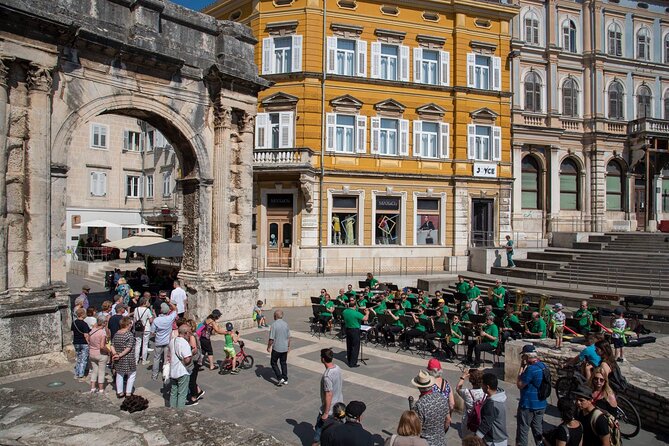
The walk continues to the Riva, where the route includes about ten minutes by the waterfront and a sunset moment. Timing will affect this part of the experience, since the tour’s starting time varies and sunset conditions change through the year.
The Riva offers a change of pace after the concentrated old-town monuments. You can expect the guide to connect the harbor with Pula’s more recent story and to discuss activities in the local area or farther across Istria. One particularly useful feature of the guiding style is the willingness to handle questions beyond the headline monuments, including subjects connected with the harbor and local culture.
The final sightseeing stop is Pula Cathedral, with about ten minutes. Its place on the route helps widen the story again, from Roman and civic remains to the city’s religious heritage.
The tour ends at either Tito’s Park or the Forum. That gives you a convenient choice depending on what you want to do next. From the Forum, you are well placed to continue exploring central Pula. At Tito’s Park, you return to the starting area.
The guides make the biggest difference
The strongest praise is directed at the guides, especially Stefano and Ana. Stefano is repeatedly described as friendly, clear, and able to explain Pula’s past in a way that is easy to understand. Ana is also praised for her pleasant manner, strong command of local history, and practical advice for making the most of the area.
That matters because this route covers a lot. Roman, medieval, Austrian, Italian, Yugoslav, and modern Croatian periods can become a blur if the guide simply recites dates. The best version of this tour gives you a clear thread, showing how each era left traces in the city you see now.
You should also expect a conversational element. Guides are reported to answer questions about subjects as varied as shipbuilding in the harbor, local dog breeds, conservation, and Croatia more broadly. That suggests the tour can adapt when the group is curious, rather than staying locked to a script.
There is one caution. A four-star experience noted repeated explanations and a guide who appeared to have been drinking before the evening walk. That is the only clear negative in the supplied feedback, while the overall rating is 4.8 from 64 reviews. It is worth keeping the point in proportion, but it also shows that guide quality can vary by departure.
Pace, group size, and who will enjoy it
The standard format is a public group walk, with a private group option available. The tour requires at least two participants. If you are the only person booked one hour before the start, the activity is cancelled and you receive a refund.
A small group can be a real advantage. You can ask more questions, hear the guide clearly, and get more tailored suggestions. One booking became a private walk because only two people had reserved, which offered especially good value at the same price structure.
The route is suitable for first-time visitors who want a clear introduction without spending half a day in formal sightseeing. It also suits cruise or short-stay visitors who need a quick orientation. Families and older visitors may appreciate the 90-minute length, though the organizer should be contacted if you need detailed accessibility information beyond the stated wheelchair access.
I would be less likely to choose it if I wanted a slow photography walk or a full visit inside every monument. The schedule moves through many stops, and the short time at the Temple of Augustus and cathedral means the focus is on overview and context.
Is $34 a good value?
At $34 per person, the price is reasonable for a guided introduction to central Pula. You are paying for a certified guide, a carefully arranged route, and advice that can help shape the rest of your stay. The walk also saves you the work of piecing together the city’s different eras from scattered signs.
The value depends on what you want from a tour. If you use the guide’s suggestions for dining, nightlife, and further activities, the experience can pay off beyond the 90 minutes. If you only want entry to the Arena, the price does not cover that, so budget separately.
The strongest value comes when you take it near the start of your visit. You get the basic map of the city, learn which sights deserve a return visit, and can ask about the parts of Istria that interest you. For a short stay, that kind of orientation can prevent wasted time.
Booking is flexible. You can cancel up to 24 hours ahead for a full refund, and you can reserve now and pay later. The tour is in English only, so it is not a fit if you need another language.
Should you book the Pula Essentials Walking Tour?
I would book it if you want a concise, human introduction to Pula and value a guide who can move beyond dates and point you toward useful things to do afterward. Stefano and Ana appear to be particularly strong choices when available, with repeated praise for their warmth, clarity, and ability to answer questions.
Choose it early in your stay, and treat the Arena as an exterior highlight rather than an included museum visit. You will get the most from the tour if you enjoy asking questions and want help understanding how Roman, Venetian, Austrian, Italian, Yugoslav, and Croatian influences shaped one compact city.
Skip it if your main goal is private, unhurried sightseeing inside the monuments. For most first-time visitors, though, $34 is a fair price for a well-paced central walk, local pointers, and a useful starting point for exploring Pula on your own.
FAQ
How long does the Pula Essentials Walking Tour last?
The tour lasts 90 minutes.
What language is the tour offered in?
The tour is offered in English only.
Where does the tour meet?
Meet at the top of Tito’s Park, across the street from the large Anchor. Look for a cast model of the city with a small fountain.
Does the tour include entry to the Pula Arena?
No. The Pula Arena is seen from outside, and entrance tickets to sights along the route are not included.
What sights are included on the walking route?
The route includes Tito’s Park, the Pula Arena, Twin Gate, the Gate of Hercules, Giardini, the Arch of the Sergii, Ulica Sergijevaca, the Forum, the Temple of Augustus, the Riva, and Pula Cathedral.
Is the tour wheelchair accessible?
Yes, the activity information states that the tour is wheelchair accessible.
What happens if I am the only person booked?
At least two participants are required. If you remain the only person booked one hour before the tour begins, you will be refunded.
More walking tours in Pula
- Dubrovnik: Old Town Walking Tour
★ 4.8 · 5,174 reviews - Split: Old Town and Diocletian Palace Walking Tour
★ 4.9 · 4,727 reviews - Dubrovnik Discovery Old Town Walking Tour
★ 5.0 · 4,458 reviews - Walking Tour of Split and Diocletian’s Palace
★ 5.0 · 2,588 reviews
Just added in Pula
- Pula: Historic Walking Tour with Local Guide & City Views★ 4.8 · 143 reviews
- Pula: Historic Sites Guided Walking Tour★ 4.8 · 78 reviews
- Pula walking tour★ 5.0 · 96 reviews
- Brijuni National Park Boat Excursion from Pula. With a visit to the island★ 4.0 · 179 reviews
- Pula: Introduction to Scuba Diving★ 4.9 · 190 reviews
- Medulin: Boat Cruise to Kamenjak/Ceja with Lunch and Drinks★ 4.4 · 221 reviews
- Pula: Brijuni National Park Cruise, Lunch and Fažana Beach★ 4.1 · 229 reviews
- Dolphins Watching in the National Park Brijuni from Pula★ 4.5 · 233 reviews
Walking Tours, compared.
Walking Tour of Split and Diocletian’s Palace
Read our review →
Krka Waterfalls tour with Trogir Walking tour and Krka panoramic boat cruise
Read our review →
City Walls Early Morning or Sunset Walking Tour
Read our review →
Browse the lists this tour appears in