
Reviewed · HISTORICAL TOURS
Split: Walking tour of Split with a ‘Magister’ of History
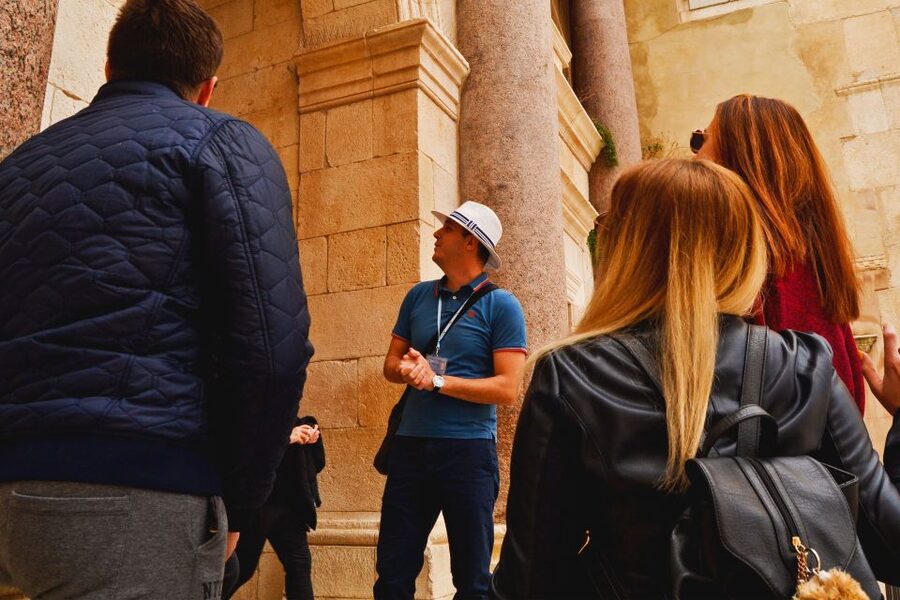
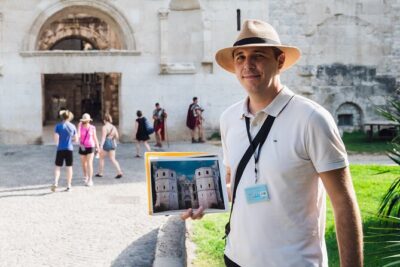
Split’s old core is not a museum sealed behind glass. It is a living city built inside and around Diocletian’s Palace. Toni Šare, a local historian and former teacher, helps you read its layers, from Roman imperial power to medieval homes, Venetian rule, and modern Split. His 3D reconstructions make the ruins easier to picture, while his open question-and-answer style keeps the walk lively.
I like the clear historical progression and the fact that Toni brings personal knowledge of a city where he was born and has spent his life. I also like the care taken with pace, shade, and crowded streets, especially in summer. The main consideration is that this is a walking and storytelling tour, not an attraction-ticket tour. You will not enter paid museums or monuments, and the $33 price is higher than some basic city walks.
Key points to know before booking
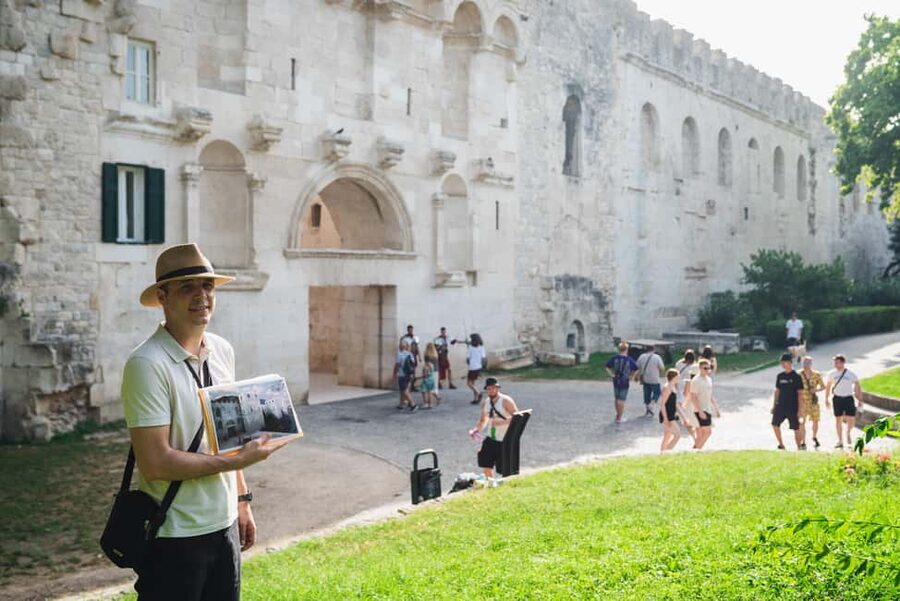
- A former history teacher leads the walk: Toni explains events in plain language and welcomes questions instead of reciting a fixed script.
- Diocletian’s Palace is still part of daily life: You walk through real streets, courtyards, homes, shops, and squares built into the Roman complex.
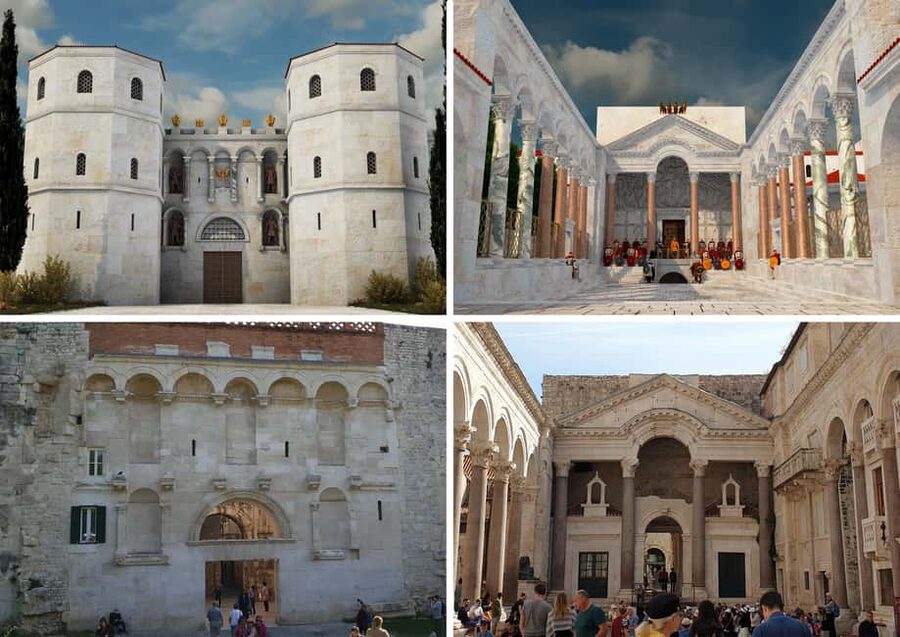
- Printed 3D reconstructions show the palace in its original form: These images are especially useful when only fragments of a structure remain.
- The route covers several periods: Roman, medieval, Venetian, and modern Split all have a place in the story.
- The tour lasts 110 minutes and costs $33: That is fair value if you want context, but less so if you only want a quick orientation walk.
- Start early if you can: The old center gets busier as the day goes on, and an early time slot can mean more room and shade.
Why Toni’s Split tour feels different
Many city walks give you a string of dates, names, and buildings. This one is built around a question: how did a Roman emperor’s retirement palace become the center of a modern Croatian city?
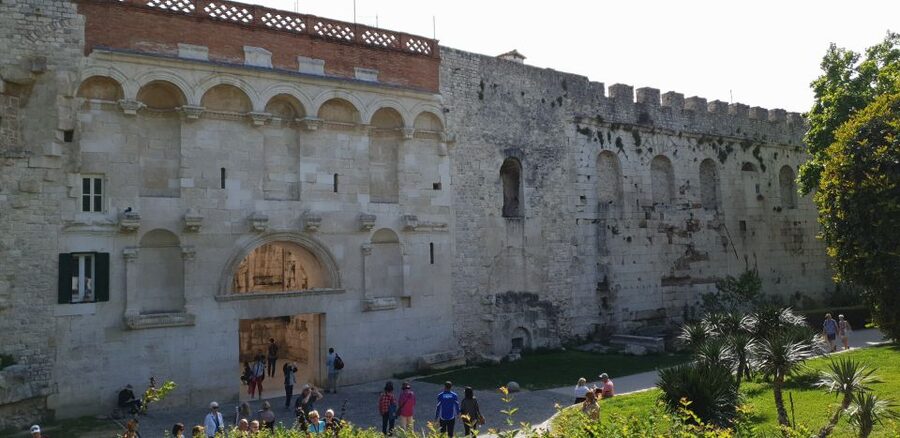
That question gives the walk a useful shape. You begin at the waterfront, enter through the southern Bronze Gate, and move inward through the palace. From there, Toni traces the changes over time. Roman buildings were altered, reused, covered, and joined by medieval houses. Later rulers left their own marks. Modern Split grew around all of it.
Toni’s background matters here. He is a local who was born and has lived his entire life in Split, and he previously taught history. That combination gives the tour both classroom structure and local feeling. He does not treat history as a list of facts. He connects old events with the way the city works today.
I also like that questions are encouraged throughout the walk. You can ask about architecture, Croatian history, local customs, or more recent events. Toni is comfortable explaining what is firmly known and what remains uncertain, rather than forcing every ruin into a tidy story.
The 3D images are another strong point. Toni brings printed reconstructions showing how important parts of the palace may have looked in Roman times. When you are standing beside weathered stone, a reconstruction helps you see the columns, walls, decoration, and proportions that are no longer intact.
Other guided walks in Split:
- Split: Old Town and Diocletian Palace Walking Tour
★ 4.9 · 4,727 reviews - Walking Tour of Split and Diocletian’s Palace
★ 5.0 · 2,588 reviews - Krka Waterfalls tour with Trogir Walking tour and Krka panoramic boat cruise
★ 5.0 · 1,659 reviews
Meeting the palace at the Riva and Bronze Gate
The tour begins at Obala Hrvatskog narodnog preporoda 22, beside the Riva Promenade. Look for the Bronze Gate, also called the Brass Gate, which is the southern entrance from the waterfront into Diocletian’s Palace.
This is a good starting point because the Riva gives you an immediate sense of Split’s setting. The palace is not isolated from the city. Its southern wall faces the sea, and the promenade runs directly alongside it.
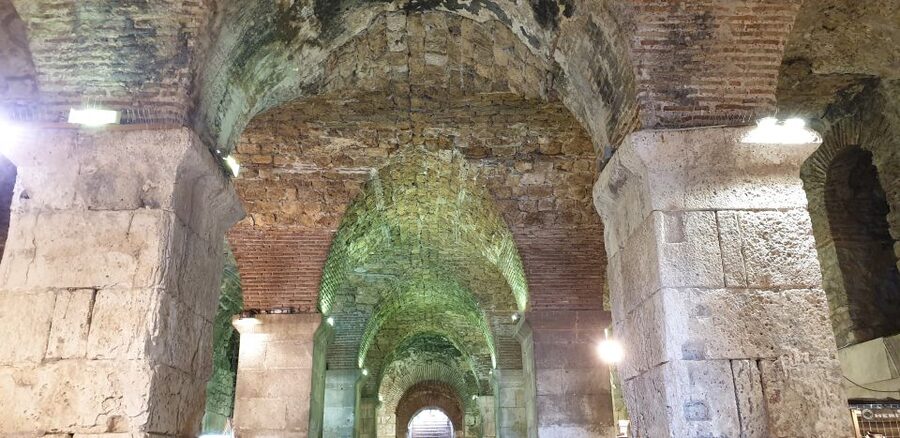
From the Bronze Gate, Toni introduces the basic plan of the palace and explains how the imperial residence became the heart of Split. The gate leads into the palace’s lower level, known as Diocletian’s Cellars.
The entrance is easy to find once you reach the Riva, but the address may be more useful than searching for the tour name. Arrive with a little time to spare, especially during the busy summer season.
The Cellars and the secret of the palace plan
The route passes through or beside the Cellars for about 10 minutes. You should not expect a long visit inside a paid attraction. The tour does not include admission to ticketed sites or museums, and the palace itself is freely accessible as part of the city.
The Cellars are still important because they reveal the shape of the imperial rooms above. In Roman construction, strong lower chambers supported the upper residence. Their layout gives Toni a way to explain how Diocletian’s private quarters were arranged.
This is also where the tour begins to show why Split can be confusing on your own. A modern street may follow an ancient corridor. A wall that looks like a simple house foundation may once have served a grander imperial building. Toni uses the 3D images to bridge that gap between what you see and what once stood there.
Do not expect every part of the Cellars to be explored at length. The stop is brief, and the main focus remains the open palace streets and courtyards.
One hour inside Diocletian’s Palace
The main palace section takes about an hour, giving you time to understand the site rather than simply photograph it. You walk through the remains of Diocletian’s private residence, along with medieval houses that were built into and around the Roman structure.
This is the most valuable part of the tour for first-time visitors. Without context, the palace can feel like a maze of narrow passages and mismatched stonework. With Toni’s explanation, the disorder becomes the point. The building was repeatedly adapted, and each generation treated the old palace as useful material.
You will see how private imperial spaces became part of a working town. Roman walls were not abandoned after the emperor’s era. They became the framework for homes, alleys, businesses, and public spaces.
Toni’s teaching style is especially useful here. He focuses on the details that help you understand the place, rather than trying to mention every date connected with Split. Several people who took the tour praised his ability to give a broad regional setting while keeping the palace at the center.
The route is outdoors and on foot. Some areas are narrow and crowded, and the stone surfaces may be uneven. It is not suitable for wheelchair users, and the walk may be tiring for anyone who has difficulty standing or walking for nearly two hours.
Same base, a different kind of day out:
- Split: Krka Waterfalls Trip with Boat Cruise and Swimming
★ 4.8 · 10,519 reviews - From Split: Krka Waterfalls, Food & Wine Tasting Tour
★ 5.0 · 9,326 reviews - Blue cave, Mamma Mia and Hvar, 5 islands speedboat tour
★ 5.0 · 7,150 reviews - From Split: Krka Waterfalls, Food & Wine Tasting Tour
★ 4.9 · 6,598 reviews
Peristyle, Vestibule, and the imperial center

The Peristyle is the visual center of the palace tour. This grand square preserves some of the strongest signs of Roman planning, and it helps you understand the scale of Diocletian’s residence.
Toni spends about 10 minutes here, using the square to explain the palace’s public and ceremonial side. The surrounding structures include the former mausoleum of Diocletian, the Temple of Jupiter, and the Vestibule.
The 3D reconstructions are particularly helpful at this stop. They show how the square may have appeared when it had a more complete Roman design, rather than the worn and layered appearance you see today. I find this kind of visual aid more useful than a long verbal description because you can compare the image with the actual columns and walls in front of you.
The Vestibule receives a shorter explanation of about five minutes. Its round form and position make more sense once you understand the route into the emperor’s private quarters. It is a compact stop, but it fits neatly into the larger plan.
The nearby Triklinij also receives about five minutes. Toni uses it to explain another part of the imperial residence and the way Roman domestic spaces worked. These short stops are not separate museum visits. They are pieces of a larger explanation of how the palace functioned.
The cathedral and Temple of Jupiter
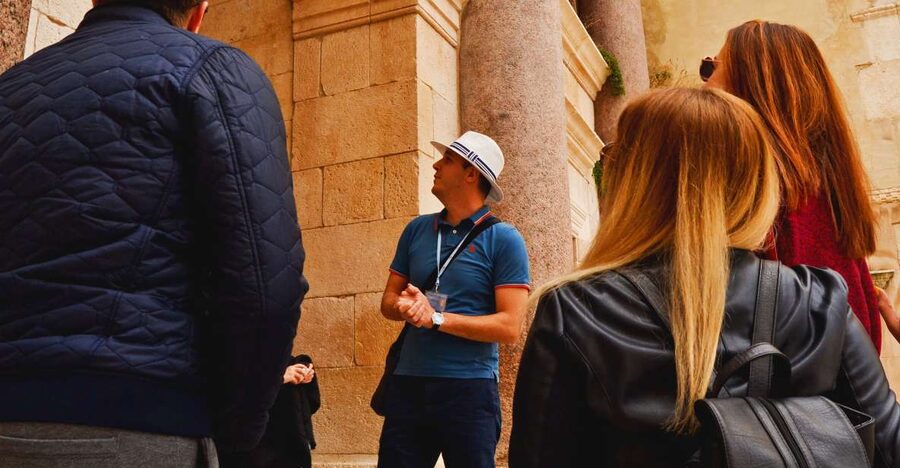
The route passes by the Cathedral of Saint Domnius and the Temple of Jupiter. You do not enter paid sites as part of this tour, so think of these as exterior explanations rather than interior visits.
Their importance lies in the changes they represent. The palace was not frozen in its Roman form. Buildings were reused and adapted as religious and civic life changed. Toni places these monuments within that long sequence instead of treating them as unrelated photo stops.
This is one reason the walk suits visitors who want to understand how Split developed. You are not only looking at Roman remains. You are seeing how later generations made practical use of them.
If you want a longer visit inside the cathedral or other ticketed locations, plan that separately. This tour gives you orientation and historical context, but it does not replace a paid interior visit.
Silver Gate, Golden Gate, and the medieval city
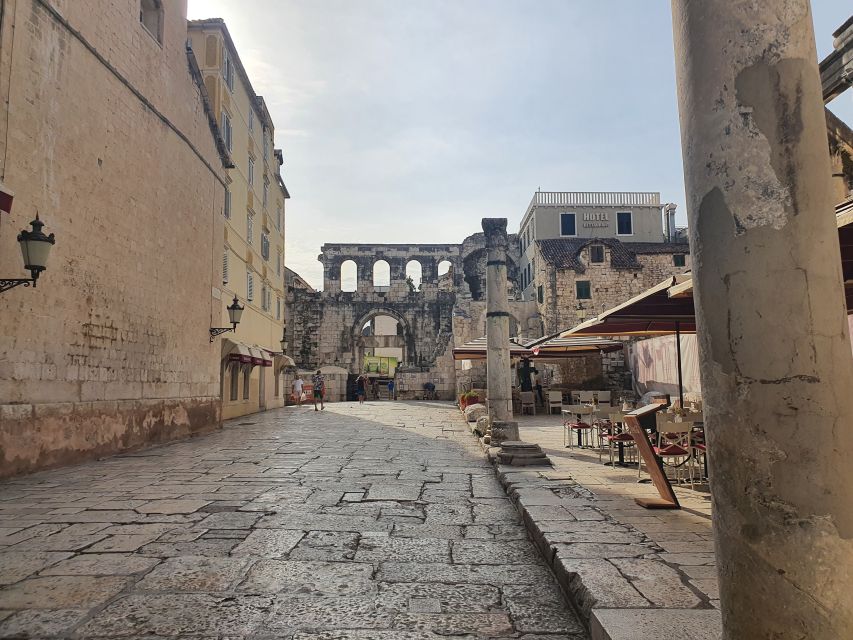
The route continues toward the Silver Gate, where Toni gives a short guided explanation, then moves on to the Golden Gate. The Golden Gate marks the end of the tour and is one of the clearest places to see how the palace connected with the wider city.
Along the northern wall, you can also see the famous statue of Bishop Gregory of Nin. The statue is tied to Split’s medieval heritage and gives the walk a change of focus after the Roman material.
The Golden Gate area is a fitting finish because it leads you out of the imperial residence and toward the medieval and Venetian parts of the old center. Toni explains how the city grew beyond the original palace and how later buildings preserved, covered, or changed earlier structures.
The official route ends at the Golden Gate, not back at the Riva. That is useful if you want to continue walking through the old center afterward. It also means you should not assume you will finish beside the starting point.
How the 3D images improve the experience
The reconstructions are more than a decorative extra. They solve the central problem of visiting ancient ruins: your eyes see fragments, but the original building was complete, painted, decorated, and used in ways that are no longer obvious.
Toni’s images show the palace as a functioning imperial complex. You can better understand the relationship between the Peristyle, the private residence, the Temple of Jupiter, and the lower chambers.
They also help younger visitors and people who do not usually enjoy archaeological sites. A 12-year-old, for example, may find a reconstruction easier to grasp than a long explanation about foundations and later building phases.
The images cannot prove every detail of the original appearance. They are reconstructions, not surviving photographs. Toni’s willingness to separate evidence from interpretation is important, and it keeps the visual material useful without pretending that every feature is certain.
Pace, crowds, weather, and practical comfort
The walk takes 110 minutes, which is long enough for a serious introduction but short enough to fit into a morning or afternoon in Split. Toni’s pace has been described as comfortable, with attention to shade and quieter areas when possible.
Timing still matters. The old center becomes more crowded later in the day, especially during the summer. An early departure gives you a better chance of hearing clearly and standing in less crowded spaces.
The tour runs rain or shine, so bring a drink and check the forecast. In hot weather, light clothing, sun protection, and comfortable shoes will make a real difference. The route includes old stone streets and frequent standing.
The walk is conducted in English. It is not designed for wheelchair users, and people over 95 are listed as unsuitable for the activity. Those limits are worth taking seriously because the route moves through historic streets that were not designed for modern accessibility.
Is $33 a fair price for 110 minutes?
At $33 per person, this is not the cheapest way to see Split. You can walk through much of the old center without paying for entry, and a basic orientation walk may cost less.
The value comes from the guide rather than from admission tickets. You are paying for Toni’s training, local knowledge, teaching experience, preparation of the 3D material, and the chance to ask questions. If you are curious about how the palace became a city, that extra explanation can change the way you see every street afterward.
I think the price is reasonable for visitors who want a focused historical tour and plan to spend more time exploring Split independently afterward. It is less appealing if you mainly want a quick list of landmarks or hope to enter several paid monuments as part of the same activity.
Free cancellation up to 24 hours before the start and the option to reserve now and pay later add useful flexibility. Food and drinks are not included, though the main practical need is simply to bring water.
Who should book this Split walking tour?
I would choose this tour if you enjoy history, architecture, and local stories, or if Diocletian’s Palace seems confusing when you first see it. It also suits families with older children, since the images and questions make the past easier to picture.
It is a good first activity in Split. After the walk, you will know where the main gates and squares are, and you will have a clearer idea of which buildings deserve a second look.
You may want a different option if you need step-free access, dislike standing for long periods, or want interior admission included. It is also not the right choice for someone seeking a food tour, a nightlife walk, or a broad excursion beyond the old center.
Final verdict: a strong choice for understanding Split
Book this tour if you want more than attractive Roman ruins and narrow lanes. Toni’s local background, former teaching career, question-led style, and carefully prepared 3D reconstructions give the palace a clear human story.
The chief drawback is simple: the $33 fee does not include paid entrances, and the route is not accessible to wheelchair users. For most history-minded visitors who can manage the walking, though, the combination of Roman architecture, medieval change, Venetian influence, and modern local life makes this a worthwhile introduction to Split.
FAQ
Where does the Split history walking tour start?
It starts at the Bronze Gate, also called the Brass Gate, at Obala Hrvatskog narodnog preporoda 22. This is the southern seaside entrance to Diocletian’s Palace from the Riva Promenade.
Where does the tour finish?
The walk finishes at the Golden Gate of Diocletian’s Palace.
How long does the tour last?
The tour lasts 110 minutes.
Is entry to Diocletian’s Palace included?
The palace itself does not require admission, but the tour does not enter paid sites or museums. Interior visits that require a ticket are not included.
What language is the tour conducted in?
The live tour guide speaks English.
Does the tour run in bad weather?
Yes. The tour takes place rain or shine. Bring a drink and dress for the conditions.
More Historical Tours in Split
- Walking Tour of Split with a ‘Magister’ of History
★ 5.0 · 1,122 reviews - Split Walking Tour with Professor of History
★ 5.0 · 926 reviews - Split: History and Heritage Walking Tour
★ 4.9 · 650 reviews - Split History and Gastro Small-Group Tour with Food and Drinks
★ 5.0 · 375 reviews
Just added in Split
- Krka Waterfalls & Primošten from Trogir, Seget, Čiovo & Kaštela★ 5.0 · 18 reviews
- From Trogir, Seget, Okrug: Krka Waterfalls & Šibenik Culture Tour★ 5.0 · 10 reviews
- Slatine – Island Hopping Excursion (Trogir/Blue Lagoon/Shipwreck)★ 4.0 · 24 reviews
- Island Hopping Boat Excursion with Lunch (Trogir,Blue Lagoon, Šolta)★ 3.5 · 6 reviews
- From Split & Trogir: ATV Quad Tour on Island Čiovo★ 5.0 · 21 reviews
- Split: Sunset Guided Kayaking Tour★ 4.8 · 71 reviews
- Split Sunset Stand Up Paddle Tour★ 5.0 · 16 reviews
- Stand Up Paddle Tour in Split★ 4.7 · 17 reviews
Historical Tours, compared.
Walking Tour of Split with a ‘Magister’ of History
Read our review →

Split History and Gastro Small-Group Tour with Food and Drinks
Read our review →
PREMIUM Emperor’s Walking Tour for History Lovers + Museum
Read our review →
Browse the lists this tour appears in