
Reviewed · HISTORICAL TOURS
Split: History Walking Tour of the Old Town
Split’s most memorable surprise is underground. In the Diocletian’s Cellars, you’ll see the spaces used for Daenerys Targaryen’s dragons and the Unsullied in Game of Thrones, but the real story is older and stranger: these rooms helped support a Roman emperor’s palace nearly 1,700 years ago.
I like the way this walk joins major sights with small details, from the headless Sphinx near Jupiter’s Temple to the human mousetrap passage. I also like the practical finish on the Riva, where your guide can point you toward Dalmatian food, beaches, ice cream, and islands.
The main drawback is its short 90-minute length. You’ll see the essential old town, but this is a brisk introduction rather than a slow archaeological study. The price, $41 per person, makes the tour good value if you want context and local advice without spending half a day.
Key points to know before you book
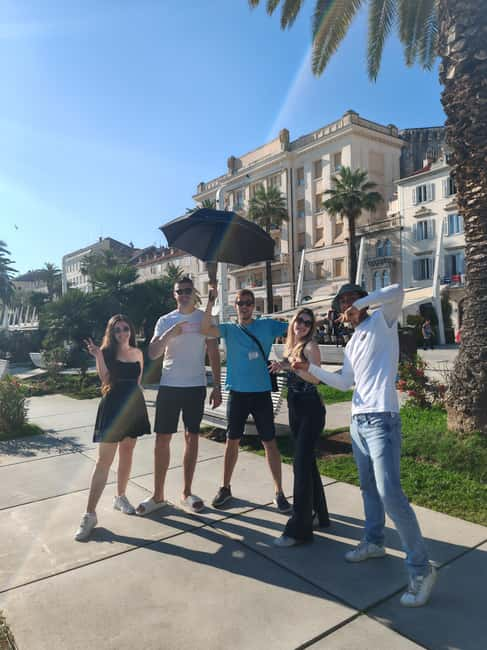
- The Roman palace is still a living city: Split’s old town grew inside and around Diocletian’s palace, so the walk mixes ancient stone with daily local life.
- The cellars offer shade and strong Game of Thrones connections: You’ll see filming locations while learning why the underground rooms mattered to the palace.
- Guides keep the history lively: Riddles, jokes, questions, photos, and maps have been part of the guiding style.
- The route covers Split’s essential landmarks: Golden Gate, Peristyle, Mausoleum, Jupiter’s Temple, Vestibule, Pjaca, Fruit Square, and the Riva all appear.
- English and Spanish tours are available: Private groups can be booked, and hotel or cruise pickup may be arranged depending on the option selected.
- The end point is useful: You finish beside the palm-lined Riva with advice for food, beaches, islands, and the rest of your day.
Why Split’s old town makes a good walking tour
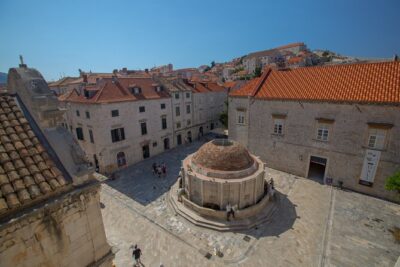
Split is not a museum district placed beside a modern city. Much of the old town occupies the remains of Emperor Diocletian’s palace, built around the beginning of the fourth century. Homes, shops, cafés, lanes, and public squares now fill spaces first designed for an imperial residence and military complex.
That setup is ideal for a walking tour because the past is not sealed away behind glass. You can move from a Roman gate into a narrow lane, turn into a medieval square, and then step into a café or shop inside the palace walls. A guide helps you read those layers instead of seeing only old stones.
The route lasts 90 minutes, which is enough to cover the main center without making the history feel endless. I would treat it as a first orientation to Split. You get the shape of the old town, the key stories, and some useful ideas for later. If you want long stops at every monument, you’ll need extra time on your own.
Other guided walks in Split:
- Split: Old Town and Diocletian Palace Walking Tour
★ 4.9 · 4,727 reviews - Walking Tour of Split and Diocletian’s Palace
★ 5.0 · 2,588 reviews - Krka Waterfalls tour with Trogir Walking tour and Krka panoramic boat cruise
★ 5.0 · 1,659 reviews
Starting at the Golden Gate and Đardin Park
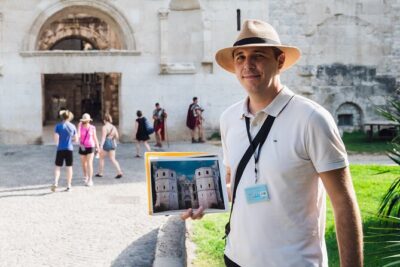
The walk begins at the Golden Gate, with the exact meeting place depending on the option you book. This is a strong starting point because the gate gives you an immediate sense of the palace’s scale and defensive design.
From here, your guide also takes you toward Đardin Park. The park provides a change of pace before the route moves into the denser stone lanes. Guides have used questions, riddles, and jokes to get people involved, so the opening is not simply a list of dates and names.
If you are meeting at a busy time, check your confirmation carefully for the exact location. Pickup may be available for some bookings, including a hotel or cruise ship meeting point, but it is not automatic for every option.
Peristyle and the Mausoleum: the palace at its grandest
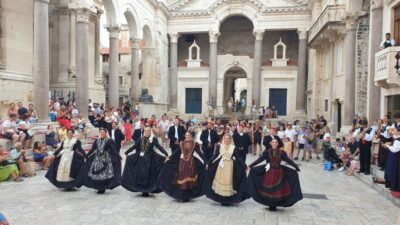
The Peristyle is the visual center of the walk. This open Roman court once formed the ceremonial heart of Diocletian’s palace. Tall stone columns and imposing walls make it easy to picture an emperor presenting himself here, surrounded by the architecture of power.
The guide’s job at this stop is to connect the building to the man. Diocletian is presented not only as a Roman emperor but also as one of the greatest persecutors of Christians. The tour uses memorable stories to make the political and religious conflict easier to follow, including the curious account of why Diocletian vomited after dinner.
The nearby Mausoleum adds another layer. What began as the emperor’s tomb later became Split Cathedral, often described on the tour as the oldest cathedral in the world. That contrast is one of the most interesting things in Split: a building made for a Roman ruler was given a new religious life.
You’ll also see the bell tower from this area. The route does not present it as an isolated monument. Instead, it shows how Roman, Christian, medieval, and later additions share the same compact center.
Jupiter’s Temple and the headless Sphinx
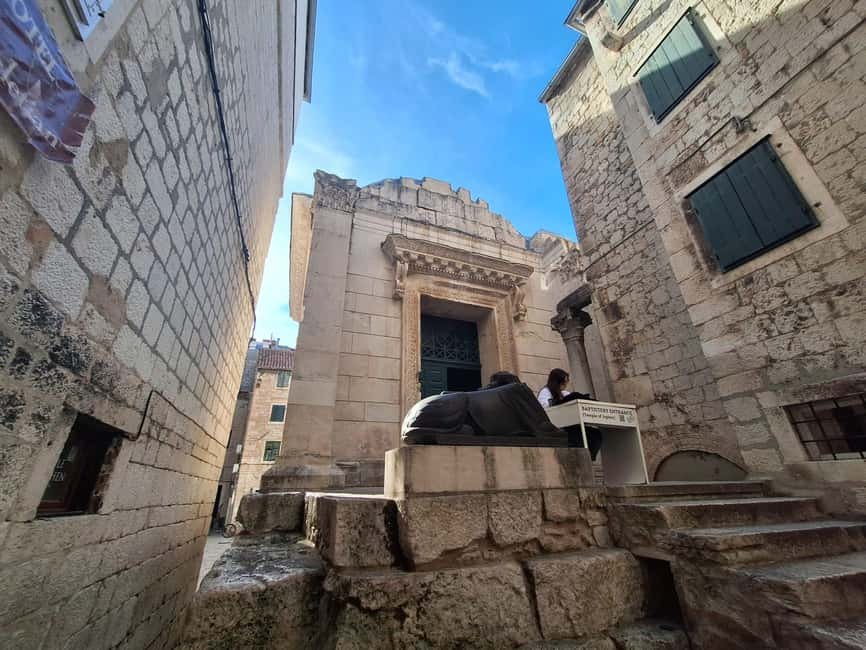
The Temple of Jupiter is a small stop, listed at about five minutes, but it carries plenty of story. The temple was linked to Jupiter, the chief Roman god, and its position inside the palace helps explain how imperial power and religion worked together.
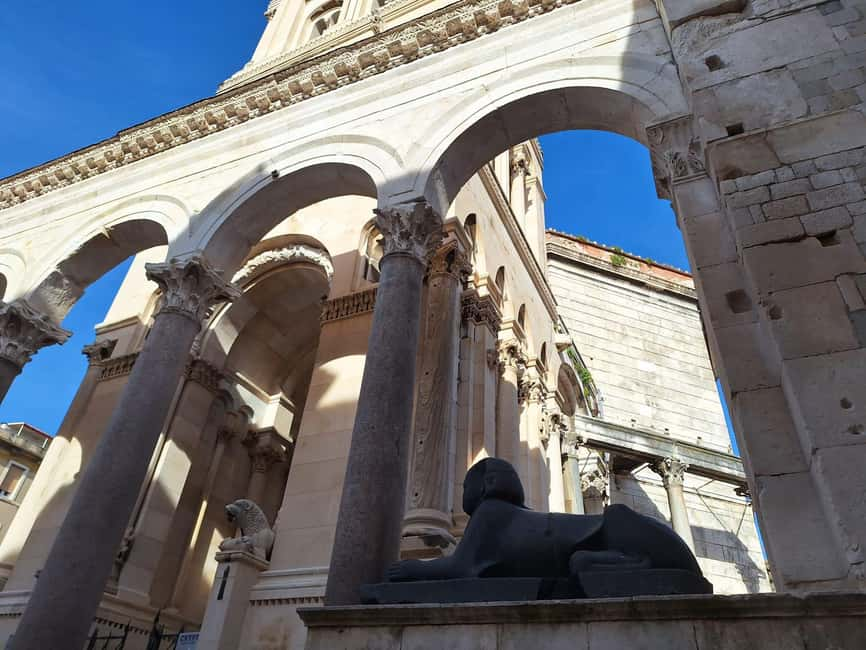
A headless Sphinx guards the entrance area. Its presence can seem odd until your guide explains the connection with Egypt and Roman imperial taste. The story gives you something concrete to look for, rather than asking you to remember another abstract name.
The guide also brings in the Sphinx’s riddle, with the playful suggestion of replacing your head with the Sphinx’s. This kind of humor suits the setting. Split’s old town is full of serious history, but it is also a maze of odd details, reused stones, and stories that stick better when they make you smile.
Same base, a different kind of day out:
- Split: Krka Waterfalls Trip with Boat Cruise and Swimming
★ 4.8 · 10,519 reviews - From Split: Krka Waterfalls, Food & Wine Tasting Tour
★ 5.0 · 9,326 reviews - Blue cave, Mamma Mia and Hvar, 5 islands speedboat tour
★ 5.0 · 7,150 reviews - From Split: Krka Waterfalls, Food & Wine Tasting Tour
★ 4.9 · 6,598 reviews
The Vestibule and the palace’s unusual passageways
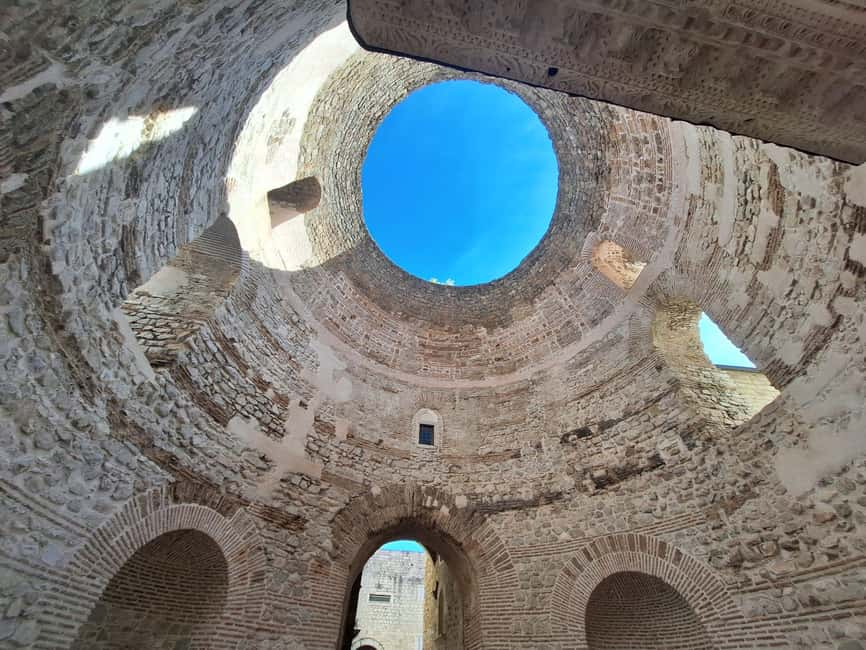
The Vestibule is another short but worthwhile stop. This circular entrance space once led toward the emperor’s private quarters. Its shape and acoustics help show how carefully the palace was planned, even though the modern town has grown around it.
The route also introduces the so-called human mousetrap, a passageway with an unusual layout that made movement through the palace more controlled. You do not need to remember every architectural term to get the point. The palace was both a home and a statement of authority, built to guide visitors toward the emperor.
This is where a live guide adds real value. A map or sign can show you the outline of a building, but a guide can direct your attention to the entrance, the lines of movement, and the way the old spaces connect.
Diocletian’s Cellars and the Game of Thrones connection
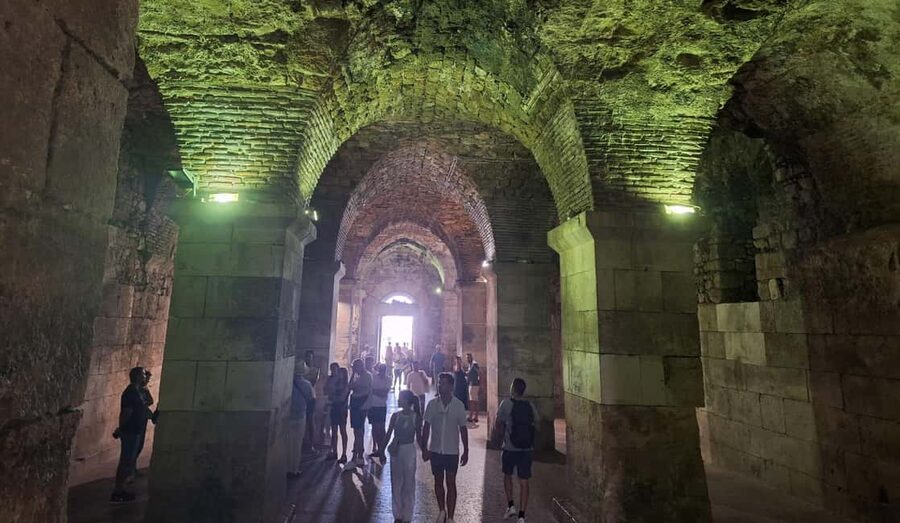
The cellars are one of the tour’s biggest draws. These underground rooms once helped support the upper parts of the palace. Their preserved layout gives you a clearer sense of the original plan than many of the altered streets above.
They were also used as filming locations for Game of Thrones. You’ll see the spaces associated with Daenerys Targaryen’s dragons and the scenes involving the Unsullied and the Sons of the Harpy. If you know the show, this adds a fun visual layer. If you do not, the cellars still work as Roman architecture and a cool break from the summer heat.
That shade matters in Split. One guide, Marko, was praised for taking the group through the cellars during hot weather, making the time pass quickly. You should still bring water, a hat, sunscreen, and comfortable shoes, but the underground portion offers relief during a sunny afternoon.
The Game of Thrones material is used as an extra hook, not the whole purpose of the visit. I consider that the right balance. You can enjoy the filming locations without losing sight of the palace’s actual Roman purpose.
Pjaca and Fruit Square, where the palace meets daily life

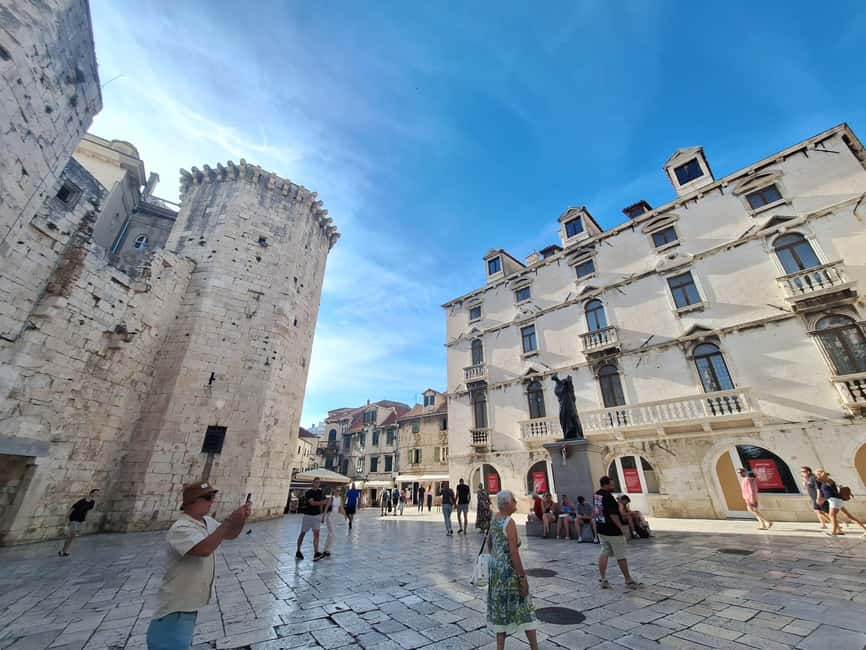
After the palace complex, the walk continues toward Pjaca, also called People’s Square. This shift is important because it shows how Split developed beyond the original imperial core. The route is no longer only about an emperor’s residence. It is about the city people use today.
Fruit Square, or Voćni trg, adds another view of local life. The name points to the market activity once associated with the area. The square is a good place to notice how old façades, narrow streets, shops, and cafés occupy the same space.
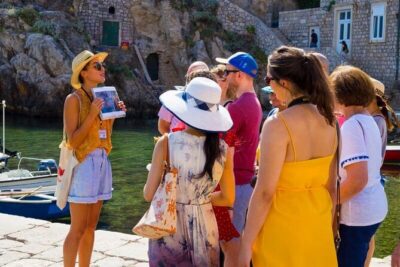
The guide also talks about Split’s people, local habits, and food. That makes the tour more useful than a basic monument circuit. You can ask where to look for Dalmatian specialties and what locals eat, then use the advice later in your stay.
The practical suggestions have been a strong part of the guiding style. Nina, Maya, Marc, and Marko are among the guides associated with especially personal tours, with Maya also using photos and maps to explain the city. Guide assignments can vary, but the experience is designed to include more than dates and architecture.
Finishing on the Riva
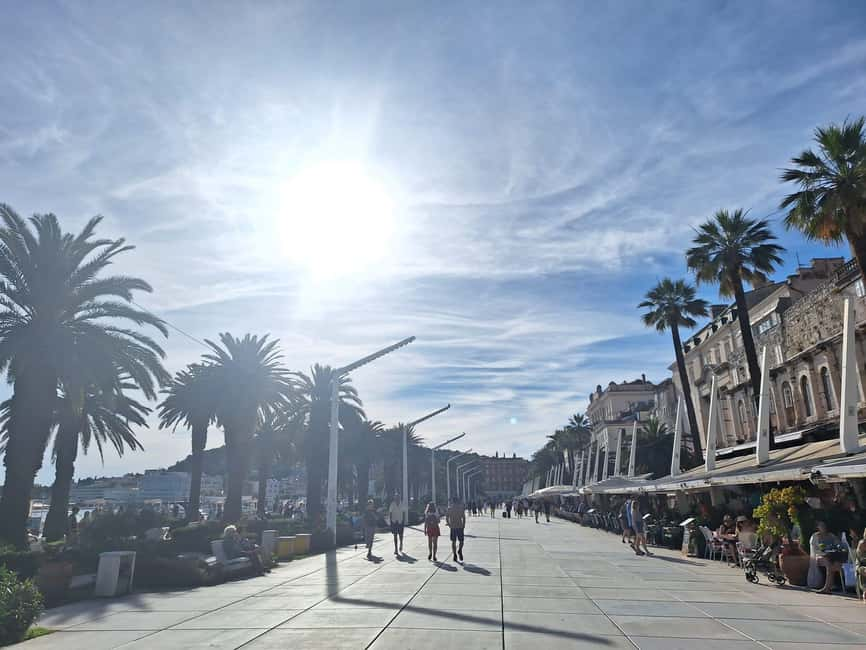
The walk ends on the Riva, Split’s seafront promenade lined with tall palm trees. This is a smart ending because you move from enclosed Roman lanes to open waterfront space.
Your guide can suggest how to spend the rest of the day, which islands to consider, where to find beaches, and where to stop for ice cream. This advice is most valuable at the beginning of a Split visit, when you may still be deciding how to divide your time between the old town, the coast, and island trips.
The final location also gives you a natural place to continue exploring. You can stay near the water, return into the palace, or use the tour’s food tips to choose your next meal. The walk ends with options rather than simply dropping you beside the last monument.
How the $41 price compares with the experience
At $41 per person, this is not the cheapest way to wander through Split. You can walk through much of the old town without paying anything. The question is what you want the money to do.
For the price, you receive a licensed local guide, a focused 90-minute route, explanations at major landmarks, access to the palace cellars as part of the tour, and advice about food and the rest of your stay. A guide can also help you handle crowded areas and find shade. One guide was especially noted for managing crowds and locating a cool spot, as well as pointing out an old freshwater fountain supplied by a roughly 2,000-year-old aqueduct.
The value improves if you are new to Split, short on time, or interested in Roman history but unsure how to read the old town. It also works well for a private group, where the guide can respond to your questions more directly.
The price is harder to justify if you have already studied the palace in detail or prefer to explore at your own pace. You may feel rushed at some stops, especially the Temple of Jupiter and the squares. Still, the practical local guidance can save time later, which is part of the value.
Group size, language, and the pace of the walk
The tour is offered in English and Spanish. Spanish-language guides have received particularly warm praise for clear explanations, humor, and advice about Croatia beyond Split. If you are more comfortable in Spanish, this is a useful choice rather than settling for a tour where you only catch part of the explanation.
Private groups are available. Group size affects the feel of the walk: a smaller party makes it easier to ask questions and stay close to the guide in narrow lanes. The experience has also operated with very small groups, including a solo booking, but group size can vary by option and date.
The pace is steady. You’ll walk over old-town surfaces and through crowded historic lanes, so comfortable shoes matter. Bring water, a hat, and sunscreen, particularly in summer. The cellars provide shade, but much of the route is outdoors.
Who should book this Split walking tour
I would recommend it to first-time visitors who want a clear introduction before exploring alone. Families and mixed-age groups may also like the riddles, jokes, Sphinx story, and Game of Thrones connection, which keep the history from feeling like a lecture.
It suits cruise passengers especially well if pickup and timing work with the selected option. The 90-minute format gives you a compact look at the core sights, followed by a useful finish near the waterfront.
History fans will appreciate the Roman palace, Mausoleum, temple, and cellars, though anyone seeking detailed archaeology should plan independent time afterward. Game of Thrones fans should book it for the filming locations plus the Roman setting, not as a show-only excursion.
I would be less eager to recommend it to someone who dislikes guided walks, already knows Split well, or wants a slow, photography-first outing. The tour covers a lot in a short period, and the old town can feel crowded.
Should you book the Old Town History Walking Tour?
Book it if you want Split’s main sights to make sense quickly. The combination of the Roman palace, underground cellars, lively guide style, and useful food and island advice gives you more than a simple stroll through attractive streets.
The best reason to choose it is the balance. You get Diocletian, Roman architecture, Christian reuse, Game of Thrones locations, local food pointers, and the Riva in one compact route. Choose a private option if questions and personal attention matter most, and wear shoes suited to old stone streets.
Skip it if you prefer complete independence or want to spend a full morning at each monument. Otherwise, $41 is a fair price for a well-paced introduction, especially near the start of your stay when local advice can shape the days that follow.
FAQ
How long does the Split walking tour last?
The tour lasts 90 minutes.
How much does the tour cost?
The listed price is $41 per person.
Which sights are included?
The route includes the Golden Gate, Đardin Park, Peristyle, Mausoleum, Temple of Jupiter, Vestibule, Diocletian’s Cellars, People’s Square, Fruit Square, and the Riva.
Does the tour visit Game of Thrones filming locations?
Yes. You visit the cellars associated with Daenerys Targaryen’s dragons and the scenes involving the Unsullied and the Sons of the Harpy.
Which languages are available?
The live tour guide is available in English or Spanish.
Is a private tour option available?
Yes. Private groups are available, and private bookings include a private meeting point.
Can the guide meet me at my hotel or cruise ship?
Pickup is optional for some choices. You can provide the hotel name and street, or state that you are arriving by cruise ship.
What should I bring?
Bring comfortable shoes, a hat, sunscreen, and water.
More Historical Tours in Split
- Walking Tour of Split with a ‘Magister’ of History
★ 5.0 · 1,122 reviews - Split Walking Tour with Professor of History
★ 5.0 · 926 reviews - Split: History and Heritage Walking Tour
★ 4.9 · 650 reviews - Split History and Gastro Small-Group Tour with Food and Drinks
★ 5.0 · 375 reviews
Just added in Split
- From Trogir, Seget, Okrug: Krka Waterfalls & Šibenik Culture Tour★ 5.0 · 10 reviews
- Krka Waterfalls & Primošten from Trogir, Seget, Čiovo & Kaštela★ 5.0 · 18 reviews
- Slatine – Island Hopping Excursion (Trogir/Blue Lagoon/Shipwreck)★ 4.0 · 24 reviews
- Island Hopping Boat Excursion with Lunch (Trogir,Blue Lagoon, Šolta)★ 3.5 · 6 reviews
- From Split & Trogir: ATV Quad Tour on Island Čiovo★ 5.0 · 21 reviews
- Split: Sunset Guided Kayaking Tour★ 4.8 · 71 reviews
- Split Sunset Stand Up Paddle Tour★ 5.0 · 16 reviews
- Stand Up Paddle Tour in Split★ 4.7 · 17 reviews
Historical Tours, compared.
Walking Tour of Split with a ‘Magister’ of History
Read our review →

Split History and Gastro Small-Group Tour with Food and Drinks
Read our review →
PREMIUM Emperor’s Walking Tour for History Lovers + Museum
Read our review →
Browse the lists this tour appears in