

Reviewed · HISTORICAL TOURS
Zadar: Virtual Reality Guided History Walking Tour
Zadar’s old town is full of visible history, but this tour adds the missing pieces. At each stop, you put on a VR headset and see the Roman Forum, medieval battles, vanished markets, and destroyed parts of the city as they once looked. One especially striking scene shows an attack arriving by sea during the Fourth Crusade in 1202.
I like the mix of real walking and virtual reconstruction, and I like that a friendly assistant stays with you instead of leaving you to manage the equipment alone. The audio guide comes in seven languages, and the tour includes places you cannot normally enter, including St. Chrysogonus’ Church. The main caution is the technology: some headsets have needed frequent help, and the image quality can feel dated.
Key points at a glance
- Roman Forum brought back to life: Use the headset while standing in the center of ancient Zadar’s social and economic heart.
- Aerial and sea views of the city: See Zadar’s peninsula from above and watch a historical attack approach from the water.
- Access to otherwise closed history: Virtual scenes let you look inside St. Chrysogonus’ Church.
- A guide handles the practical side: The assistant leads you between stops, explains the sights, and helps with the Oculus Go headset.
- Seven audio languages: Choose Croatian, English, Esperanto, French, German, Italian, or Spanish.
- Good value for a two-hour experience: At $35, you pay for a guided walk plus historical reconstructions, not simply a standard city stroll.
Why Zadar works so well with virtual reality

Zadar’s old town is compact, but its past is layered. Roman streets, medieval churches, Venetian-era traces, wartime damage, and modern rebuilding all occupy the same peninsula. A normal walk can show you surviving walls and buildings. It cannot easily show you what has disappeared.
That is where this tour earns its place. You walk to actual historic locations, then use the headset to see a reconstruction tied to that spot. The technology is not a substitute for Zadar itself. It gives you a way to compare the present city with earlier versions that no longer exist.
The format also helps if you find dates and names hard to place. Instead of hearing only that the Roman Forum was important, you can stand in its center and see how it functioned. Instead of trying to picture a former market on the other side of town, you can view the site through a recreated scene.
The tour lasts two hours, long enough to cover several periods without turning into an all-day history class. The spoken information is compact, which suits anyone who wants context but does not want a flood of dates.
Other guided walks in Zadar:
- Zadar: Guided Walking Tour
★ 4.8 · 445 reviews - Zadar City Tour 120min Walk
★ 5.0 · 203 reviews - Zadar Walking Tour sponsored by Gligora Cheese and deli.
★ 5.0 · 119 reviews
Meeting beside the Sea Gate
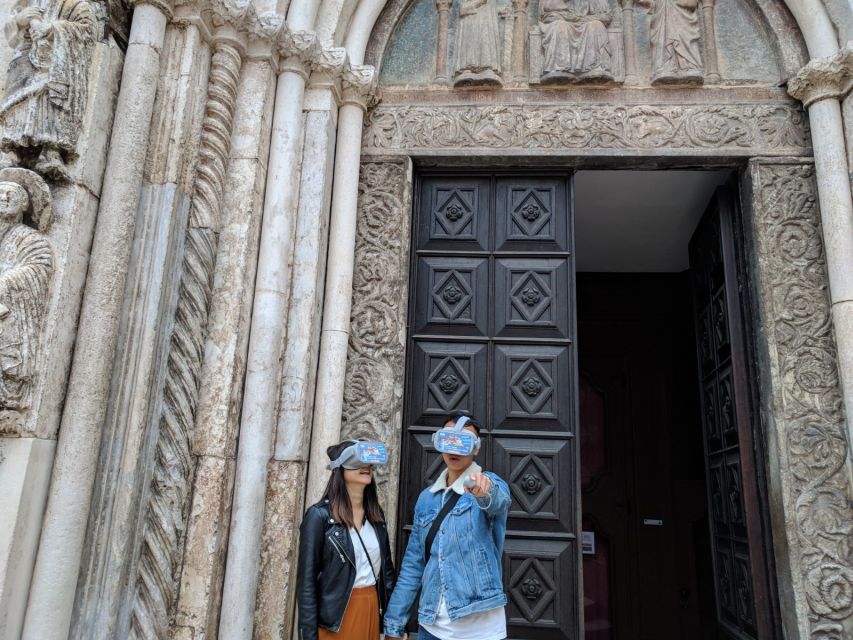
The tour begins at a souvenir shop in a red building next to the Sea Gate, at Poljana Pape Aleksandra III 7. This is a useful starting point because the Sea Gate places you right at the edge of Zadar’s old town and within reach of the main historic stops.
Bring your passport or ID card. The activity is listed as wheelchair accessible, and the experience takes place on foot through the old town. Food and drinks are not included, so plan those separately before or after the two-hour walk.
Your guide leads the route and controls the pace. English is the instructor language, while the headset’s audio guide offers seven language choices. If you need help with the headset, you do not have to solve the problem alone. The assistant remains available throughout the walk.
That human help matters. One guide, Veronica, has been praised for giving enough information without burying the group in detail. Another useful habit is stopping in a quieter, shaded place whenever the headset is in use. In Zadar’s summer heat, that small choice can make the equipment easier to handle.
Standing in the Roman Forum
The Roman Forum is one of the most important stops because it shows the difference between looking at ruins and understanding a city. Today, you can see the surviving stones and open space. With the VR view, you get a sense of the forum as the center of public and economic life in ancient Zadar.
The value here is visual scale. A guide can describe the forum’s role, but a three-dimensional reconstruction helps you picture people, structures, and activity occupying the same area. You are not watching history from a distant screen. You are standing where the ancient scene is placed.
The headset adds 360-degree views, 3D objects, animation, and sound effects. These features are most useful when they clarify the physical setting. The audio supplies the explanation, while the images give you a better idea of how the area may have functioned.
Do not expect modern cinema quality. Some of the images have been described as dated, and that is a fair warning. The historical idea remains interesting, but the visual polish may not satisfy you if you expect the crisp graphics of a new video game.
Seeing the Fourth Crusade from the sea
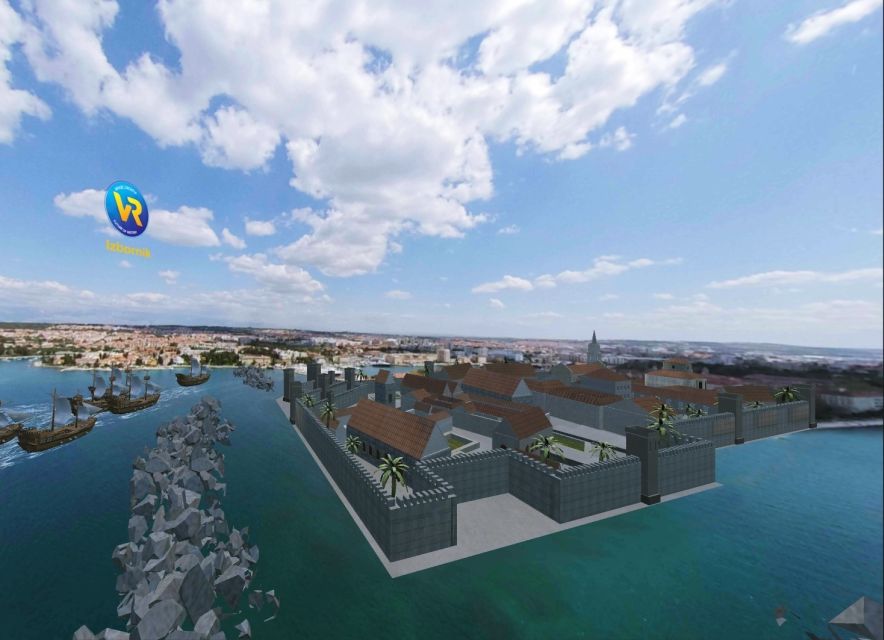
One of the tour’s more unusual scenes focuses on the Fourth Crusade and the invasion of Zadar in 1202. The reconstruction shows the attack arriving from the sea, giving you a view of the city under threat rather than a quiet look at its monuments.
This is a smart use of VR because an attack is difficult to explain from a modern street corner. The headset can place you in an aerial or wide-angle view, then show movement across the water and toward the peninsula. It gives the event a physical direction and helps you understand Zadar’s exposed position.
You may also see attacks from the air and sea during World War II. These scenes connect medieval conflict with the city’s more recent damage. The contrast is useful: Zadar’s history is not a single ancient chapter, but a long sequence of rebuilding, loss, and change.
The sound effects are part of the impact, though you should treat them as an aid to the story rather than a full historical record. The guide remains important for explaining what you are seeing and keeping the scene in context.
Same base, a different kind of day out:
- Zadar: Plitvice Lakes Guided Day Tour with Tickets
★ 4.9 · 3,148 reviews - Zadar: Kornati Boat Trip with Lunch and Swim Stops
★ 4.5 · 1,498 reviews - Zadar: Plitvice Lakes with Boat Ride and Zadar Old Town Tour
★ 4.9 · 1,368 reviews - From Zadar: Plitvice Lakes with Boat Ride & Zadar Old town tour
★ 5.0 · 1,129 reviews
Looking inside St. Chrysogonus’ Church
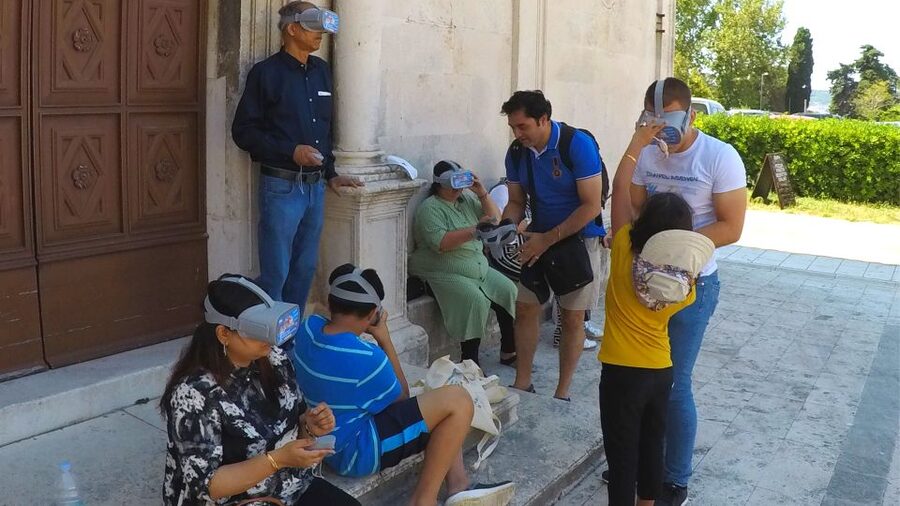
The tour includes a virtual visit to St. Chrysogonus’ Church, which is otherwise closed to the public. This is one of the clearest reasons to choose the experience over a standard walking route.
A closed building can create a frustrating gap in an old-town tour. You may pass the exterior and hear that the interior matters, but you cannot see it. Here, the VR sequence offers a way to view the church without ordinary public access.
This stop also shows the limits of the format. A virtual interior is not the same as entering a real church, feeling its scale, or studying original surfaces at close range. Still, it gives you more than an outside wall and a short explanation.
I would pay close attention to the audio here. The visual sequence may be brief, and the spoken guide helps you understand why the church belongs in Zadar’s story. If you are especially interested in religious buildings, ask your guide questions while the group is stopped.
Finding the vanished city market
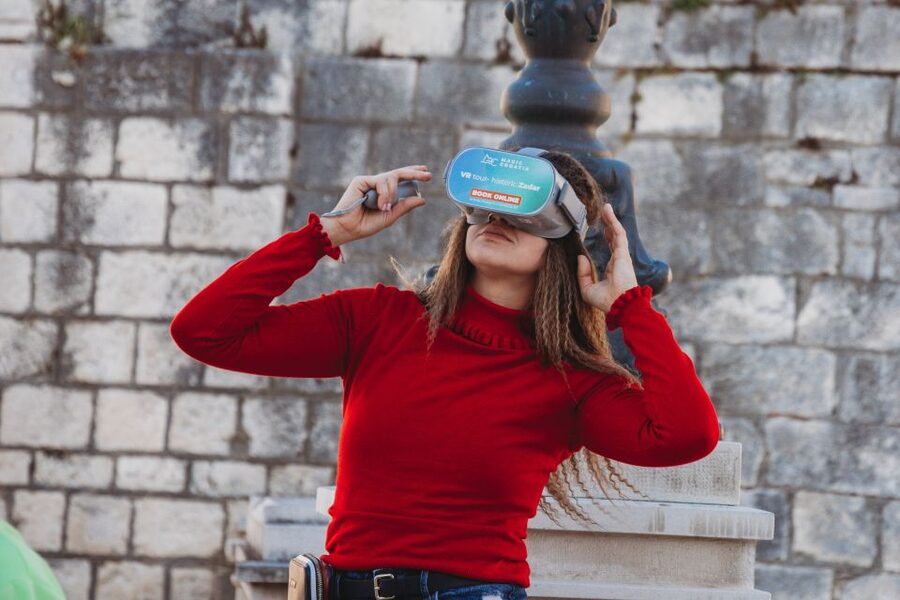
Another unusual stop takes you to the location of a former city market. Its position was different from the market area you would associate with modern Zadar, and the virtual view helps you understand that change.
This is the sort of detail easy to miss on a normal walk. You can learn the name of a church or gate from a guidebook, but vanished civic spaces are harder to picture. The VR scene gives the old market a location and a relationship to the rest of the town.
For me, this is where the tour becomes more than a collection of famous sights. It shows how daily life shaped the city. Markets, public forums, churches, and defensive routes tell you how people used Zadar, not just what monuments survived.
The scene may appeal most to visitors who enjoy urban history. If you want only postcard views, this stop could feel less exciting than the Roman Forum or the attack sequence. Its reward is understanding, not spectacle.
Rising above Zadar in a hot-air balloon
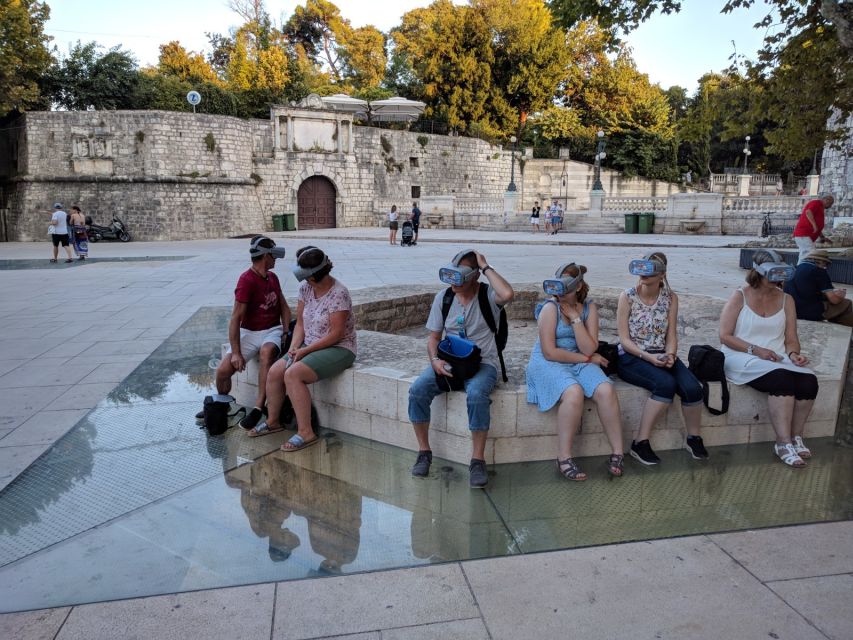
The hot-air balloon scene gives you a wide view of the old city. From above, the peninsula’s layout becomes easier to read. You can see how the historic center relates to the water and how tightly the old streets fit together.
This is a useful break from ground-level scenes. At street height, walls and buildings can hide the overall shape of the city. The aerial view lets you step back and see Zadar as a connected place.
You will also see how Zadar looked after World War II. That view adds another layer to the experience, showing a city affected by conflict and later change. The point is not simply to admire an old image. It is to compare the city you are walking through with earlier versions of its streets and buildings.
The aerial sequence may be especially helpful at the start of your visit. It can give you a quick sense of the peninsula before you continue on foot. You should not expect the headset to replace a real lookout, but it offers a historical view that an ordinary viewpoint cannot provide.
How the headset works in practice
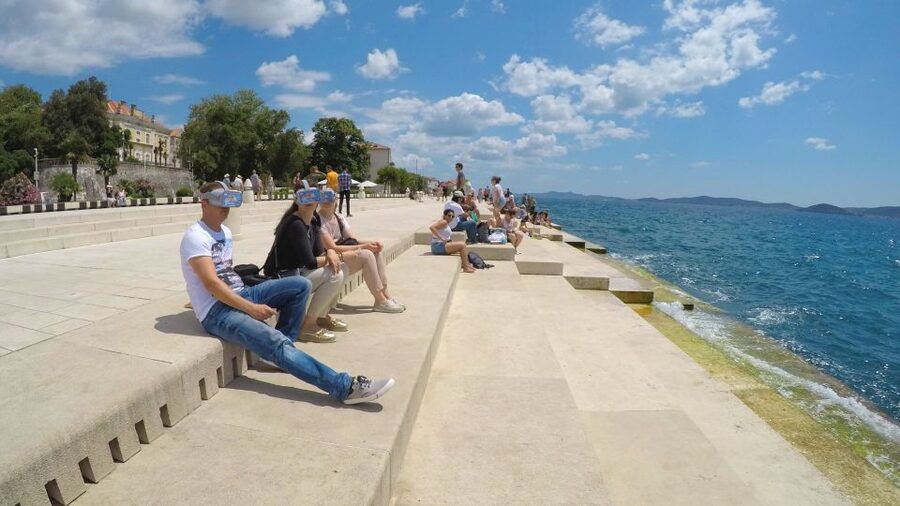
The equipment is an Oculus Go all-in-one VR headset with a controller. You do not need advanced technical skills. The interface is designed so you can choose when to move to the next point, and the assistant remains nearby if you need help.
That control is worth noting. You are not forced through every scene at the same speed. If you need a moment to look around, you can take it. If the group is ready to continue, the guide can help keep the tour moving.
Still, the technology is the experience’s weak spot. Some equipment has not worked perfectly, and one participant needed frequent assistance from the guide. Another person found the picture quality behind current standards. Those are not small points if you are booking mainly for cutting-edge VR.
The best way to think about the headset is as a storytelling tool. It creates a sense of place and shows lost views, but it is not a high-end gaming system. Keep that expectation in mind and you are more likely to appreciate what it does well.
The guide makes the difference
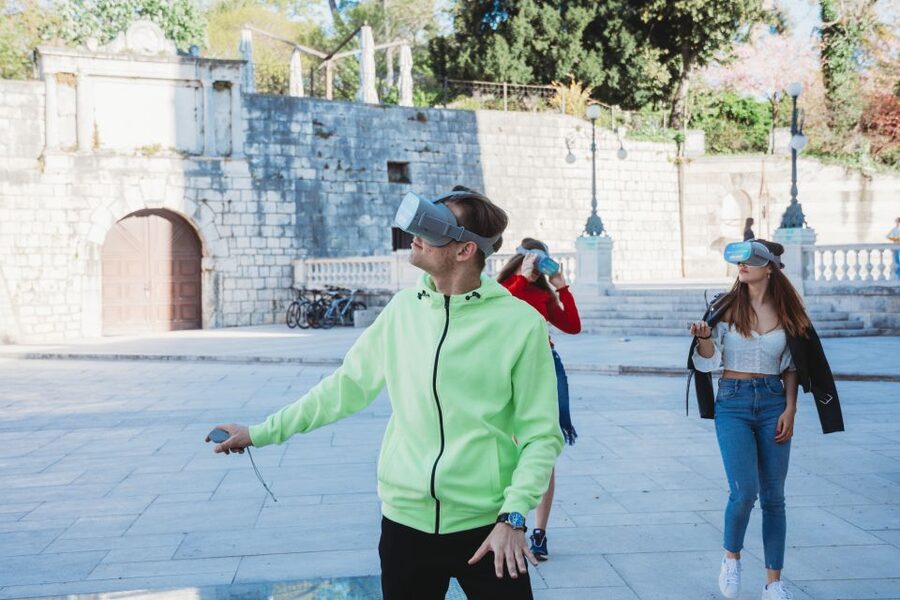
The guide is not simply there to lead you from one point to another. The assistant handles the route, explains the historical scenes, answers questions, and helps with the headset. That support keeps the tour from becoming a technical exercise.
The strongest guiding style here is concise and local. Veronica, who has led the experience, has been noted for sharing useful information without overwhelming the group. That approach fits the two-hour format, especially if you want a clear introduction rather than a specialist lecture.
You can also ask questions during the stops. The guide can explain what you are seeing, clarify a date, or help you compare the virtual reconstruction with the building or street in front of you.
The quality of the tour will depend partly on the guide’s ability to manage both history and equipment. A patient assistant is especially important if a headset needs to be reset or adjusted. The available feedback suggests that patience has been part of the experience, but technical hiccups remain possible.
Is $35 a fair price?
The cost is $35 per person. That is more than a basic self-guided walk, but the comparison is not quite fair. You are paying for a two-hour guided route, an audio guide, a headset and controller, historical animation, 3D scenes, sound effects, and access to views of places that are normally closed or gone.
I see the value most clearly if you are visiting Zadar for the first time and want an overview with a visual edge. The tour can give you a better map of the old town and show why several locations matter before you explore on your own.
The value is weaker if you already know Zadar well or dislike wearing headsets. It is also less attractive if you expect modern, high-resolution graphics. In that case, a standard walking tour may offer better value and fewer interruptions.
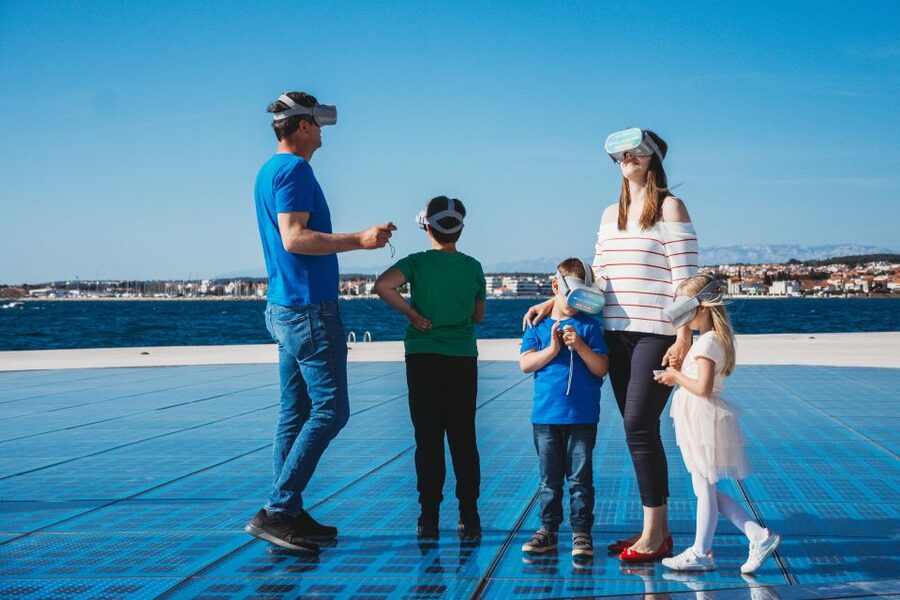
Families may find the format appealing, since the VR scenes add a playful element to dates and ruins. The experience can also suit history-minded visitors who want to see lost buildings and events rather than only hear about them.
Who should book this Zadar tour?
I would choose this experience if you want:
- A first look at Zadar’s old town with historical context
- A visual explanation of the Roman Forum
- A way to see inside St. Chrysogonus’ Church
- Aerial views of the peninsula and historical city scenes
- A family-friendly activity with a technology angle
- Audio support in Croatian, English, Esperanto, French, German, Italian, or Spanish
I would hesitate if you want a polished, high-end VR production. The images may look dated, and the equipment may need help. You should also consider how comfortable you are wearing a headset during a walking tour.
The tour is wheelchair accessible, but the supplied information does not give detailed route measurements or surface conditions. If you need specific access information, ask before booking.
You can cancel up to 24 hours before the activity for a full refund, and the reserve-now, pay-later option keeps your plans flexible. Starting times vary, so check availability when you book.
Should you book it?
Book this tour if you want Zadar’s past made visible, especially the Roman Forum, the 1202 attack, the old market, St. Chrysogonus’ Church, and the city after World War II. At $35, the combination of a real walking route and historical VR scenes is a fair deal.
Skip it if your priority is flawless modern graphics or a purely traditional history walk. The technology can be uneven, but the concept is useful, the guide adds steady support, and the tour reaches parts of Zadar’s story that are hard to picture on your own.
FAQ
Where does the Zadar virtual reality tour meet?
Meet at the souvenir shop in the red building next to the Sea Gate, at Poljana Pape Aleksandra III 7, 23000 Zadar, Croatia.
How long does the activity last?
The tour lasts two hours.
How much does the tour cost?
The listed price is $35 per person.
What equipment is included?
You receive an Oculus Go all-in-one VR headset and a controller. A tour assistant and the walking tour are also included.
Which languages are available?
The instructor language is English. The audio guide is available in Croatian, English, Esperanto, French, German, Italian, and Spanish.
Do I need technical experience to use the headset?
No. The user interface is designed for simple operation, and the assistant is available throughout the tour to help.
Which historic places and events are shown?
The experience includes the Roman Forum, the Fourth Crusade invasion in 1202, St. Chrysogonus’ Church, the former city market, aerial views of Zadar, attacks during World War II, and Zadar after the war.
Is the tour wheelchair accessible?
Yes, the activity is listed as wheelchair accessible.
Can I cancel or pay later?
You can cancel up to 24 hours in advance for a full refund. You can also reserve now and pay later.
More Historical Tours in Zadar
- Dubrovnik Old Town History Walking Tour
★ 5.0 · 1,684 reviews - Walking Tour of Split with a ‘Magister’ of History
★ 5.0 · 1,122 reviews - Split Walking Tour with Professor of History
★ 5.0 · 926 reviews - Split: History and Heritage Walking Tour
★ 4.9 · 650 reviews
More walking tours in Zadar
- Dubrovnik: Old Town Walking Tour
★ 4.8 · 5,174 reviews - Split: Old Town and Diocletian Palace Walking Tour
★ 4.9 · 4,727 reviews - Dubrovnik Discovery Old Town Walking Tour
★ 5.0 · 4,458 reviews - Walking Tour of Split and Diocletian’s Palace
★ 5.0 · 2,588 reviews
Just added in Zadar
- Zadar: Zrmanja River Kayaking, with optional transfer from Zadar★ 4.5 · 166 reviews
- Zadar: River Zrmanja Guided Kayak Safari & Waterfalls★ 4.8 · 132 reviews
- Zadar Walking Tour sponsored by Gligora Cheese and deli.★ 5.0 · 119 reviews
- Zadar: Sunset Boat Tour with Aperol Spritz★ 4.9 · 125 reviews
- Zadar: Sunset Cruise on Traditional Boat with Wine★ 4.8 · 168 reviews
- Zadar: Sunset Boat Tour★ 4.9 · 72 reviews
- Private Sailing Tours in Zadar Archipelago★ 5.0 · 102 reviews
- From Zadar: Full day sailing tour★ 4.5 · 158 reviews
Historical Tours, compared.
Walking Tour of Split with a ‘Magister’ of History
Read our review →

Split History and Gastro Small-Group Tour with Food and Drinks
Read our review →
PREMIUM Emperor’s Walking Tour for History Lovers + Museum
Read our review →
Browse the lists this tour appears in