
Reviewed · WALKING TOURS
Zadar Walking Tour sponsored by Gligora Cheese and deli.
Zadar’s old town is compact, but its past is layered thickly under your feet. Roman paving, Venetian defenses, medieval churches, and a modern food market all fit into one easy walk. This tour gives you a useful first look at the city without asking you to spend half a day on your feet.
I like the central meeting point on Narodni Trg, and I like the mix of major sights and everyday Zadar, especially the green market and fish market. The guide also gives practical advice on where to eat and shop, with some tours including a taste of Pag cheese. The main thing to consider is the meeting point: one visitor found it hard to locate the guide, so arrive early and confirm the exact instructions on your mobile ticket.
Key things to know before booking
- Roman, medieval, and Venetian Zadar in one walk: The route connects the Forum area, old churches, city defenses, and Renaissance wells.
- About 100 minutes: You see a lot in a short time, making this a sensible first-day activity.
- A useful local-food stop: The route includes Zadar’s green market and covered fish market, with Pag cheese tasting mentioned in several tour experiences.
- Several departure choices: You can choose from three morning or afternoon start times.
- English-speaking guides: Guides named in the tour feedback include Melina, Jasmina, Sara, Lucinja, Inez, Angela, Mirena, Milena, and others.
- Strong overall rating: The experience is rated 4.9 out of 5, with 98 percent of bookers recommending it.
Why this walk works well in Zadar
Zadar can be confusing at first. The old peninsula has a simple shape, but its streets reveal pieces of different eras without much explanation. A Roman column may sit near a medieval church. A Renaissance bastion may now hold a peaceful park. A market that feels thoroughly local occupies ground once connected with the ancient Forum.
A guide helps you connect these fragments. You are not just ticking off churches. You are learning why the Five Wells were built, how old churches were reused, and why Zadar’s center still functions as a place for daily life rather than only sightseeing.
The route is especially useful if you are in Zadar for one day or arriving on a cruise schedule. It covers much of the historic core at a steady pace, then leaves you free to return to the places that interest you most. I would take it early in a stay, since the food and restaurant advice can help shape the rest of your time in town.
The tour costs $18.14 per person, a fair price for an English-language introduction lasting roughly 1 hour and 40 minutes. You are paying for a guide who supplies context and local suggestions, not for admission to attractions. The listed stops are free, so the value depends on how much you want explanation and orientation.
Other guided walks in Zadar:
- Zadar: Guided Walking Tour
★ 4.8 · 445 reviews - Zadar City Tour 120min Walk
★ 5.0 · 203 reviews - Zadar: Virtual Reality Guided History Walking Tour
★ 4.4 · 86 reviews
Narodni Trg, the natural starting point
The tour begins on Narodni Trg, or People’s Square, a practical place to meet in the center of the old town. This square has been a focus of public life since the Middle Ages, when it was known as Platea Magenta.
The City Guard building on the north side dates from 1562. Venetian architect Michele Sanmicheli designed it, and its presence gives the square a clear reminder that Zadar spent centuries tied to Venice. Your guide uses this first stop to set up the city’s political and architectural story.
The square is also useful for orientation. Once you know where Narodni Trg is, you can find your way toward the market, the Forum, the waterfront, and the main pedestrian streets. I would save the meeting location in your map app and look for the guide a little ahead of time. One person had trouble finding the group, so this is not the moment to arrive at the last second.
St. Lawrence Church and the older layers of the square
The remains of St. Lawrence Church are reached through the premises of Cafe Lovro. This small detail matters because the church is easy to miss if you are exploring on your own.
Dating from the 11th century, it is the oldest part of Narodni Trg. The stop is short, but it shows how much of Zadar’s past survives in tucked-away corners rather than in grand monuments. You may not get a long interior visit, and the route gives only about ten minutes here, but the site helps you see the square as an old civic space rather than a modern plaza.
St. Simeon and one of Croatia’s great medieval treasures
At St. Simeon’s Church, the focus shifts from urban history to sacred art. The church holds the mummified body of Simeon the God-receiver in a silver casket of great artistic value.
The story comes from the Gospel of Luke. Simeon, guided by the Holy Spirit, took the infant Jesus into his arms at the Temple in Jerusalem. Zadar adopted him as a patron saint, and his body is preserved here.
The casket is considered Croatia’s most valuable work of medieval goldsmith art. Even if religious relics are not your main interest, the stop gives you a clear sense of Zadar’s importance during the medieval period. Your guide can also explain the local name, Šimun or Šime, which makes the saint feel less distant and more part of the city’s daily identity.
The scheduled visit lasts about ten minutes. That is enough for an introduction, but not for a long, quiet examination of every detail. If St. Simeon becomes a highlight for you, ask the guide how to return later.
Same base, a different kind of day out:
- Zadar: Plitvice Lakes Guided Day Tour with Tickets
★ 4.9 · 3,148 reviews - Zadar: Kornati Boat Trip with Lunch and Swim Stops
★ 4.5 · 1,498 reviews - Zadar: Plitvice Lakes with Boat Ride and Zadar Old Town Tour
★ 4.9 · 1,368 reviews - From Zadar: Plitvice Lakes with Boat Ride & Zadar Old town tour
★ 5.0 · 1,129 reviews
Five Wells and the city’s struggle for water
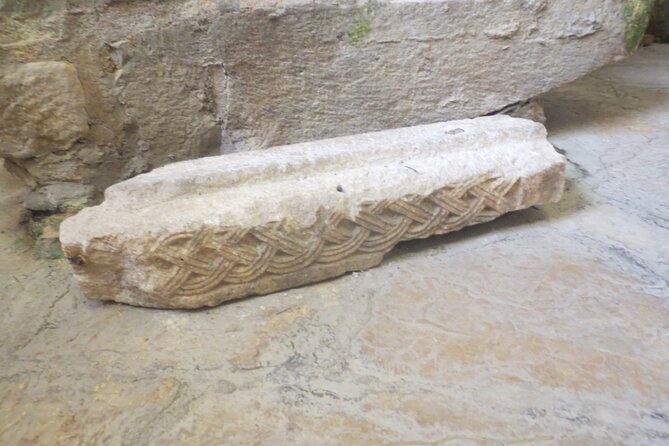
Five Wells Square offers one of the clearest practical stories on the route. The square sits between the medieval city walls and the Renaissance bastion called Grimani. Its five stone wells line up in a row, exactly as the name promises.
In the Middle Ages, a defensive ditch lay below the old walls. During the 16th century, Venetian authorities helped Zadar withstand Turkish sieges by building a large cistern with five ornamental wellheads. The wells were not decoration alone. They helped secure water when the city was under pressure.
This is the kind of stop I value on a walking tour. You see an attractive square, then learn that it was part of a serious defense system. The story also explains why water was such a vital concern in a walled city.
Queen Jelena Madijevka Park above the bastion
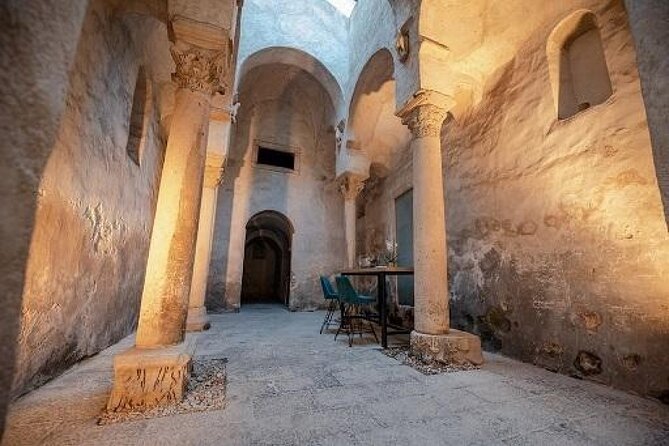
Next comes Queen Jelena Madijevka Park, built on top of the Grimaldi bastion. Creating a public garden on a military structure was an unusual choice, but it gave Zadar an important green space.
The park was founded in 1829 by Austrian commander Baron Franz Ludwig von Welden, a botanist interested in Dalmatian plant life. It was the first public park in Dalmatia.
This stop changes the pace. After churches, walls, and old stone streets, you get a little room to breathe. The tour allows around ten minutes, enough to understand the park’s unusual origin and see how the city adapted a defensive site for public use.
If you visit during a hot part of the day, the shade may be welcome. One person found the walking uncomfortable in warm September weather, with little breeze between buildings. The park helps, but you should still bring water and wear sensible shoes.
Zadar Market, fish, produce, and Pag cheese
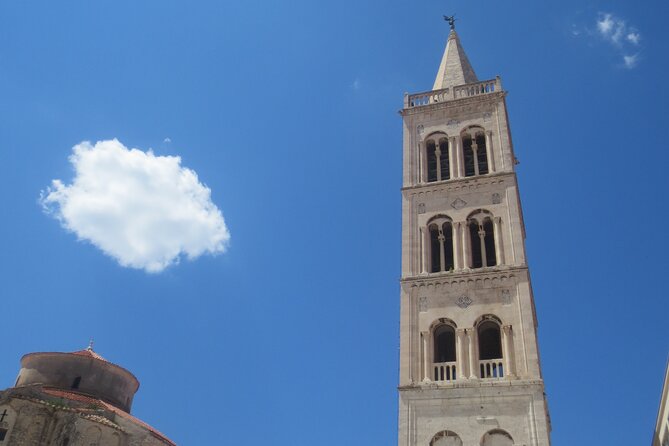
The main green market is one of the most useful stops for anyone who wants to experience Zadar beyond monuments. Locals call it Tržnica or Pijaca. The market includes open-air produce stalls and a covered fish market, with fruit, vegetables, fresh fish, meat, local products, and souvenirs.
The market has occupied its current location since 1952, though Zadar’s main market once operated near the ancient Roman Forum. That long connection with food and trade gives this part of the tour a different feel from the churches and ruins.
A guide can point out what is local and what makes a good purchase. Several tour accounts also describe a cheese tasting, especially Pag cheese, at a well-known cheese shop. Since the formal stop information does not promise a tasting at every departure, treat it as a possible feature rather than a guaranteed inclusion.
This is where the tour feels most personal. Guides such as Hajdi Josic and Jasmina were praised for combining the market visit with food advice. You can ask where to eat, what to try, and where to shop during the rest of your stay. That practical help may be worth as much as the historical commentary.
St. Chrysogonus and a vanished Benedictine abbey
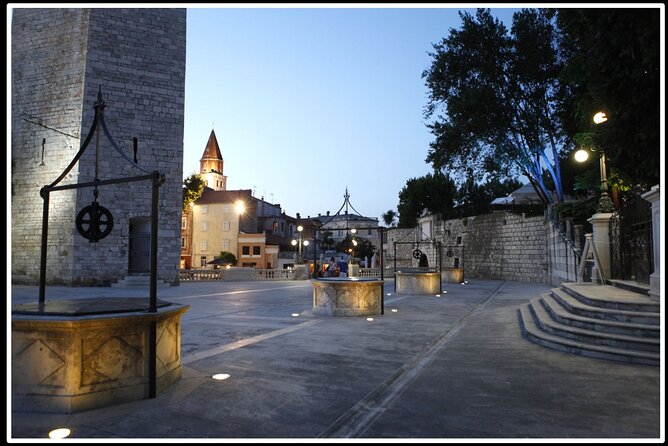
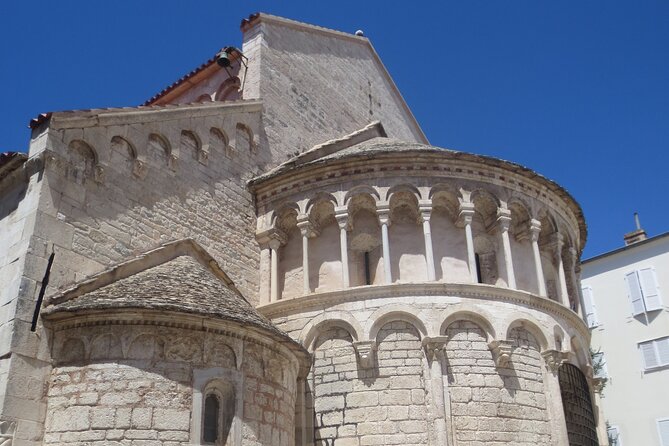
The Church of St. Chrysogonus, or St. Krševan, is a Romanesque church consecrated in 1175 by Lampridius, Archbishop of Zadar. It was built on the site of a Roman emporium and replaced a church dedicated to St. Anthony the Hermit.
The church is the only remaining part of a large medieval Benedictine abbey. That fact gives the building extra weight. You are not looking at an isolated monument, but at a surviving fragment of a much larger religious complex.
The church also has a royal connection. Elizabeth of Bosnia, the murdered queen dowager of Hungary and Dalmatia, was secretly buried here in 1387. Her body remained for three years before being moved to the basilica at Székesfehérvár.
A bell tower was begun in 1485 but left unfinished in 1546. Unfinished work can be as revealing as completed architecture. It hints at changing fortunes, shifting priorities, and the long, uneven process of building a city.
Cathedral of St. Anastasia
Zadar’s cathedral dates from the 12th and 13th centuries. Its facade is richly decorated, while the interior has three naves and remnants of frescoes in the side apses.
The cathedral suffered severe bombing during the Second World War and was later rebuilt. On the altar in the left apse is a marble sarcophagus containing the relics of St. Anastasia. The choir has finely carved stalls.
The visit is listed at only about five minutes, so expect a quick explanation rather than a long interior exploration. The cathedral may also be closed when you pass by. A glass vestibule lets you look inside when the doors are shut, which makes the stop worthwhile even if your timing is unlucky.
This is a good example of why a guide helps. You might notice the facade and move on, but the wartime damage, reconstruction, relics, and carved choir give the building much more meaning.
The Roman Forum and St. Donatus
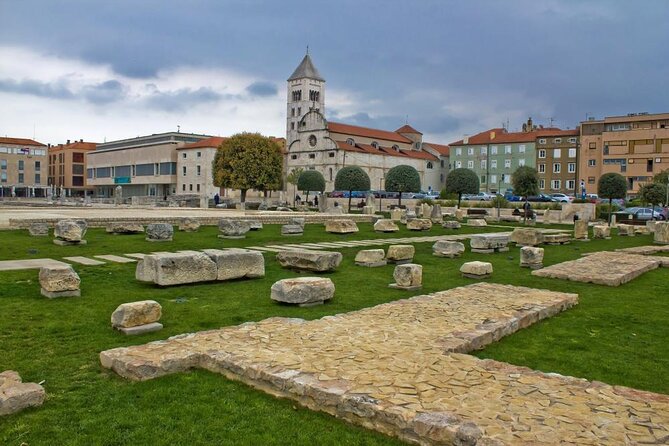
The route finishes near the ancient Roman Forum, built between the first century BC and the third century AD. Roman ruins appear in several parts of Zadar, sometimes in ways that seem almost accidental. Here, the remains form the setting for the city’s religious and civic center.
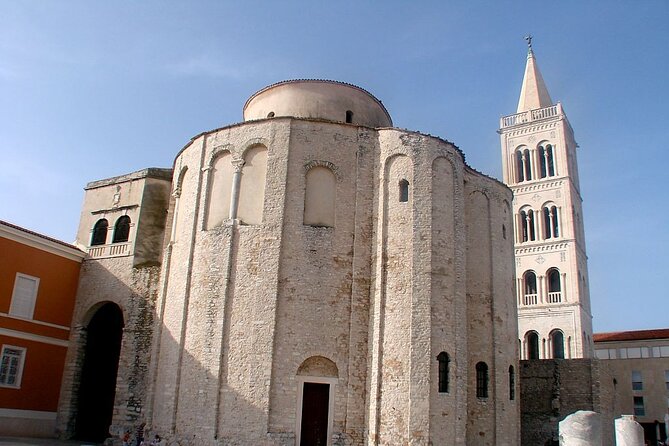
St. Donatus dominates one side of the Forum. The church dates from the early ninth century and is one of the most unusual buildings in Zadar. Its circular Byzantine-style design was commissioned by Bishop Donatus, after whom it was named.
The interior is spare. Two complete Roman columns were reused inside, and paving slabs from the Forum were revealed when the original floor was removed. This reuse of older materials is part of Zadar’s story. Each era built over, borrowed from, or adapted what came before.
St. Donatus has not been used for regular worship for about 200 years. Today it may serve as a concert hall or exhibition space. The tour allows about seven minutes here, enough to explain the structure and its place beside the Forum. If you want a longer look, ask about returning later.
The itinerary lists St. Donatus twice, first as the Forum setting and then as the church itself. In practical terms, these are two connected parts of the same final stop.
What the guides add to the walk
The guide makes the largest difference in this experience. The named guides include Melina, Jasmina, Sara, Lucinja, Inez, Angela, Mirena, Milena, and others. The most praised qualities are clear explanations, humor, local stories, and the ability to answer questions from both adults and children.
Melina was noted for taking time with a child’s questions. Sara was praised for fitting a lot of information into a short period. Jasmina was repeatedly described as funny, friendly, and good at pointing out less obvious places. Lucinja was singled out for local stories and historical context.
The experience is not built around theatrical performance. It is a compact city walk, so the guide must keep the pace moving. That works well for most people, though anyone wanting long time inside each church may find the schedule brisk.
Groups can reach 30 people. Some departures may be much smaller, including one evening walk with six people and another with only one participant. A small group makes it easier to ask questions, but the group size can vary by date.
Price, timing, and practical fit
At $18.14, this is a reasonable introduction to Zadar. All listed stops have free admission, so you are paying mainly for the guide’s time, route planning, historical explanation, and local recommendations.
The tour lasts about 100 minutes and offers three morning or afternoon departure choices. That flexibility helps you fit it around a meal, ferry plan, or other old-town visit. Since the route is on foot and passes through historic streets, comfortable shoes are sensible.
The experience is offered in English and uses a mobile ticket. It is near public transportation, service animals are allowed, and most people can participate. The tour ends back at Narodni Trg, which is convenient if you want to continue exploring from the same central point.
Free cancellation is available up to 24 hours before the start time for a full refund. Changes or cancellations made less than 24 hours ahead are not accepted for a refund.
Who should book this Zadar walk?
I would choose this tour if you are visiting Zadar for the first time, especially if you want history without a long museum visit. It also suits families, since the route includes visible ruins, wells, markets, and churches rather than relying only on lectures.
History fans will appreciate the range of periods. Food-minded visitors will like the market and possible Pag cheese tasting. The tour also helps if you have already wandered the old town and want to understand what you saw.
I would be more cautious if you dislike group walks, hot weather, or a fixed pace. The route covers many places quickly, and several stops are short. You should also check the meeting instructions carefully, since finding the guide was a problem for at least one person.
Should you book it?
Yes, if you want a practical first introduction to Zadar at a modest price. The 4.9 rating from 119 reviews and 98 percent recommendation rate reflect what this tour does best: it connects the city’s main sights, adds useful food advice, and gives you stories you would likely miss alone.
Book it early in your stay, ideally in the morning or early afternoon, so you can use the restaurant and shopping tips later. If your priority is a slow, detailed visit inside every church, choose a private guide or plan return visits afterward. For most first-time visitors, this is a smart, efficient way to get oriented.
FAQ
How long does the Zadar Walking Tour last?
The tour lasts approximately 1 hour and 40 minutes.
How much does the tour cost?
The listed price is $18.14 per person.
Where does the tour begin?
It begins at People’s Square, Narodni trg, in Zadar.
Where does the tour finish?
The activity ends back at the meeting point on Narodni Trg.
Is the tour offered in English?
Yes. The tour is offered in English.
What sights are included?
The route includes Narodni Trg, St. Lawrence Church, St. Simeon’s Church, Five Wells Square, Queen Jelena Madijevka Park, Zadar Market, St. Chrysogonus Church, the Cathedral of St. Anastasia, the Roman Forum, and St. Donatus Church.
Is cheese tasting included?
Pag cheese tasting is described as part of some tour experiences, but it is not clearly guaranteed for every departure in the provided tour details.
How large can the group be?
The maximum group size is 30 people.
Can I cancel for a full refund?
Yes. You can cancel at least 24 hours before the experience begins for a full refund. Cancellations or changes made less than 24 hours before the start time are not accepted for a refund.
More walking tours in Zadar
- Dubrovnik: Old Town Walking Tour
★ 4.8 · 5,174 reviews - Split: Old Town and Diocletian Palace Walking Tour
★ 4.9 · 4,727 reviews - Dubrovnik Discovery Old Town Walking Tour
★ 5.0 · 4,458 reviews - Walking Tour of Split and Diocletian’s Palace
★ 5.0 · 2,588 reviews
Just added in Zadar
- Zadar: Virtual Reality Guided History Walking Tour★ 4.4 · 86 reviews
- Zadar: River Zrmanja Guided Kayak Safari & Waterfalls★ 4.8 · 132 reviews
- Zadar: Zrmanja River Kayaking, with optional transfer from Zadar★ 4.5 · 166 reviews
- Zadar: Sunset Boat Tour with Aperol Spritz★ 4.9 · 125 reviews
- Zadar: Sunset Cruise on Traditional Boat with Wine★ 4.8 · 168 reviews
- Zadar: Sunset Boat Tour★ 4.9 · 72 reviews
- Private Sailing Tours in Zadar Archipelago★ 5.0 · 102 reviews
- From Zadar: Full day sailing tour★ 4.5 · 158 reviews
Walking Tours, compared.
Walking Tour of Split and Diocletian’s Palace
Read our review →

Krka Waterfalls tour with Trogir Walking tour and Krka panoramic boat cruise
Read our review →
City Walls Early Morning or Sunset Walking Tour
Read our review →
Browse the lists this tour appears in