
Reviewed · HISTORICAL TOURS
Split Walking Tour with Professor of History
Split’s old town is not a museum behind velvet ropes. It is a living city built inside and around Diocletian’s Palace, where Roman walls frame cafés, shops, homes, and narrow lanes. This tour makes that unusual setting easier to read, with a history professor leading you from the harbor through the Palace and into modern Split.
I like the strong historical focus and the way the route connects Roman, medieval, Napoleonic, and Croatian stories. I also like the practical extras, including food, ATM, and onward travel advice shared by guides such as Mario. The main consideration is pace: although advertised at about 2 hours 20 minutes, the tour can run closer to three hours, and much of it takes place standing outdoors.
Key points at a glance
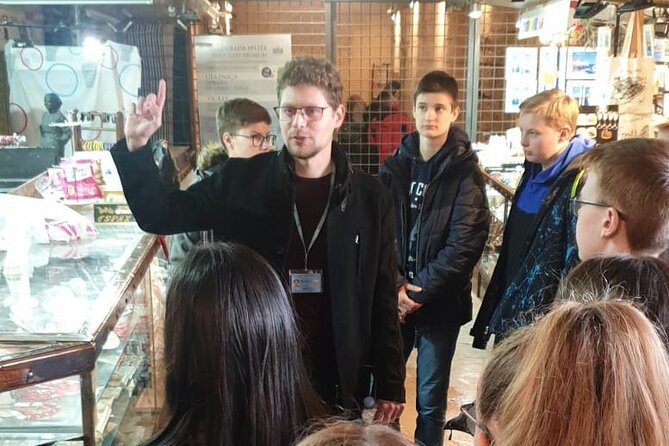
- A professor-led route through Split’s Roman core: Learn how Diocletian’s Palace became the center of today’s city.
- Eleven stops with useful variety: The walk includes the Riva, palace cellars, temples, gates, squares, and public streets.
- Mario and Anita bring different strengths: Expect clear history, humor, local pride, and practical advice.
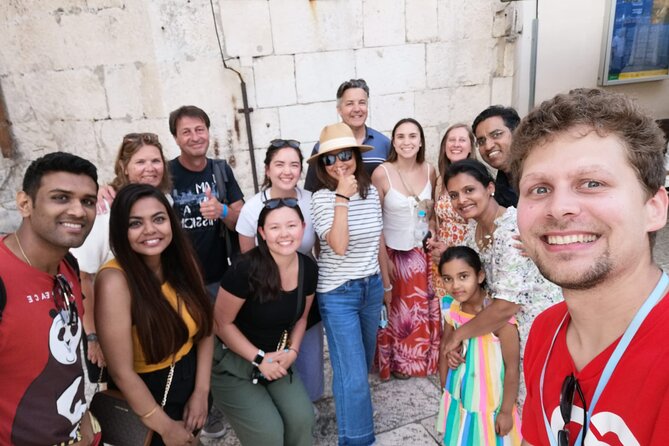
- Small groups help: The maximum is 17 people, with more personal attention than a large coach tour.
- The cathedral and Temple of Jupiter are exterior visits: Entry fees are not included, so you can return later if you want a closer look.
- Good value at $24.19: You get a long, history-heavy introduction to Split without paying admission charges along the route.
Why a history professor changes the walk
The best reason to book this tour is not simply that it covers Diocletian’s Palace. You can walk through the Palace on your own. The value comes from having someone explain why a Roman imperial residence became the street plan of a modern Croatian city.
Mario is repeatedly described as funny, warm, and exceptionally well prepared. His style mixes dates and political events with trivia, local customs, current issues, and the occasional bit of earthy humor. Anita brings a similar sense of care, with a clear pride in Croatia and a thoughtful way of managing a group.
That mix matters in Split. Roman ruins can blur together when you see them without a story. A professor can point out the role of the Emperor, explain the original function of a hall, and then show you how later generations changed the building. You leave with a framework, not just a collection of photographs.
The group size is capped at 17 people. That is still large enough that you may need to stay close and listen carefully in busy parts of the old town, but it is much more manageable than a large sightseeing group. Guides have also been praised for keeping people in the shade when possible and moving the group along instead of leaving everyone in one place too long.
Other guided walks in Split:
- Split: Old Town and Diocletian Palace Walking Tour
★ 4.9 · 4,727 reviews - Walking Tour of Split and Diocletian’s Palace
★ 5.0 · 2,588 reviews - Krka Waterfalls tour with Trogir Walking tour and Krka panoramic boat cruise
★ 5.0 · 1,659 reviews
Starting beside the Riva at the Brass Gate
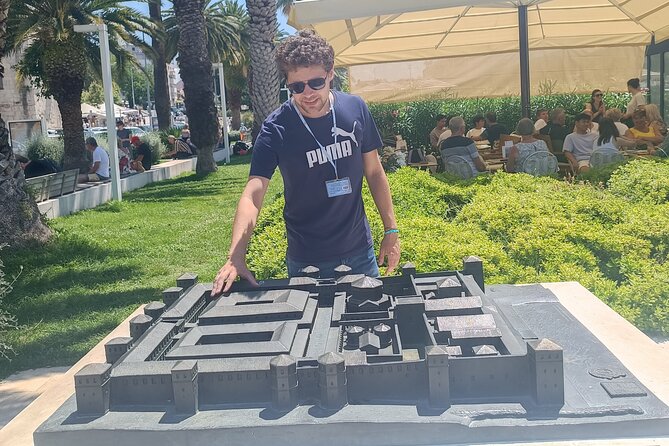
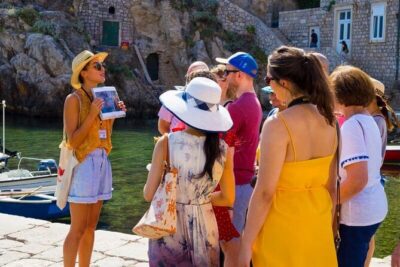
The meeting point is the Brass Gate, also called Porta Aenea, at Obala Hrvatskog narodnog preporoda 22. The tour opens on the Riva, Split’s waterfront promenade, beside a model of the Palace.
This is a smart starting point. The Riva is not only a pretty harbor walk. It is where local public life happens, with people meeting for coffee, enjoying the sun, and watching the waterfront. Beginning here gives you a quick sense of present-day Split before the guide turns back to the Roman past.
Allow a little time to find the exact meeting point. The old center has several gates and many lanes, so arriving early is sensible. Since the activity ends back at the meeting point, you can easily continue along the waterfront or return to another part of the old town afterward.
The opening section lasts about 15 minutes and costs nothing beyond the tour fee. It also helps set up an important idea: Split is not a separate ancient site outside town. The Palace is the town.
Below Diocletian’s Palace in the substructures
From the waterfront, the group enters the substructures of Diocletian’s Palace. These basement halls are among the best-preserved ancient complexes of their kind and helped earn Split’s historic center UNESCO World Heritage status in 1979.
The substructures are especially useful for understanding the Palace above. They preserve the shape and organization of the imperial complex, while later construction has made other sections harder to read. Your guide can connect the lower rooms to the emperor’s residence and show why these spaces matter beyond their dramatic stonework.
The scheduled visit lasts about 15 minutes. That is enough for an introduction, though not enough for every corner or a slow architectural study. Entry is listed as included, with no extra admission charge on this route.
If you want a longer look at the cellars, ask about returning later. The tour is designed as an overview, and the guide’s explanations may help you decide which paid interiors deserve more of your time.
The Peristyle and the power of the emperor
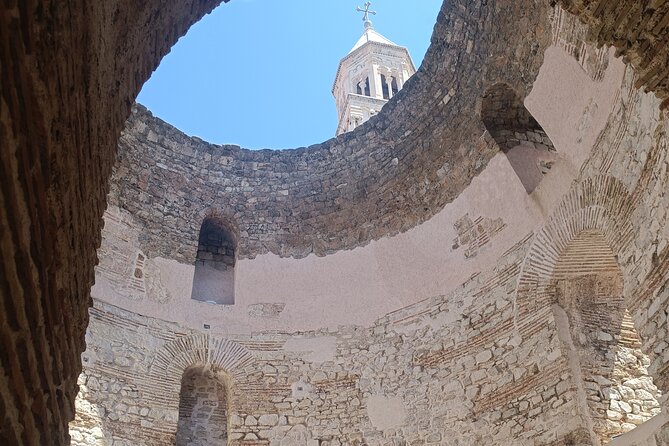
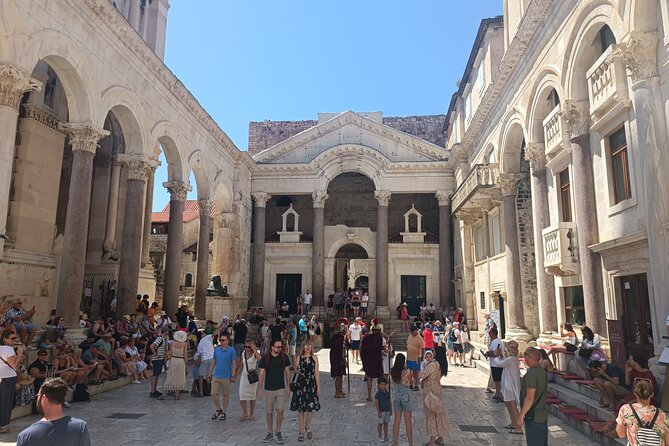
The Peristyle is the central square of the Palace and one of the walk’s key moments. This was not a casual courtyard. It was a stage for imperial power, where Diocletian appeared beneath the central architrave as the living son of Jupiter.
The guide explains how subjects approached the emperor, kneeling, kissing the edge of his scarlet cloak, or lowering themselves fully to the ground. That detail makes the space easier to imagine. The columns and stone are impressive, but the political theater is what gives the square its force.
The stop lasts about 10 minutes. You will probably wish for more time to look around, but this is also one of the places where several groups may gather. Listen closely, then take your own photographs after the explanation.
Same base, a different kind of day out:
- Split: Krka Waterfalls Trip with Boat Cruise and Swimming
★ 4.8 · 10,519 reviews - From Split: Krka Waterfalls, Food & Wine Tasting Tour
★ 5.0 · 9,326 reviews - Blue cave, Mamma Mia and Hvar, 5 islands speedboat tour
★ 5.0 · 7,150 reviews - From Split: Krka Waterfalls, Food & Wine Tasting Tour
★ 4.9 · 6,598 reviews
Vestibule, the round entrance to imperial life
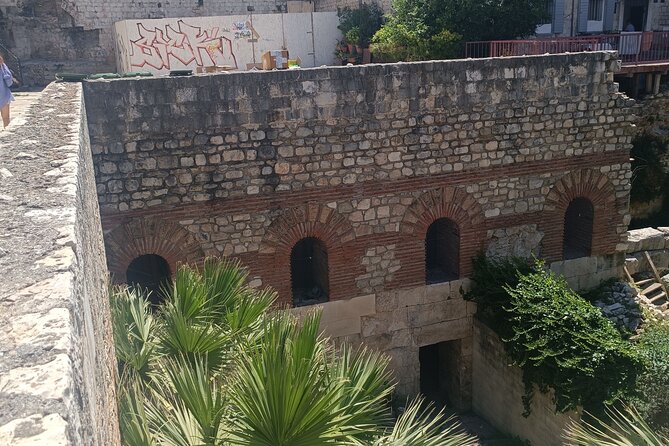
The next stop is the Vestibule, also called the Rotonda. It was the first section of the imperial corridor leading from the Peristyle toward the private apartments.
The circular hall was built by the beginning of the fourth century. It once had a dome, reached about 17 meters in height, and measured about 12 meters across. Its purpose was formal and selective, designed for important audiences such as ambassadors rather than ordinary daily traffic.
This is a short, 10-minute stop, but the scale helps you understand the Palace as a working imperial residence. The guide can explain how movement through the complex was controlled, from public ceremony to restricted access.
Saint Domnius and the layers of Split’s faith
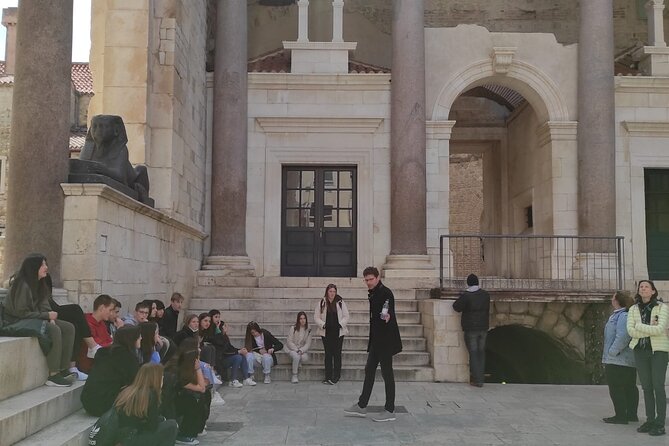
The Cathedral of Saint Domnius is examined from outside, and admission is not included. That limitation is worth knowing before you arrive, especially if you want to climb, enter, or spend time inside the cathedral later.
The building has had several lives. It began as a Roman temple and mausoleum, then became a church. That change captures the wider story of Split, where Roman structures were adapted rather than simply cleared away.
The scheduled stop is about 20 minutes, one of the longer pauses on the route. Use it to ask questions about what you are seeing and to note the guide’s advice if you plan to return for the paid interior. You get an explanation here, not an entry visit.
Jupiter, Saint John, and the narrowest street
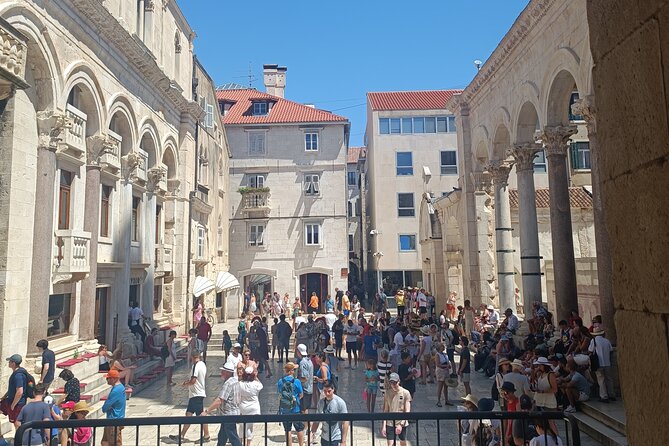
The Temple of Jupiter offers another clear example of change over time. Jupiter was the Roman sky and thunder god and the supreme figure in Roman religion. Later, the temple was converted into a baptistery dedicated to Saint John the Baptist.
Again, the tour stays outside, and admission is not included. That keeps the price low, but it means the experience is best for orientation rather than a full examination of the interior.
On the way to the Golden Gate, the group passes through Let Me Pass Street, a very narrow lane between the ancient temple and a medieval building. Local people believe it is the narrowest street in the world. Treat that claim as local lore, but enjoy the lane for what it is: a compact reminder that Split grew layer by layer around its oldest walls.
Through the Golden Gate and toward Gregory of Nin
The Golden Gate was the Palace’s northern entrance and the route used by Diocletian to enter the complex. It was more elaborate than an ordinary doorway, marking the emperor’s status.
The gate later lost columns and statuary and was sealed during the Middle Ages. It was reopened and repaired in modern times, which gives your guide another chance to explain how a Roman monument can be altered, forgotten, and brought back into public life.
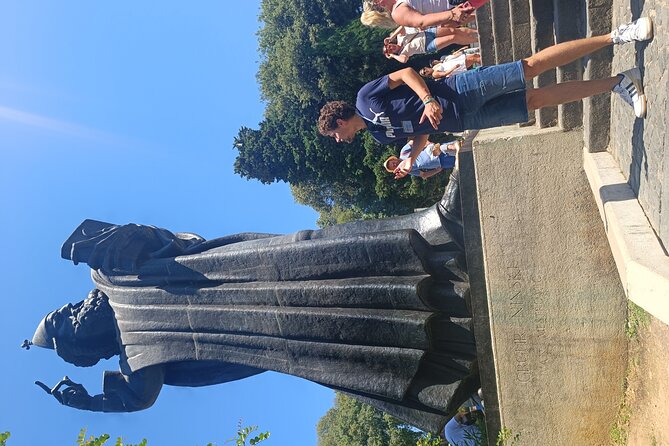
The stop lasts about 15 minutes. Afterward, the route reaches the 8.5-meter statue of Gregory of Nin by Croatian sculptor Ivan Meštrović. The statue’s toe is polished by generations of hopeful hands. Rubbing it is said to bring good luck, and the shiny surface makes the custom hard to miss.
This is a light moment after the heavier imperial and religious material. It also gives you a simple photo opportunity and a memorable piece of local visitor tradition.
Marmontova Street and the Prokurative
Marmontova Ulica shifts the story away from ancient Rome. Although Marshal Marmont was a conqueror, he is remembered in Split for helping urbanize Dalmatian cities. The street named for him is considered one of the city’s most attractive.
The walk then reaches Republic Square, better known as the Prokurative. Three sides of the square are lined with elaborate neo-Renaissance buildings, creating a broad open space that feels very different from the tight Roman lanes.
These two stops are useful because they prevent the tour from treating Split as only an ancient city. You see later political influence and a more open urban style. Each stop lasts around 10 minutes, giving you enough time for context without turning the walk into a long architectural lecture.
Ending at Fruit Square with local life and food
The final stop is Fruit Square, or Trg Braće Radić. Its name recalls the women who once sold fruit there. The square is small and attractive, and the guide points out monuments including the statue of Marko Marulić, often called the father of Croatian literature.
This is a good place to finish because the subject turns naturally to Croatian history, food, and daily life. Guides such as Mario are also known for giving advice on where to eat, which places to avoid, which banks or ATMs to use, and what to do next in and around Split.
The tour ends back at the meeting point, so you can use those recommendations immediately. You may also want to return to the cathedral, Temple of Jupiter, or palace interiors after deciding which sites deserve an admission fee.
Price, pace, and practical value
At $24.19 per person, this is a strong price for a 2-hour-20-minute introduction led by a trained history teacher. The route covers eleven locations, and the listed stops do not add admission charges. That makes the fee pay for interpretation, organization, and local guidance rather than a bundle of entry tickets.
The main cost is your time and energy. One person noted that the walk lasted closer to three hours, longer than advertised. That may be welcome if you enjoy history, but it can matter if you have a cruise departure, a meal booking, or a hot afternoon ahead.
Wear comfortable shoes and be ready for uneven old-town surfaces. The tour requires good weather, and poor weather can lead to a different date or a full refund. Free cancellation is available up to 24 hours before the start time. Service animals are allowed, public transportation is nearby, and most people can take part.
You can also upgrade to a private tour if you want a more personal format. The standard tour is offered in English and accepts a maximum of 17 people.
Who should book this Split walking tour?
I would choose this tour for a first visit to Split, especially if you want the city’s Roman remains explained rather than simply photographed. It suits people who enjoy dates, political history, architecture, and stories about how old buildings remain part of daily life.
It is also a good match if you like practical advice. The food, banking, and onward travel tips can save time after the walk, while the route gives you a useful map of the old center.
I would think twice if you dislike standing outdoors, prefer a short highlights walk, or want interior access to every major site. The cathedral and Temple of Jupiter are exterior stops, and the tour may run long. For everyone else, $24.19 buys a lively and well-organized introduction to Split, with enough detail to make the old town far more readable.
FAQ
Where does the Split walking tour begin?
The tour begins at the Brass Gate, also called Porta Aenea, at Obala Hrvatskog narodnog preporoda 22 in Split.
Where does the tour end?
The activity ends back at the meeting point.
How long does the tour last?
The stated duration is approximately 2 hours and 20 minutes. It can run closer to three hours, so leave extra time afterward.
What language is the tour offered in?
The tour is offered in English.
How many people can join the standard tour?
The maximum group size is 17 people.
Is a private tour available?
Yes. You can upgrade to a private tour for a more personal experience.
Are admission fees included?
All fees and taxes are included, and the listed route does not charge admission at the Riva, substructures, Peristyle, Vestibule, Golden Gate, Gregory of Nin statue, Marmontova Street, Prokurative, or Fruit Square. The Cathedral of Saint Domnius and Temple of Jupiter are outside visits, and their admission is not included.
Is the tour suitable for most people?
Most people can participate. Service animals are allowed, and the route is near public transportation.
What happens if the weather is poor?
The experience requires good weather. If it is canceled because of poor weather, you will be offered another date or a full refund. You can cancel for a full refund up to 24 hours before the start time.
More Historical Tours in Split
- Split: History and Heritage Walking Tour
★ 4.9 · 650 reviews - Split History and Gastro Small-Group Tour with Food and Drinks
★ 5.0 · 375 reviews - SPLIT-PREMIUM Emperor’s Walking Tour for History Lovers + Museum
★ 5.0 · 333 reviews - Split: Local History and Culture 90-Minute Walking Tour
★ 5.0 · 194 reviews
More walking tours in Split
- Split & Diocletian’s Palace Walking Tour
★ 5.0 · 1,125 reviews - Walking Tour of Split with a ‘Magister’ of History
★ 5.0 · 1,122 reviews - Split: Diocletian Palace & Old Town Guided Walking Tour
★ 4.7 · 882 reviews - From Split: Krka Waterfalls Cruise & Trogir Walking Tour
★ 4.7 · 681 reviews
Just added in Split
- Discover The Old Town Split 1.5h walking Small group tour★ 4.8 · 93 reviews
- From Split: Zagreb Transfer & Plitvice Lakes Tour★ 4.7 · 131 reviews
- Blue Cave, Komiža, Stiniva Bay, Budikovac, Hvar Split Island Boat Tour★ 5.0 · 53 reviews
- Split to Dubrovnik Private transfer 1-8 pax (Door to Door any location)★ 5.0 · 118 reviews
- From Sinj: Panoramic Flight over Split★ 5.0 · 14 reviews
- **Private Door to Door Airport Split Transfer up to 15 People**★ 5.0 · 136 reviews
- Sinj: Panoramic Flight over Peruca Lake and Dinara mountain★ 5.0 · 9 reviews
- The Diocletian route – Panoramic Flight over Split★ 5.0 · 9 reviews
Historical Tours, compared.
Walking Tour of Split with a ‘Magister’ of History
Read our review →
Split History and Gastro Small-Group Tour with Food and Drinks
Read our review →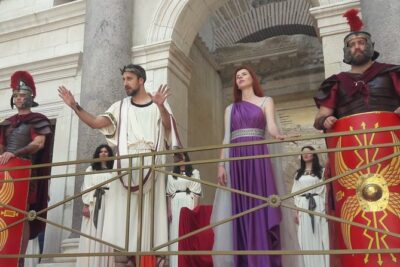
PREMIUM Emperor’s Walking Tour for History Lovers + Museum
Read our review →
Local History and Culture 90-Minute Walking Tour
Read our review →Browse the lists this tour appears in