
Reviewed · HISTORICAL TOURS
Split Walking Tour with History Professor
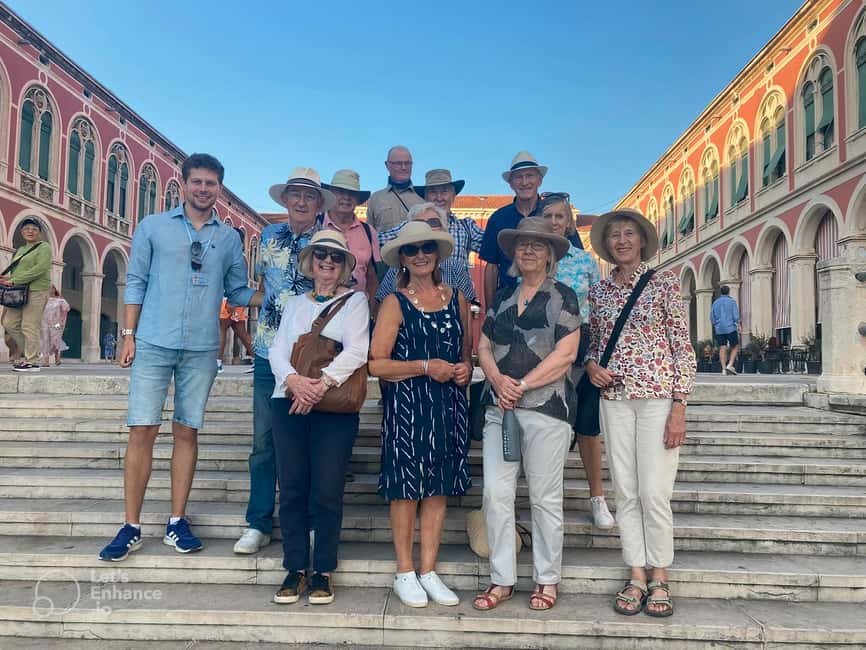
Split’s Roman Palace is only the beginning. This walking tour with history professor Mario takes you from Diocletian’s fourth-century complex into medieval lanes, Venetian-influenced squares, Napoleonic-era streets, and modern Split. I like the wider time frame, and I like that Mario teaches through questions and conversation rather than delivering a flat speech. The main consideration is pace: two hours is enough for a strong introduction, but not enough to linger at every stop or include the admission fees for the Cathedral and Temple of Jupiter.
The small-group format should feel more personal than a large city tour, and private tours are available by request. I also appreciate the practical meeting point beside the Brass Gate, the clear route through the old center, and the easy price of $23 per person. Wear comfortable shoes, since this is a walking tour on historic streets, and note that the route is not suitable for wheelchair users.
Key points at a glance
- Roman Split beyond the postcard view: See the Palace substructures, Peristyle, Vestibule, Cathedral, and Temple of Jupiter.
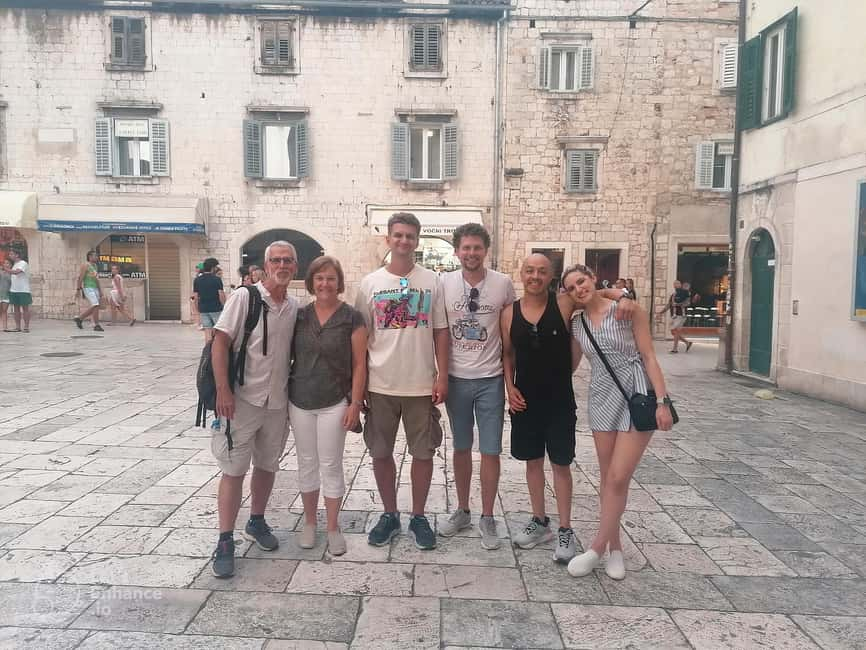
- A professor as your guide: Mario brings a teacher’s approach, encouraging questions and explaining events across several periods.
- Three layers of the city: The route connects Roman, medieval, and modern Split rather than stopping at Diocletian’s Palace.
- Game of Thrones and local stories: Expect filming locations, legends, curious details, and glimpses of everyday Split.
- A useful two-hour orientation: The walk covers many central landmarks, making it a good first activity in town.
- Good value at $23: The tour includes the guided walk, while entry to the Cathedral and Temple of Jupiter costs extra.
Why this walk gives you more than Diocletian’s Palace
Many visitors come to Split for Diocletian’s Palace and leave with a few impressive photographs but only a loose idea of how the city fits together. This tour helps you see the Palace as the oldest layer of a living town.
I like that the route moves outward from the Roman core. You begin with Diocletian, but then follow Split through medieval growth, Venetian influence, Ottoman pressure, Napoleon’s period, and modern urban life. That wider story makes the old stones easier to understand. The Palace is not simply a monument set apart from the city. It is part of the city center, with streets, shops, squares, homes, and daily movement inside and around it.
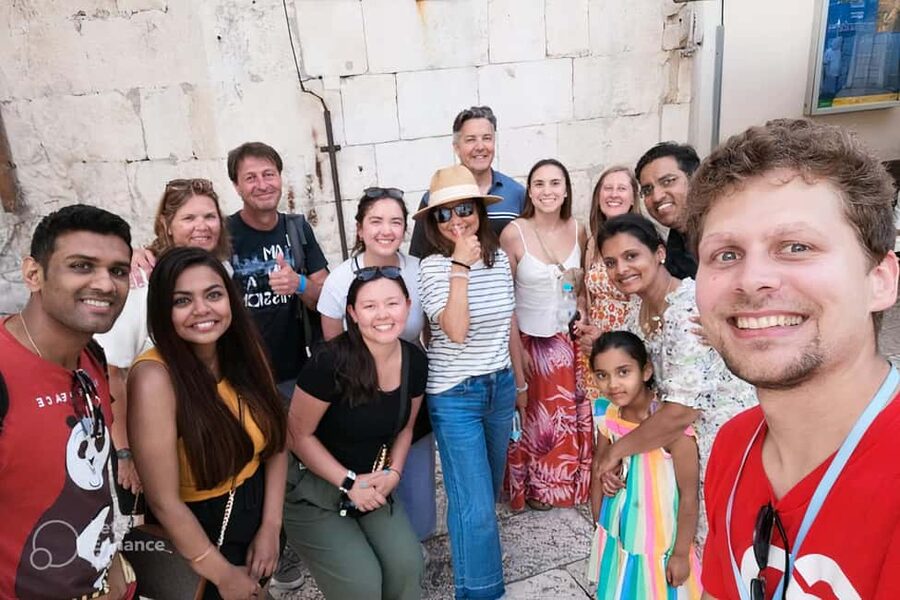
Mario’s style also suits travelers who want more than dates and names. He is a history professor, and his method includes asking questions and drawing the group into the subject. That can make a big difference on a warm day when a long lecture would begin to blur together. His humor and enthusiasm are part of the experience, but the strong point is the way he connects facts to places you can see.
The tour is listed as two hours, while the experience description refers to two hours and fifteen minutes. Plan for roughly two hours, with some flexibility depending on the group and the time spent at each stop. The listed stops add up to a substantial portion of that time, so you should expect an overview rather than a slow study of every building.
Other guided walks in Split:
- Split: Old Town and Diocletian Palace Walking Tour
★ 4.9 · 4,727 reviews - Walking Tour of Split and Diocletian’s Palace
★ 5.0 · 2,588 reviews - Krka Waterfalls tour with Trogir Walking tour and Krka panoramic boat cruise
★ 5.0 · 1,659 reviews
Starting at the Riva and the city model
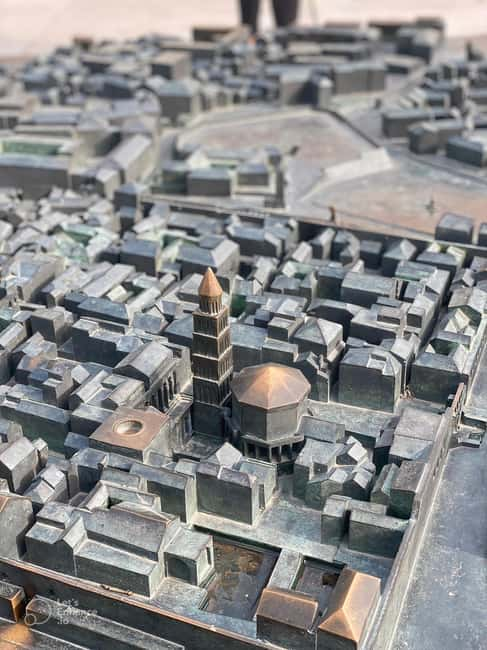
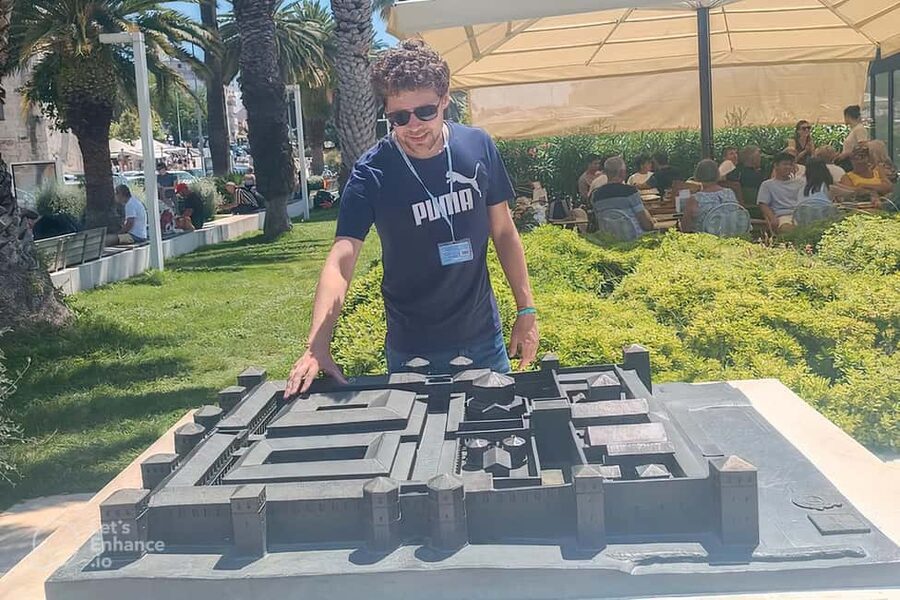
The walk begins at a model of Split’s historic center near Riva Harbor. This is a smart starting point because the compact shape of the old city can be hard to grasp once you are inside its narrow lanes.
Use this first stop to get oriented. The model gives you a visual sense of the Palace, the waterfront, the gates, and the surrounding center before the walk becomes more detailed. I find that a map or model is especially useful in Split because the Roman plan has been altered and built over many times.
The official meeting point is beside the Brass Gate of Diocletian’s Palace. Give yourself enough time to find it, since the old center has several gates and the waterfront can be busy with people coming and going. The guide waits there, so you do not need to arrange transport between stops.
Beneath the Palace at the substructures
The Palace substructures are one of the clearest places to see how Diocletian’s complex was built. The underground rooms supported the upper palace and preserve the basic arrangement of the Roman plan.
You will spend only about five minutes here, so expect an introduction rather than a detailed underground visit. That short stop still matters. It gives you a sense of the Palace’s scale and helps explain why the streets above follow such a strong grid.
This is also where a guide earns the fee. Without context, underground stone rooms can look alike. Mario can connect the lower spaces with the rooms and courtyards above, helping you read the Palace as a planned residence rather than a collection of disconnected ruins.
Peristyle: the Palace’s grand public heart
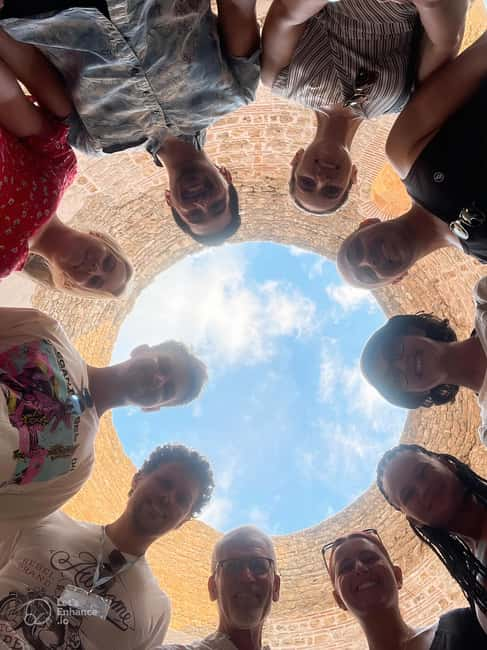
The Peristyle is one of the tour’s central moments. This open court formed the ceremonial heart of Diocletian’s Palace, and its columns and surrounding buildings show the formal side of Roman power.
You have about ten minutes here. That is enough time for an explanation, photographs, and a few questions, but not a long architectural study. Listen for the way the space worked as part of the imperial residence, then look at how later Split grew around it.
The appeal of the Peristyle is its layering. Roman stone, later religious use, and present-day city life occupy the same space. You are not looking at a sealed archaeological site. People move through it as part of ordinary Split, which makes the history feel close and physical.
Same base, a different kind of day out:
- Split: Krka Waterfalls Trip with Boat Cruise and Swimming
★ 4.8 · 10,519 reviews - From Split: Krka Waterfalls, Food & Wine Tasting Tour
★ 5.0 · 9,326 reviews - Blue cave, Mamma Mia and Hvar, 5 islands speedboat tour
★ 5.0 · 7,150 reviews - From Split: Krka Waterfalls, Food & Wine Tasting Tour
★ 4.9 · 6,598 reviews
The Vestibule and the Cathedral of Saint Domnius
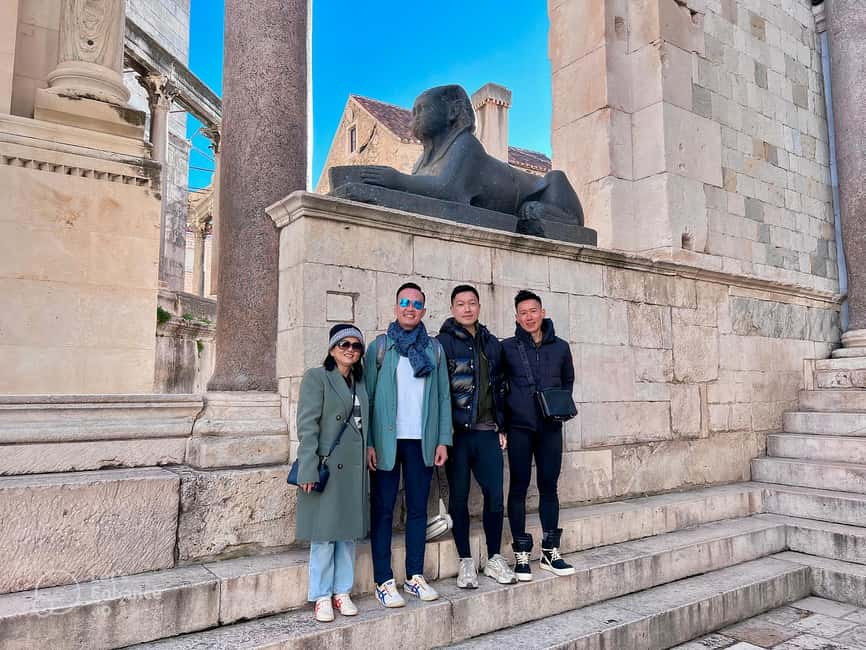
The Vestibule follows with another ten-minute stop. Its circular form and unusual design make it one of the Palace’s memorable interiors or passage spaces, and it helps you understand how the emperor’s residence was organized.
The Cathedral of Saint Domnius receives about twenty minutes, the longest single stop on the route. The building is especially important because it combines Roman and Christian history in one place. A structure associated with Diocletian’s Palace later became a cathedral, showing how Split’s identity changed without erasing the earlier city.
Admission to the Cathedral is not included. That matters when you compare the $23 tour price with the total cost of your morning. You may still find the stop worthwhile if you want to see the interior, but the tour can explain the cathedral from outside if you prefer not to pay for entry.
The time here also gives you a chance to ask about the relationship between Diocletian, the Palace, and the later Christian city. Mario’s teaching approach is most useful at places like this, where a simple date does not explain the full story.
Jupiter’s Temple and the shift from Roman religion
The Temple of Jupiter is another ten-minute stop, with admission also excluded. It adds a religious dimension to the Palace and helps place the Roman emperor’s world in its proper setting.
The temple is a useful contrast with the Cathedral. One stop reflects Roman religious life, while the other shows the later Christian use of the Palace. You do not need a specialist background to follow the change, but a guide can point out why the two places belong in the same story.
Because the entry fee is separate, decide in advance how much paid sightseeing you want to do. The tour itself remains inexpensive, but the extras can add up if you enter every site along the way.
Golden Gate and Grgur Ninski
The Golden Gate receives about ten minutes. As one of the Palace’s major entrances, it gives you another way to understand the scale and defensive logic of the complex. Look for how the gate connects the Roman core with the streets beyond it.
The route then reaches the Grgur Ninski Statue for another ten-minute stop. The statue is tied to Croatian cultural identity and local tradition, and it offers a break from the Roman material. This is one of the places where the walk moves beyond imperial architecture and into the stories Split tells about itself.
The sequence works well. You first see the Palace as a Roman residence, then move through the gate and encounter a later cultural symbol. A tour that stayed only inside the Palace would miss this change in focus.
Marmontova Street and Prokurative
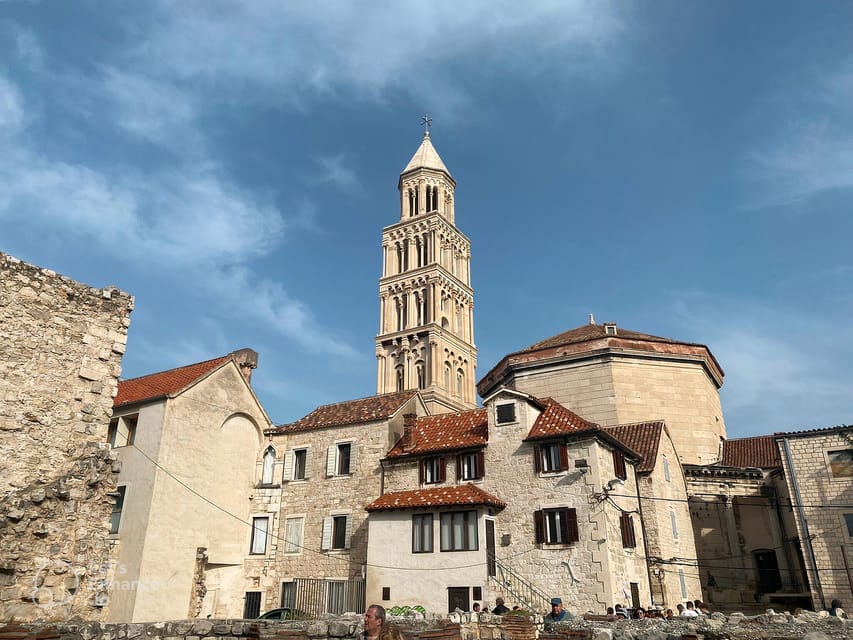
Marmontova Ulica brings you into modern Split. The street reflects the influence of Napoleon’s period and shows that the city’s story did not end with the Romans or the Middle Ages.
You have about ten minutes here. That may not sound long, but the stop helps break up the ancient monuments with a more recent part of the city. It also gives Mario a chance to explain how foreign powers and political changes shaped Split’s streets and public life.
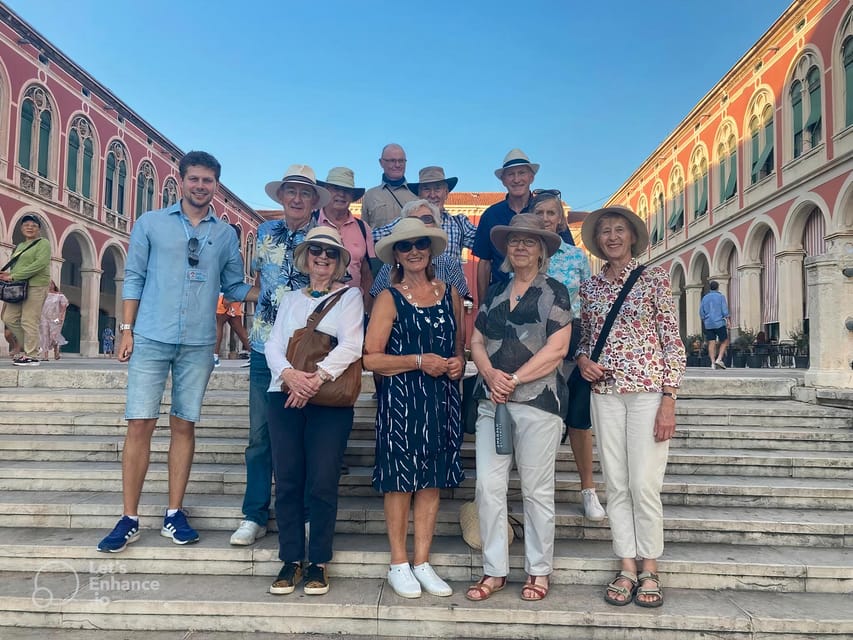
The next stop is Prokurative, officially known as Trg Republike. Allow about ten minutes. Its design and atmosphere offer another contrast with the tight Roman lanes. This is a useful place to see how Split developed public spaces in later centuries.
I like this part of the route because it prevents the tour from becoming a parade of ancient stones. You get a clearer sense of the city as a place that changed with each new period, rather than a museum frozen in the age of Diocletian.
Fruit Square, local legends, and Game of Thrones
The final listed stop is Fruit’s Square, or Trg Brace Radic, with about fifteen minutes. It is a fitting place to end because it brings together architecture, local life, and the city’s later identity.
Along the way, Mario includes Game of Thrones locations, local legends, and small details about Split today. The filming references are a bonus rather than the main purpose of the tour. If you are a fan of the series, they give familiar places an extra layer. If you are not, the historical and local material remains the reason to book.
The legends also help keep the walk human. Dates can explain when a building was made, but a local story can explain how people remember a place. Mario’s reported habit of asking questions should make these sections more interactive than a standard script.
At Fruit’s Square, you can look back at the route as a whole. You have moved from the waterfront and Roman foundations through imperial rooms, Christian buildings, medieval and later streets, and modern public spaces. That is a lot for one morning, but the route gives you a useful mental map.
How Mario teaches and why it matters
The most praised feature of this experience is Mario himself. His background as a history professor gives the tour a clear academic base, but his approach is not described as stiff or overly formal. He uses humor, enthusiasm, questions, and conversation to keep the group involved.
That combination is important. A guide can know a great deal and still make a poor walking tour if the delivery is hard to follow. Mario’s style appears better suited to people who enjoy asking questions and thinking about how one period led to another.
I would choose this tour if you want solid historical information without giving up personality. It should suit first-time visitors, couples, families with older children, and anyone who wants a useful introduction before exploring alone. Since the tour is appropriate for all ages, families can join, though children who dislike walking or historical explanation may need extra patience from parents.
The small-group setup is another advantage. It usually allows more room for questions than a large group, although the exact group size is not specified. Private tours are available on request through the provider, Lanterna, using the listed email address.
Is $23 a good value?
At $23 per person, I consider this a strong value if you want a guide who can connect several periods of Split’s past. You are paying for a structured walk through major landmarks, not for entry to every attraction.
The value comes from the range. A Palace-only tour might give you stronger detail on Roman architecture, but this route covers Roman, medieval, Venetian, Ottoman, Napoleonic, and modern influences. It also includes local legends and filming locations, which gives the history more variety.
Remember to budget separately for the Cathedral of Saint Domnius and the Temple of Jupiter if you want to enter them. The tour remains fairly priced even with that limitation, but the admission exclusion should be clear before you book.
The route is not suitable for wheelchair users. Wear comfortable shoes and comfortable clothes, since the experience is entirely a walking tour through the historic center. The guide speaks English.
Who should book this Split walking tour?
Book it if you want to understand how Split grew around Diocletian’s Palace rather than simply photograph the Palace and move on. It is especially useful at the start of your stay, when a guide can help you recognize the main gates, squares, streets, and historic layers.
I would also recommend it to history-minded visitors who prefer a lively teacher to a scripted tour. Mario’s questions and humor should suit you if you like interaction and want permission to ask about details along the way.
You might choose another option if you want a very slow archaeological visit, extensive interior time, or a fully private experience included automatically. This tour covers many places in about two hours, so its strength is breadth and explanation, not long periods at one monument.
Free cancellation is available up to 24 hours in advance, and you can reserve now while paying later. Those flexible terms are useful when your Split schedule may change, but the main booking decision is simpler: choose this walk if you want a well-organized introduction to the city from a local history professor.
FAQ
Where does the Split walking tour meet?
The guide waits next to the Brass Gate of Diocletian’s Palace. The route begins near a model of Split’s historic center at Riva Harbor.
How long does the tour last?
The activity is listed as lasting two hours, while the description refers to two hours and fifteen minutes. Check the available starting time when booking and plan for roughly two hours.
What language is the tour conducted in?
The live guided tour is conducted in English.
Who leads the walking tour?
The guide is Mario, a local history professor who leads the group through Roman, medieval, and modern Split.
Are entrance fees included?
Admission to the Cathedral of Saint Domnius and the Temple of Jupiter is not included. The guided walking experience is priced separately at $23 per person.
Is the tour suitable for children?
Yes. The tour is described as appropriate for all ages.
Is the route accessible to wheelchair users?
No. The activity is not suitable for wheelchair users. Comfortable shoes and comfortable clothing are recommended.
Should you book it?
Yes, if you want more than a quick look at Diocletian’s Palace. For $23, you get a broad, well-organized walk through Split’s Roman core, later streets, public squares, legends, and modern identity, led by a professor who uses humor and questions to keep the history moving.
The main tradeoff is limited time at each place and separate admission for two sites. Still, as a first introduction to Split, this tour gives you the context you need to explore the city with sharper eyes afterward.
More Historical Tours in Split
- Walking Tour of Split with a ‘Magister’ of History
★ 5.0 · 1,122 reviews - Split Walking Tour with Professor of History
★ 5.0 · 926 reviews - Split: History and Heritage Walking Tour
★ 4.9 · 650 reviews - Split History and Gastro Small-Group Tour with Food and Drinks
★ 5.0 · 375 reviews
Just added in Split
- From Trogir, Seget, Okrug: Krka Waterfalls & Šibenik Culture Tour★ 5.0 · 10 reviews
- Krka Waterfalls & Primošten from Trogir, Seget, Čiovo & Kaštela★ 5.0 · 18 reviews
- Slatine – Island Hopping Excursion (Trogir/Blue Lagoon/Shipwreck)★ 4.0 · 24 reviews
- Island Hopping Boat Excursion with Lunch (Trogir,Blue Lagoon, Šolta)★ 3.5 · 6 reviews
- From Split & Trogir: ATV Quad Tour on Island Čiovo★ 5.0 · 21 reviews
- Split: Sunset Guided Kayaking Tour★ 4.8 · 71 reviews
- Split Sunset Stand Up Paddle Tour★ 5.0 · 16 reviews
- Stand Up Paddle Tour in Split★ 4.7 · 17 reviews
Historical Tours, compared.
Walking Tour of Split with a ‘Magister’ of History
Read our review →

Split History and Gastro Small-Group Tour with Food and Drinks
Read our review →
PREMIUM Emperor’s Walking Tour for History Lovers + Museum
Read our review →
Browse the lists this tour appears in