
Reviewed · HISTORICAL TOURS
Split: Private Walking Tour in the Historical Town Center
Diocletian’s Palace is not a fenced-off ruin. It is the old center of Split, with homes, cafés, shops, churches, and narrow lanes built into and around a Roman emperor’s retirement palace. I like that this tour puts that unusual fact first, then shows you how Roman, medieval, Venetian, French, Austro-Hungarian, and Yugoslav layers fit together.
I especially like the private format, which makes it easier to hear Sanja and ask questions as you walk. I also like the route’s useful mix of major sights and smaller details, including the former Jewish quarter and its active synagogue. The main consideration is price: $153 covers the whole group, up to 15 people, but the Palace Substructures require a separate entrance fee.
Key points to know before booking

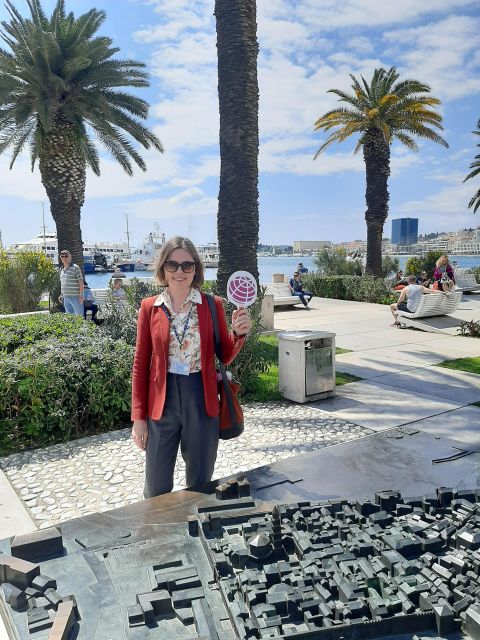
- The tour begins beside Split’s bronze old-town model: This is on the Riva promenade, directly in front of the Palace’s south entrance.
- You see Roman and medieval Split together: The route covers Diocletian’s Palace, Peristil, the cathedral, Jupiter’s Temple, palace gates, and later town squares.
- The Substructures cost extra: The guide visits the basement level, but the entrance fee is not included.
- Sanja teaches through several languages: Live guiding is available in English, Italian, French, and Spanish.
- The private group matters: Your party can include up to 15 people, with no unrelated group added.
- Allow 105 minutes on foot: The walk ends back on the Riva by the sea, at the same general meeting area.
Why Split makes sense with a private guide
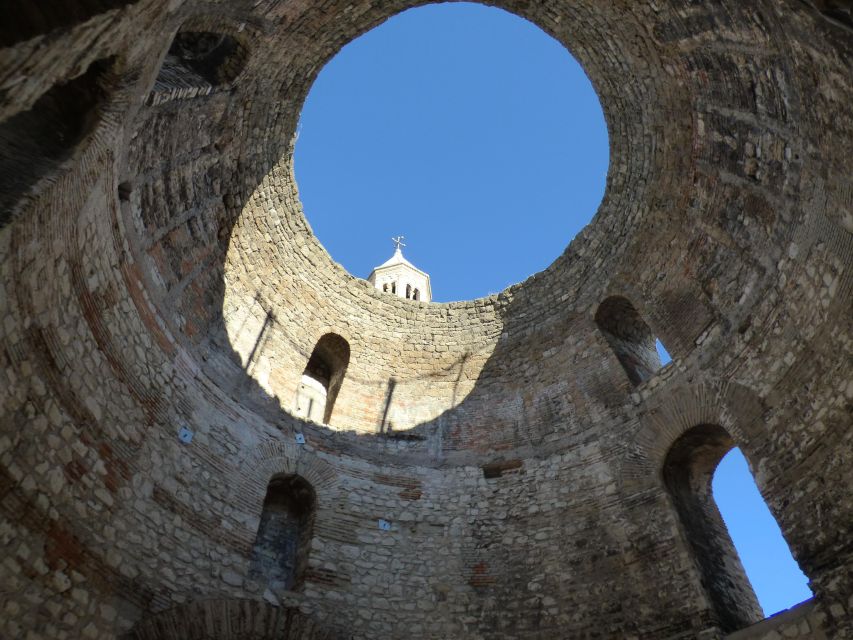
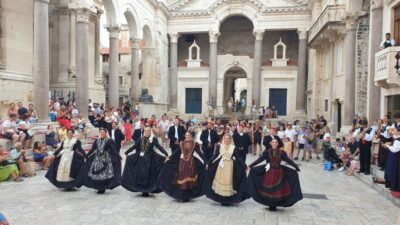
Split can look confusing at first. A Roman palace forms the heart of town, but the palace is not laid out like a normal museum. Its walls became streets. Its gates became routes into the center. Its former ceremonial rooms became public squares. Medieval houses were built against ancient stone, and later rulers added their own styles.
A guide gives you the order behind that jumble. Sanja’s route begins at the sea-facing south entrance, then moves through the Palace before continuing into the medieval town beyond its walls. That sequence helps you see Split as a living city rather than a collection of disconnected monuments.
The private setup is most useful for a small family or group of friends. You can ask how the Palace changed over time, stop for a short explanation, or request advice about what to see after the walk. In a group of four, one party found it especially easy to hear and follow the guide. For a full group of 15, the private arrangement still gives you control over who is with you, though the narrow lanes can make any larger walking group feel less nimble.
The tour’s strongest teaching point is the changing political story. You will hear how Split developed under Roman, Venetian, French, Austro-Hungarian, and Yugoslav rule, rather than hearing only a Roman origin story. That wider view is useful because many of the town’s buildings make sense only when you connect architecture with the government and society of the period.
Other guided walks in Split:
- Split: Old Town and Diocletian Palace Walking Tour
★ 4.9 · 4,727 reviews - Walking Tour of Split and Diocletian’s Palace
★ 5.0 · 2,588 reviews - Krka Waterfalls tour with Trogir Walking tour and Krka panoramic boat cruise
★ 5.0 · 1,659 reviews
Starting on the Riva and entering the Palace
Meet at the bronze model of Split’s historic core on the Riva promenade. The spot is by the sea, in front of the south entrance to Diocletian’s Palace, so it gives you a clear landmark in a busy central area.
The Riva is also a good place to begin because the Palace originally faced the water on this side. From here, the route takes you into the oldest part of town. You quickly move from an open waterfront promenade into stone passages and enclosed squares.
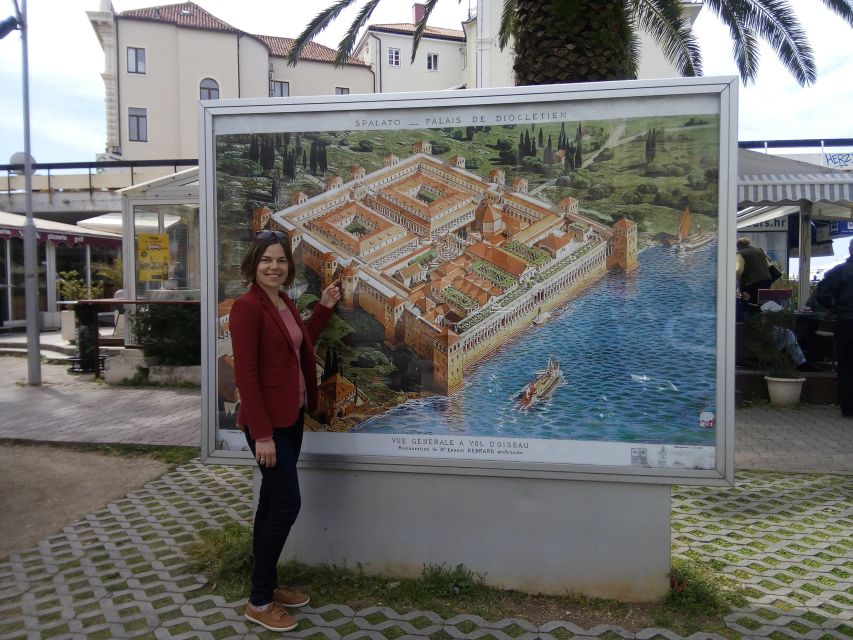
Your guide begins with Diocletian’s Palace, built in the fourth century for the Roman emperor Diocletian. The Palace is the foundation of modern Split, but it is not preserved as one untouched building. The important point is how much later life grew inside it.
You will see a small medieval neighborhood occupying the ancient complex. Noble family houses, religious buildings, shops, and residential spaces sit alongside Roman remains. This mixture can be hard to read without help, and the guide’s job is to show which elements belong to which period.
The Substructures: Split’s clearest Roman introduction
The Palace Substructures, also called the Basements, are one of the tour’s most useful stops. An entrance fee is required, and that cost is not included in the tour price, so keep it in mind when comparing the total expense.
The Substructures help explain the layout above them. They preserve the lower level of the Palace and show how Roman builders supported and organized the imperial complex. Sanja takes you through this area as part of the Palace visit, then uses it to explain the town above.
I consider this extra admission worthwhile if you want a stronger sense of the Roman plan. The basement level gives you a more focused historical setting than the busy streets overhead. If you are watching every kuna or euro, you can ask about the fee before entering, since the tour price does not cover it.
The Substructures are also one reason to take this walk early in your stay. Once you understand the Palace’s lower and upper levels, you can explore the lanes later without treating every old stone as a mystery.
Peristil and the Cathedral of Saint Domnius
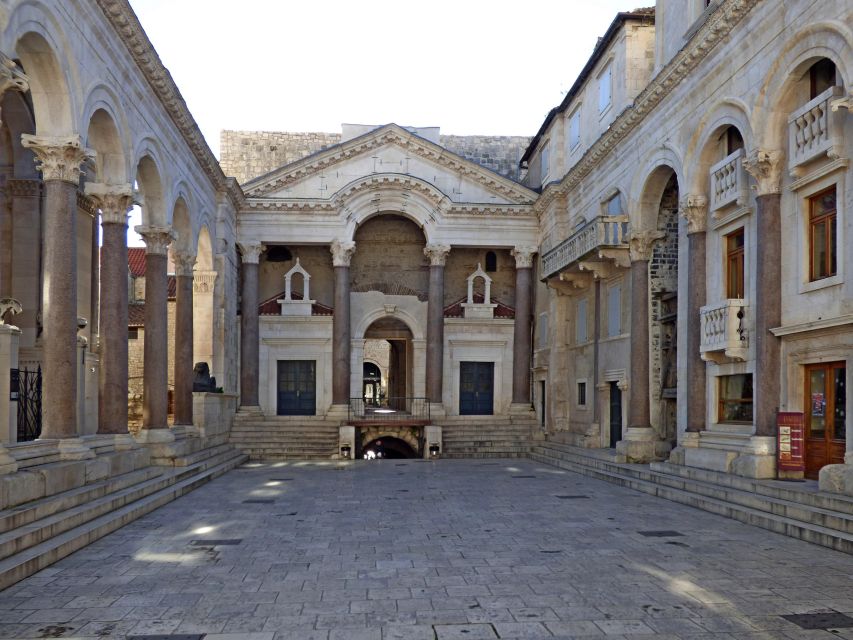
Peristil is the Palace’s main square and one of the route’s key stops. This is where the monumental Roman setting becomes easiest to picture. The square connects several important parts of the complex and gives the guide room to explain how the Palace functioned.
From Peristil, the walk continues to the Cathedral of Saint Domnius, also known as the Mausoleum in its earlier Roman role. That change in purpose tells you a great deal about Split. A structure made for an emperor became part of the Christian city, and later generations continued to adapt the old Palace rather than clear it away.
The tour includes a guided look at the cathedral and a pass by the site. The description does not include an interior cathedral admission, so do not assume that a separate ticket is part of this walk. You still get the important setting and story, while the guide places the building within the larger Palace.
I like this part because it keeps the focus on adaptation. You are not just seeing an old Roman structure and then a church as separate sights. You are seeing how Split kept reusing its central buildings.
Same base, a different kind of day out:
- Split: Krka Waterfalls Trip with Boat Cruise and Swimming
★ 4.8 · 10,519 reviews - From Split: Krka Waterfalls, Food & Wine Tasting Tour
★ 5.0 · 9,326 reviews - Blue cave, Mamma Mia and Hvar, 5 islands speedboat tour
★ 5.0 · 7,150 reviews - From Split: Krka Waterfalls, Food & Wine Tasting Tour
★ 4.9 · 6,598 reviews
Jupiter’s Temple and the Palace gates
Jupiter’s Temple is another Roman landmark on the route. The visit here is external, with no entrance fee included or required for the described stop. The building later became a baptistery, another clear example of old Roman space taking on a Christian role.
That change is easy to miss if you walk past on your own. Sanja connects the Roman dedication to Jupiter with the building’s later use as a Baptistery, helping you read the monument as a record of changing beliefs and power.
The tour also covers the Palace walls and its four gates. You will see the Golden Gate among them, one of the most recognizable entrances into the historic core. The gates are practical points of orientation, not just photo stops. They show how the Palace was structured and how movement through the old center still follows ancient lines.
A walking guide is particularly helpful here because modern streets do not always make the original layout obvious. The route gives you a mental map: the Palace core, the gates, the ceremonial center, and the later town outside the walls.
Medieval lanes, noble houses, and the former Jewish quarter
Inside and near the Palace, the route moves through medieval streets and past houses associated with noble families. These details bring the story down from emperors and rulers to the people who lived in Split over the centuries.
You will also pass through a small former Jewish ghetto with a synagogue that is still active. This is one of the more distinctive parts of the walk because it adds a social and religious layer that is easy to miss when sightseeing only for Roman remains.
The synagogue is described as an external visit, so you should not expect an interior tour. Still, its place in the old town helps explain how different communities occupied and shaped Split’s limited urban space.
This section is a good reminder that the historic center was never simply an archaeological site. It has been a neighborhood, a place of worship, a commercial center, and a political stage. That is the kind of context you can carry with you as you continue exploring after the guide leaves.
Pjaca and the town beyond the Palace walls
The second part of the walk leaves the Roman Palace and enters the medieval neighborhood built outside it. The change is subtle but important. You begin to see how Split expanded beyond its original imperial footprint.
The route reaches People’s Square, commonly called Pjaca. This is one of the town’s best-known public squares and a useful place to discuss civic life outside the Palace. The square makes the transition from imperial complex to medieval and later urban center easy to understand.
Here, the guide’s political and architectural story becomes especially useful. Roman authority was followed by different forms of Venetian, French, Austro-Hungarian, and Yugoslav administration. Each period left marks on the city’s buildings and public life.
You will not get an exhaustive course in every era during a 105-minute walk. That is a fair limit. What you do get is a compact framework that helps you notice why the town does not have one single architectural style.
Fruit Square, Prokurative, and the route back to the sea
Fruit Square is another major stop. Its name points to its traditional market role, and its position outside the Palace helps show how daily life developed around the original Roman core. The square is a useful contrast to Peristil, which was part of the imperial complex.
The route also includes Prokurative, a square shaped by later urban development. Together, these stops show the gradual shift from Roman palace, to medieval settlement, to a broader city with public spaces influenced by later European rule.
The walk finishes on the Riva promenade by the sea. The stated route brings you back to the bronze model and the starting area, giving you a familiar point from which to continue on your own.
That ending is practical. You can use the final advice to choose your next stop, return to a sight that deserves more time, or simply stay on the Riva. The guide’s tips are not an afterthought. They help turn a short orientation walk into a useful plan for the rest of your stay.
What the 105-minute schedule feels like
The tour lasts about one hour and 45 minutes. The listed timing gives roughly 30 minutes for Diocletian’s Palace, followed by shorter stops at Peristil, the cathedral, Jupiter’s Temple, the Golden Gate, People’s Square, Fruit Square, and the Riva.
That is enough time for a strong first look, not enough for long interior visits at every site. You should expect steady walking, short explanations, and frequent changes between streets, squares, and monuments.
The pace suits someone who wants orientation without giving up half a day. It is also a good choice on a first full day in Split, when you want the city’s basic structure before exploring independently. One person used the walk at the start of a stay and found that the historical framework helped with later visits inside the Palace.
Wear comfortable shoes. The route includes old streets and narrow passages, and the activity is not suitable for wheelchair users. The supplied information does not specify the exact surface conditions at every stop, so anyone with limited mobility should ask the provider for current details before booking.
Price, group size, and overall value
The price is $153 per group of up to 15 people, not $153 per person. That makes the value much better for a full family group or a group of friends. For two people, the per-person cost is high, but you are paying for a private licensed guide rather than a standard shared walk.
The guide is a local professional with a master’s degree, and Sanja’s strongest qualities are clear communication and language ability. Feedback specifically praises her excellent French, strong English, and careful answers to questions. Italian and Spanish are also available.
The main extra cost is admission to the Palace Substructures. Other listed stops, including the external look at Jupiter’s Temple, do not add an entrance fee under the described plan. Since the Substructures are central to understanding the Palace, include that ticket when calculating your real cost.
You also get flexible booking terms: cancellation is free up to 24 hours before the tour, and you can reserve now and pay later. Those terms help if your Split schedule may change, but the more important value question is group size. The tour makes the most financial sense when several people share the fixed fee.
Who should book this Split walk?
I would choose this tour if you are staying in or near the old town and want a clear first explanation of Split. It suits history-minded visitors, first-time visitors, families, and anyone who prefers to ask questions instead of following a large shared group.
It is also a strong match if you speak French, Italian, or Spanish and want more than a basic English tour. Sanja’s French received especially strong praise, while English was described as excellent.
You may want a different plan if you prefer a slow museum visit, extensive cathedral interiors, or long time for photography at each stop. The route is broad rather than exhaustive. It covers many places in 105 minutes, so the reward is orientation and context, not a leisurely examination of every building.
Should you book it?
Book this private walk if you want to understand why Split’s old center feels so unusual. The combination of Diocletian’s Palace, medieval homes, Roman temples, a former Jewish quarter, later squares, and several ruling periods gives you a useful way to read the city.
The best value comes when your group has several people to share the $153 fee, and when you take the tour early enough to use Sanja’s advice afterward. Add the Substructures entrance fee to your budget, and remember that the walk is not suitable for wheelchair users.
For a compact first look at Split, this is a well-focused choice. It gives you the map, the timeline, and enough local context to make your own wandering more rewarding.
FAQ
Where does the tour meet?
It meets beside the bronze model of Split’s historic core on the Riva promenade by the sea, in front of the south entrance to Diocletian’s Palace.
How long does the walking tour last?
The tour lasts 105 minutes, or about one hour and 45 minutes.
What languages are available?
The live guide is available in English, Italian, French, and Spanish.
Is this a private tour?
Yes. It is a private group tour for up to 15 people.
Is admission to the Palace Substructures included?
No. Entrance to Diocletian’s Palace Substructures, also called the Basements, is not included.
Is the tour suitable for wheelchair users?
No. The activity is listed as not suitable for wheelchair users.
Can I cancel for a refund?
Yes. You can cancel up to 24 hours in advance for a full refund. You can also reserve now and pay later.
More Historical Tours in Split
- Walking Tour of Split with a ‘Magister’ of History
★ 5.0 · 1,122 reviews - Split Walking Tour with Professor of History
★ 5.0 · 926 reviews - Split: History and Heritage Walking Tour
★ 4.9 · 650 reviews - Split History and Gastro Small-Group Tour with Food and Drinks
★ 5.0 · 375 reviews
Just added in Split
- From Trogir, Seget, Okrug: Krka Waterfalls & Šibenik Culture Tour★ 5.0 · 10 reviews
- Krka Waterfalls & Primošten from Trogir, Seget, Čiovo & Kaštela★ 5.0 · 18 reviews
- Slatine – Island Hopping Excursion (Trogir/Blue Lagoon/Shipwreck)★ 4.0 · 24 reviews
- Island Hopping Boat Excursion with Lunch (Trogir,Blue Lagoon, Šolta)★ 3.5 · 6 reviews
- From Split & Trogir: ATV Quad Tour on Island Čiovo★ 5.0 · 21 reviews
- Split: Sunset Guided Kayaking Tour★ 4.8 · 71 reviews
- Split Sunset Stand Up Paddle Tour★ 5.0 · 16 reviews
- Stand Up Paddle Tour in Split★ 4.7 · 17 reviews
Historical Tours, compared.
Walking Tour of Split with a ‘Magister’ of History
Read our review →

Split History and Gastro Small-Group Tour with Food and Drinks
Read our review →
PREMIUM Emperor’s Walking Tour for History Lovers + Museum
Read our review →
Browse the lists this tour appears in