

Reviewed · DIOCLETIAN PALACE TOURS
Split: Diocletian Palace & Old Town Guided Walking Tour
Split’s best introduction begins where Roman stones meet the sea. This $17 walking tour starts on the Riva and takes you into Diocletian’s Palace, where homes, cafés, shops, churches, and ancient walls still share the same streets. I like the clear route through the Peristyle courtyard and four original gates, and I like that guides such as Ina, Nataša, Darko, Tin, and Doge explain how a palace became a living city.
The main consideration is pace. At about 50 minutes, this is a brisk orientation rather than a full archaeological visit. You’ll walk over cobblestones and uneven ground, take 15 to 30 steps, and may find the group harder to hear if it is large or noisy. Still, for a short first look at Split, the price is hard to argue with.
Key points before you book

- Roman palace turned city center: Diocletian’s Palace is not a sealed ruin. People still live, work, shop, and eat among its ancient walls.
- A compact route: In roughly 50 minutes, you see the Peristyle, palace cellars, private areas, four gates, Fruit Square, Town Hall, and St. Domnius Cathedral.
- Guides bring the place to life: Ina is often praised for her archaeology background and clear storytelling, while Nataša, Darko, Tin, and Doge are also noted for humor, passion, and helpful local advice.
- A smart first-day activity: The route gives you a useful map of the Old Town before you return on your own for meals, shopping, museums, and photos.
- Low-cost, flexible booking: The $17 price includes the guided walk, with cancellation up to 24 hours before departure and payment later.
- Come prepared for stone streets: Wear shoes with a firm sole, bring water, and expect sun, wind, steps, and uneven paving.
Why Diocletian’s Palace is more than an ancient ruin
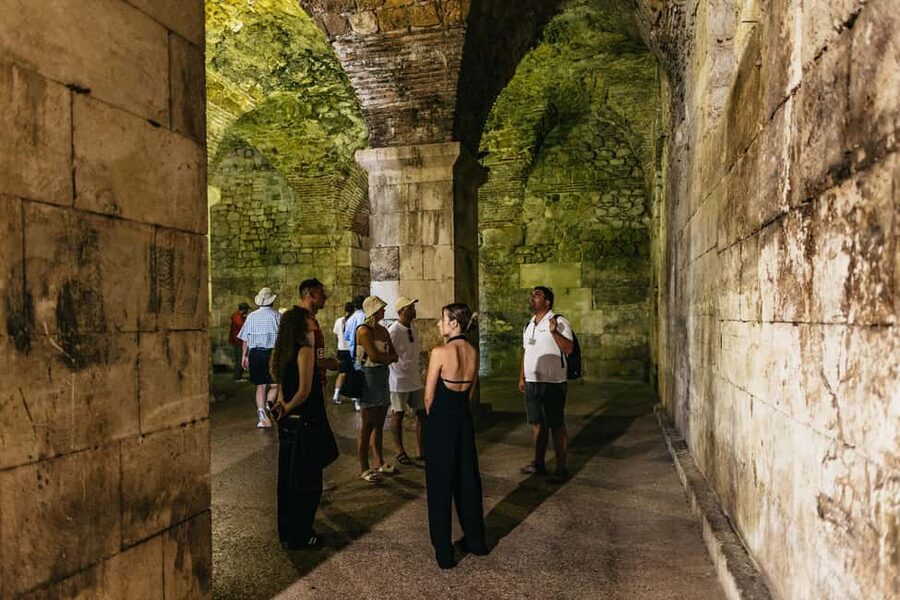
The surprising thing about Split is that Diocletian’s Palace is not simply an old building you walk through for an hour. It forms the core of the modern city. Roman walls frame medieval lanes, Venetian-era details appear beside ancient columns, and ordinary life continues in spaces first built for an emperor.
Diocletian built the complex in the fourth century AD as a retirement residence and fortified palace. That simple description can make it sound like a museum. It is not. The palace has been adapted over centuries, and the tour helps you read those changes instead of seeing only scattered stones.
I especially like this approach for a first visit because the guide supplies the connections. A column in the Peristyle, a gate opening toward the waterfront, and a medieval building in the Old Town are not isolated sights. Together, they show how Split grew by using what earlier generations left behind.
The tour also gives you a useful sense of scale. You move from the open waterfront into enclosed lanes, then into the palace center and out toward town squares. That change of setting makes the old complex easier to understand than a list of dates and names.
Other guided walks in Split:
- Split: Old Town and Diocletian Palace Walking Tour
★ 4.9 · 4,727 reviews - Walking Tour of Split and Diocletian’s Palace
★ 5.0 · 2,588 reviews - Krka Waterfalls tour with Trogir Walking tour and Krka panoramic boat cruise
★ 5.0 · 1,659 reviews
Meeting beside the red bus on the Riva
The meeting point is at Apodos Travel Agency, next to an open-top red bus. Look for team members in red or white shirts, since they connect you with the guide. One practical warning is worth taking seriously: the red bus and the meeting area can be easy to miss if you are hurrying along the waterfront, so arrive with enough time to identify the stop.
The Riva is a good place to begin. Palm trees, cafés, bright sunlight, and the Adriatic set the mood before the route turns inland. You are not being transported to a distant site, and there is no complicated transfer. You simply start walking from central Split into the old city.
The tour is offered in English, Spanish, and Italian. Guides named in recent bookings include Ina, Nataša, Darko, Tin, Doge, and Ena. Their styles vary, but the strongest pattern is clear: guides explain the site in a friendly, conversational way and welcome questions.
Ina receives particularly strong praise for her archaeology background, clear explanations, and ability to keep the group moving. Nataša is described as an art historian with a warm, enthusiastic manner. Darko is known for humor and a strong interest in local history, while Tin is often noted for his clear English and care with anyone walking at the back.
Entering through the Bronze, Silver, Golden, and Iron Gates
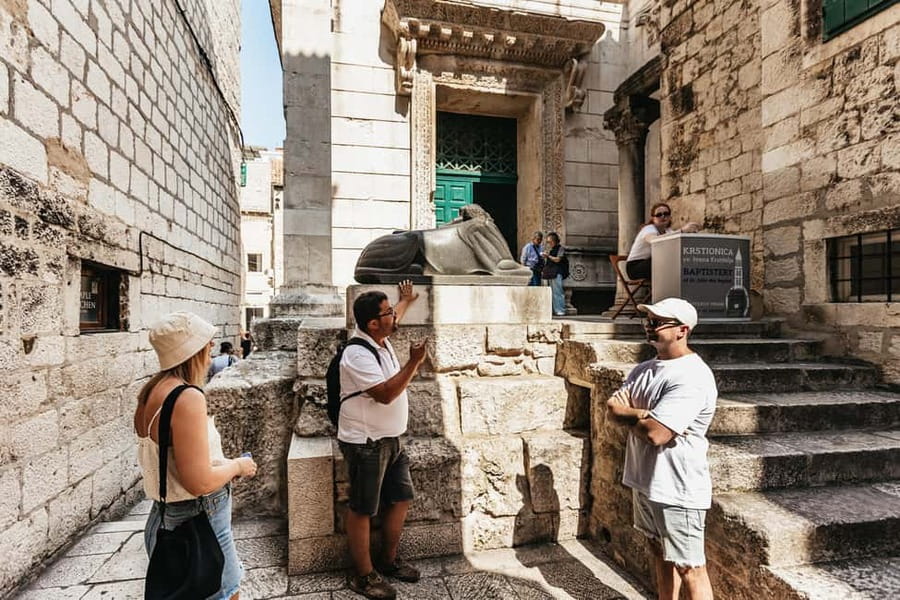
The route introduces the palace through its original entrances: the Bronze, Silver, Golden, and Iron Gates. Each gate faced a different direction and helped control movement through the fortified complex. Seeing all four gives you a better idea of how the palace was organized than entering through one modern access point alone.
The Bronze Gate is close to the waterfront, making it a natural transition from the Riva into the palace. The Golden Gate is the grandest of the four and gives you a sense of the formal approach to the emperor’s residence. The Silver and Iron Gates complete the picture, showing how the palace connected with the wider settlement around it.
Do not expect long stops at every gate. The walk is compact, so the guide has to keep the group moving. That is useful in summer heat, but it also means you may want to return later for your own photographs and a closer look.
The gates are also a good example of why a guide helps. On your own, you can admire the stonework but miss the logic of the complex. With explanation, the palace feels less like a maze and more like a planned imperial compound that later became the framework for Split.
The cellars and the Peristyle courtyard

The palace cellars are among the most useful stops on the route. Their walls and arches preserve the shape of rooms above, helping you understand the original palace plan. They also show how later residents reused Roman spaces rather than clearing them away.
The Peristyle is the visual center of the visit. This grand courtyard once formed the ceremonial approach to the emperor’s apartments. Tall columns, worn stone, and the surrounding buildings create one of Split’s most memorable spaces, and the guide explains how Roman authority was displayed here.
I like the Peristyle because it is not just a place for a quick photograph. It helps you see the palace as a working residence with a formal public side and a private side. The contrast between the open courtyard and the more enclosed streets nearby makes the original design easier to grasp.
Crowds can gather here, especially in the warmer months. A guide who keeps the group close and speaks clearly matters. Ina is repeatedly praised for making sure a group of about 15 could hear and for keeping the route efficient. One useful criticism is that a microphone would help in a noisy courtyard, so stand near the guide when possible.
Same base, a different kind of day out:
- Split: Krka Waterfalls Trip with Boat Cruise and Swimming
★ 4.8 · 10,519 reviews - From Split: Krka Waterfalls, Food & Wine Tasting Tour
★ 5.0 · 9,326 reviews - Blue cave, Mamma Mia and Hvar, 5 islands speedboat tour
★ 5.0 · 7,150 reviews - From Split: Krka Waterfalls, Food & Wine Tasting Tour
★ 4.9 · 6,598 reviews
Imperial rooms, the private observatory, and changing use
The tour moves toward Diocletian’s former private chambers and the emperor’s private observatory. These areas add a personal dimension to the story. You are not only looking at defensive walls and public ceremony. You are also considering how the ruler lived inside this enormous complex.
The private areas are valuable because they balance the grand scale of the palace. Diocletian’s public image required columns, gates, and ritual spaces, but his residence also needed rooms for daily life and private observation. Your guide links these spaces to the wider story of the emperor and the building’s later changes.
This portion is best treated as an introduction rather than a detailed architectural study. The tour does not have enough time for every room, measurement, or excavation detail. If ancient architecture is your main interest, you will likely want to return on your own after learning the basic plan.
St. Domnius Cathedral and the emperor’s mausoleum
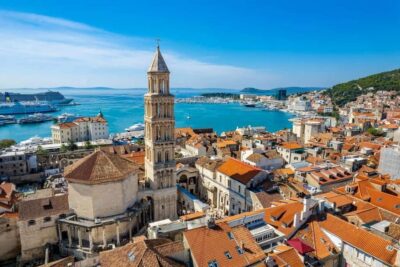
St. Domnius Cathedral, or Sv. Duje, gives Split one of its most striking historical twists. The building began as Diocletian’s mausoleum and later became a cathedral. A structure created for the emperor’s burial now serves a Christian religious community.
That change captures Split’s story in one building. Roman imperial power, later religious use, and the life of the modern city all meet in the same stone structure. The guide explains this shift so you can appreciate the site as more than an old church.
The bell tower offers panoramic views across the city and harbor. If the visit includes the climb, be ready for steps and allow for the effort involved. The overall walk already requires uneven surfaces and 15 to 30 steps, so this is not the easiest part for everyone.
The activity is described as wheelchair accessible, and one guide, Nataša, has helped people in wheelchairs and with strollers find paths with fewer or no steps. At the same time, the general requirement to manage cobblestones and steps is important. If mobility is a concern, contact the provider before booking and confirm which parts of the route and bell tower are suitable for you.
Fruit Square and the medieval town around the palace
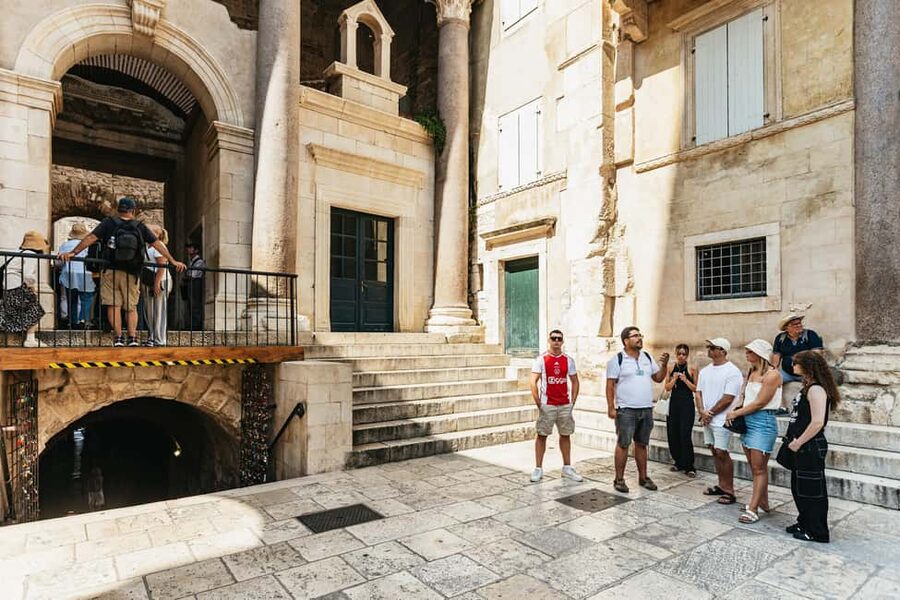
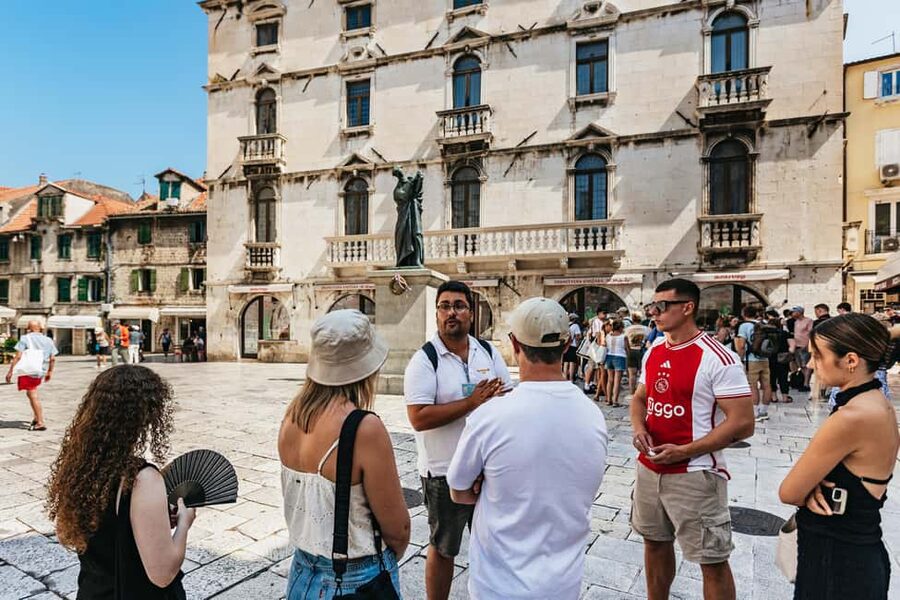
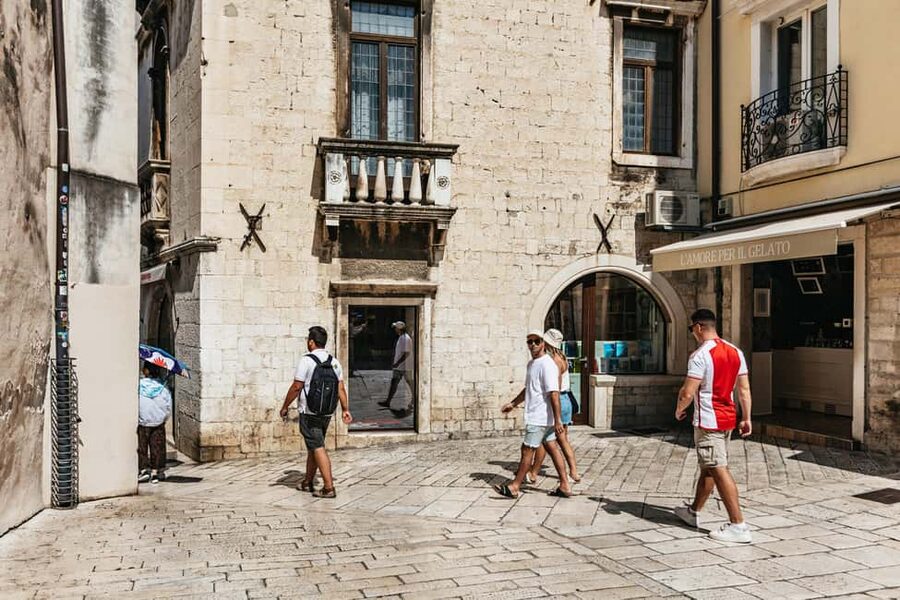
The route continues beyond the Roman core to Fruit Square, an attractive area lined with Baroque monuments. This is where Split’s later architectural layers become easier to see. The palace did not remain frozen in the fourth century. Medieval and Venetian influences reshaped it, and the town continued to grow within and around the old walls.
The 15th-century Town Hall adds another useful stop. Its presence helps show how civic life took over spaces once connected with imperial power. You get a sense of Split as a working town, not merely an archaeological site.
This is one of the tour’s best qualities. The guide does not leave you with the impression that Roman history ended when Diocletian’s building was finished. Instead, the route shows how each period reused the city and left something behind.
A short tour with useful local context
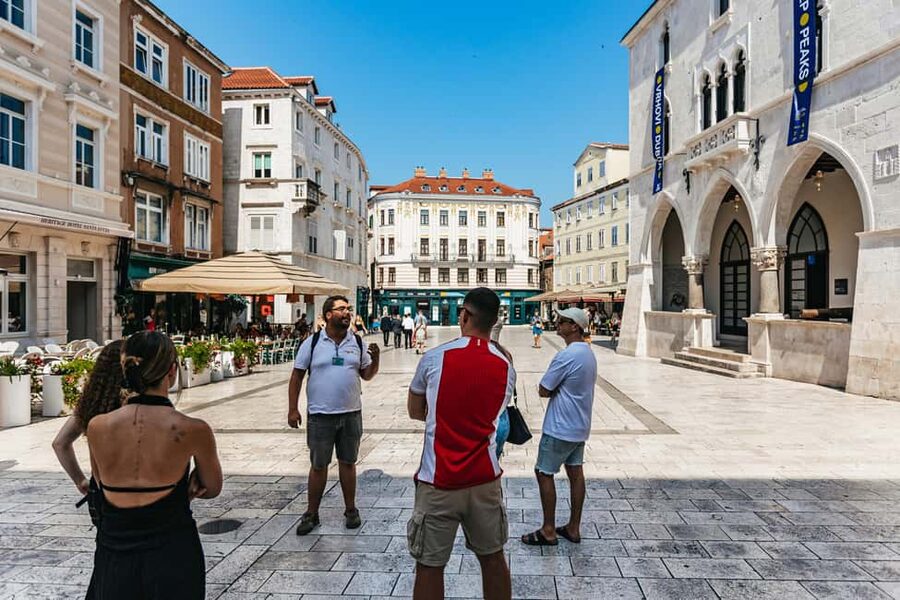
The tour’s greatest strength is its size and focus. In less than an hour, you get the basic story, the main architectural points, and enough orientation to continue exploring. Several guides also offer suggestions for what to do after the walk, which is useful if Split is a short stop on a larger Croatian trip.
I would book this early in your stay. The route gives you a mental map of the palace, so later wandering becomes less confusing. You can return to the cellars, cathedral, gates, and squares that caught your interest, or use the guide’s local suggestions to look for traditional crafts and food businesses in the Old Town.
The short length also works well in hot weather. One guide kept the pace comfortable during a warm walk, and another helped keep track of people at the back. Families with toddlers have completed the route, and its limited duration is easier to manage than a long history walk.
The tradeoff is depth. The tour cannot provide a full visit to every palace room, museum, or church. It also may feel rushed if you want long photo stops. Think of it as a strong introduction, not your entire Split sightseeing plan.
Is $17 a good value?
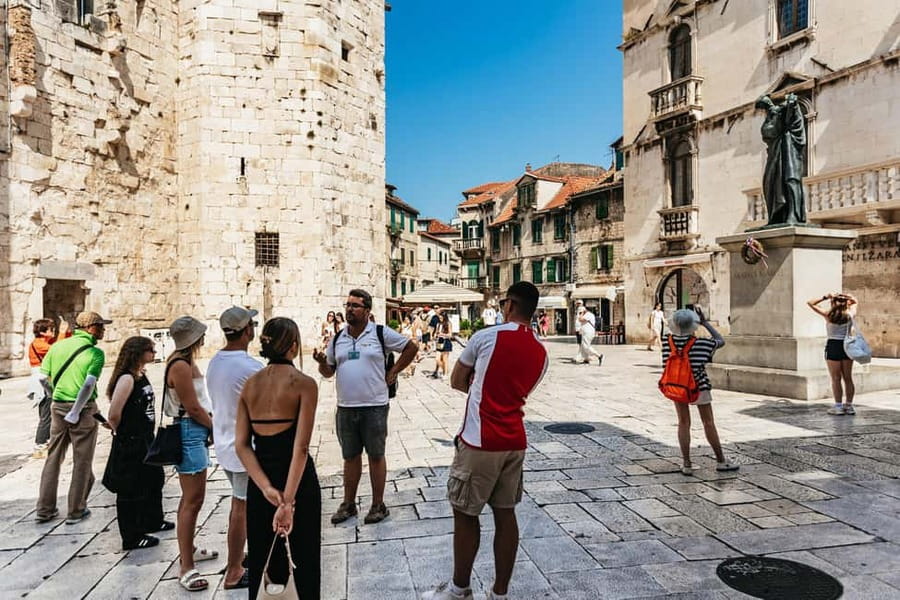
At $17 per person, the value is very good if you want context. You could walk through much of the Old Town for free, but it is easy to miss what you are seeing. The price pays for a local guide who explains the palace plan, the emperor’s role, the city’s later changes, and the connection between major sights.
The value is strongest for first-time visitors, cruise passengers, and anyone with only a few hours in Split. It is also useful for people who prefer a short activity before exploring alone. A private tour may offer more depth, but this option keeps the cost low and has occasionally operated with only one booking, creating a more personal experience.
The ticket-line benefit saves some time, though the tour itself remains subject to the pace of the group and conditions in the Old Town. Meals, drinks, transportation to the meeting point, souvenirs, and personal expenses are not included, so budget separately for those.
You can cancel up to 24 hours before departure for a full refund, and the reserve-now, pay-later option makes it easier to keep plans flexible.
What to bring and how to prepare
Wear comfortable shoes with a firm grip. Smooth paving, cobblestones, steps, and narrow streets are part of the experience, not an occasional nuisance. Bring water, sunglasses, a hat, and a camera.
On windy days, long sleeves are recommended. In bright weather, much of the route can feel exposed, while some palace areas offer shade. I would avoid carrying a large bag if possible, since the walk moves through crowded old streets.
Arrive ready to listen closely. In a group of around 15, the guide can usually manage the pace well, but sound may be less clear in the Peristyle or around busy streets. Stand near the guide, especially if you have hearing difficulties.
Who should book this Split walking tour?
Book it if you want a short, affordable introduction to Diocletian’s Palace and need help making sense of the Old Town. It is especially suitable for first-time visitors, families who prefer a compact walk, cruise passengers, and people who want local suggestions after the formal tour ends.
You may want something longer if you already know Roman architecture well or want extended access to interiors and museums. This is a brisk overview, with limited time for lingering, detailed photography, or long questions at every stop.
For most visitors, I would book it near the beginning of a Split stay. The guides bring warmth, humor, and useful local context to a complicated site, while the price keeps the risk low. Just bring good shoes, arrive at the red bus meeting point with time to spare, and treat the tour as your foundation for exploring Split on your own.
FAQ
How long does the Split walking tour last?
The activity lasts about 50 minutes. The sightseeing portion is also described as approximately one hour, so allow around an hour for the guided walk.
How much does the tour cost?
The price is $17 per person.
Where does the tour meet?
Meet at Apodos Travel Agency on the Riva. Look for an open-top red bus and team members wearing red or white shirts.
Which languages are available?
The live guide is available in English, Spanish, and Italian.
What sights are included?
The route includes Diocletian’s Palace and Split Old Town, the palace cellars, Peristyle courtyard, former private areas, the Bronze, Silver, Golden, and Iron Gates, the 15th-century Town Hall, Fruit Square, and St. Domnius Cathedral.
Is the tour wheelchair accessible?
The activity is described as wheelchair accessible. However, participation requires walking over uneven and cobblestone surfaces and managing 15 to 30 steps. Ask the provider about the exact route if you need a step-free option.
Do I need to bring food or drinks?
Meals and beverages are not included. Bring your own water, especially on sunny or hot days.
What should I wear?
Wear comfortable shoes suitable for cobblestones and uneven ground. Long sleeves are recommended on windy days, while sunglasses and a hat are useful in sunny weather.
Can I cancel the booking?
You can cancel up to 24 hours in advance for a full refund. The reserve-now, pay-later option lets you book without paying immediately.
More Diocletian's Palace tours in Split
- Split & Diocletian’s Palace Walking Tour
★ 5.0 · 1,125 reviews - Split: Game of Thrones Tour with Diocletian’s Palace Cellar
★ 4.8 · 545 reviews - Diocletian’s Palace and Old Town SMALL GROUP Walking Tour
★ 5.0 · 502 reviews - SPLIT-PRIVATE Walking Tour of Diocletian’s Palace & Old Town
★ 5.0 · 467 reviews
Just added in Split
- Discover The Old Town Split 1.5h walking Small group tour★ 4.8 · 93 reviews
- From Split: Zagreb Transfer & Plitvice Lakes Tour★ 4.7 · 131 reviews
- Blue Cave, Komiža, Stiniva Bay, Budikovac, Hvar Split Island Boat Tour★ 5.0 · 53 reviews
- Split to Dubrovnik Private transfer 1-8 pax (Door to Door any location)★ 5.0 · 118 reviews
- The Diocletian route – Panoramic Flight over Split★ 5.0 · 9 reviews
- Split Cooking Class★ 5.0 · 142 reviews
- From Sinj: 1.5-Hour Private Flight over Kornati & Šibenik★ 4.1 · 11 reviews
- From Sinj: Panoramic Flight over Split★ 5.0 · 14 reviews
Diocletian Palace Tours, compared.
Walking Tour of Split and Diocletian’s Palace
Read our review →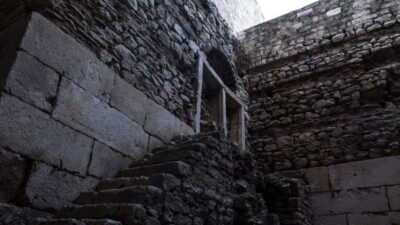
Game of Thrones Tour with Diocletian’s Palace Cellar
Read our review →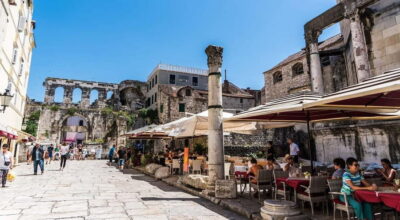
Diocletian’s Palace and Old Town SMALL GROUP Walking Tour
Read our review →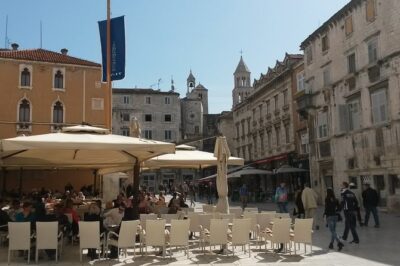


Browse the lists this tour appears in