
Reviewed · DIOCLETIAN PALACE TOURS
Split: 1.5-Hour Walking Tour and Diocletian’s Palace
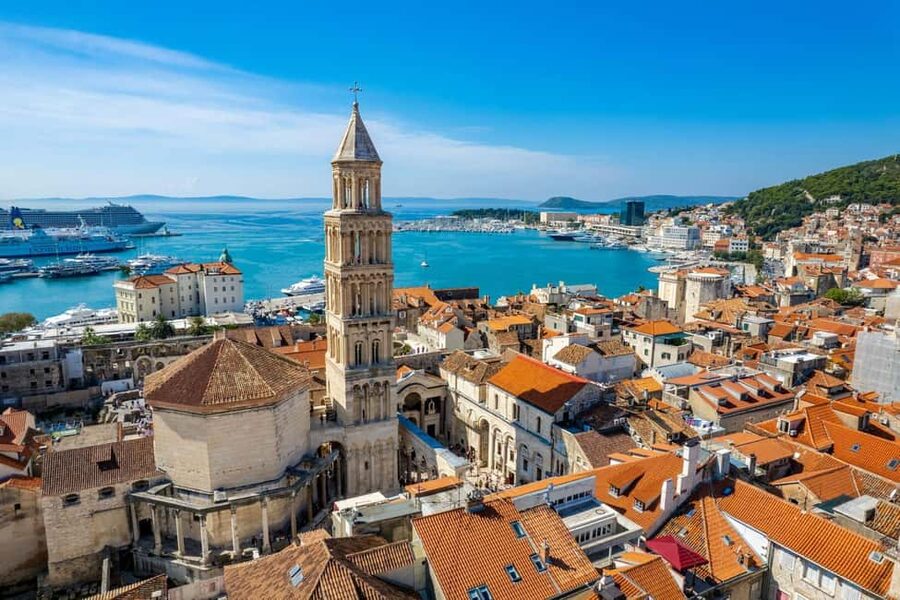
Diocletian’s Palace is not a fenced-off ruin. It is the heart of Split, with homes, cafés, shops, lanes, and daily life packed inside walls built for a Roman emperor around 300 AD. This tour helps you read that jumble, from the black-granite Egyptian sphinx at Peristyle to the palace cellars and the waterfront.
I like the local point of view. Guides such as Sandra, Ana, Ivan, and Jelena have explained Split’s past alongside its present-day customs, food, and neighborhoods. I also like the route’s useful city orientation, which takes you through the main gates, squares, Riva, and old-town shortcuts in one sitting.
The main drawback is that this is a brisk introduction, not a full archaeological visit. Entrance fees are not included, and the walk is a poor match for anyone with limited mobility or trouble handling uneven old-town streets.
Key points before you book
- Roman cellars beneath a living city: Visit the underground rooms of Diocletian’s Palace, then see how the palace still functions as Split’s old town.
- A practical first look at Split: The route covers the Golden Gate, People’s Square, Fruit Square, Riva, Peristyle, Vestibul, and cathedral.
- Guides with a local voice: English and Spanish tours may include guides such as Sandra, Ana, Ivan, or Jelena, each adding personal stories and restaurant advice.
- A short but full walk: The advertised time is 90 minutes to two hours, with several stops and little sitting.
- The best early-city lesson: You see how Roman, medieval, Venetian, Austro-Hungarian, and 20th-century buildings share the same center.
- Bring shoes and a plan for heat: Comfortable walking shoes matter, and an early or evening departure can be more pleasant than the hottest part of the day.
Why Diocletian’s Palace feels different from a normal monument
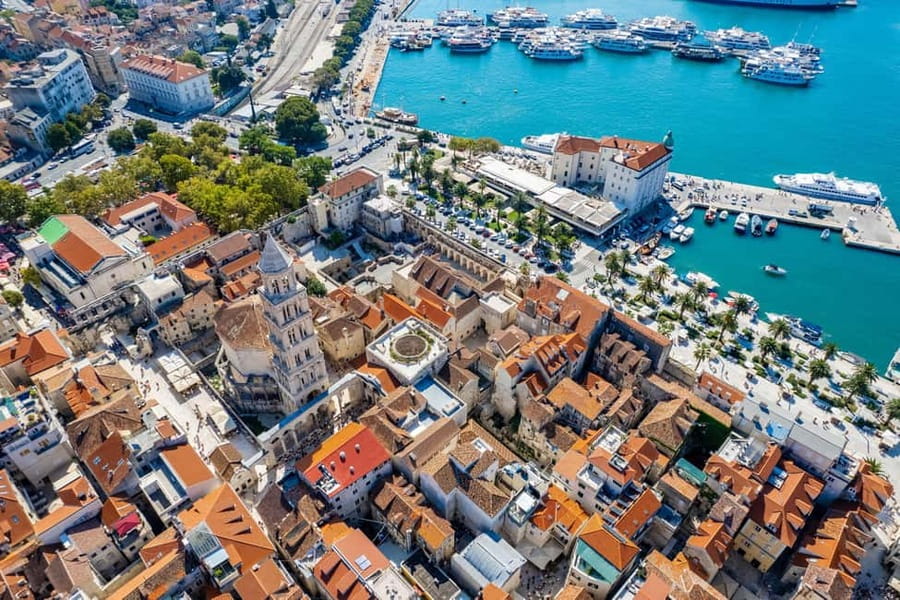
Many ancient sites are separated from modern life by ropes, lawns, and ticket gates. Split’s palace is different. Its massive Roman walls form the core of a working city, so you may pass a café table, a shop doorway, or a resident’s apartment before reaching a 1,700-year-old stone.
That is the main reason to take a guided walk here. Without context, Split’s center can feel like a maze of attractive stone lanes. With a guide, the layout begins to make sense. The southern side once faced the sea, the palace gates marked controlled entrances, and the central Peristyle served as the ceremonial heart.
The palace was built for Emperor Diocletian at the turn of the fourth century. He retired here after ruling the Roman Empire, and the building was designed partly as an imperial residence and partly as a military-style fortress. The exact line between palace, town, and later city life is not always obvious, which makes a guide especially useful.
You also get a quick lesson in architectural layering. Roman columns and carved stone sit beside medieval additions, later Venetian details, and more recent 20th-century buildings. This is not a polished recreation of Roman life. It is a city that kept adapting its old shell.
Other guided walks in Split:
- Split: Old Town and Diocletian Palace Walking Tour
★ 4.9 · 4,727 reviews - Walking Tour of Split and Diocletian’s Palace
★ 5.0 · 2,588 reviews - Krka Waterfalls tour with Trogir Walking tour and Krka panoramic boat cruise
★ 5.0 · 1,659 reviews
Starting at the Golden Gate
The route usually begins through the local operator’s meeting point, with the exact start depending on the option you book. From there, the walk reaches the Golden Gate, the grand northern entrance to the palace.
The gate is a useful place to begin because it shows the scale and defensive character of the complex. The name sounds decorative, but the gate’s original purpose was practical: control movement into the imperial compound. Your guide can point out how the entrance relates to the palace walls and the older street plan.
You should expect an outdoor explanation rather than an extended stop with seating. The first section is short, but it gives you a frame for everything that follows. Pay attention to the direction of the streets and the position of the gates. That simple orientation makes it easier to explore alone later.
The route also passes the Game of Thrones Museum. The tour does not present this as a major museum visit. It is a brief guided stop, useful if you enjoy seeing how Split’s old stone settings have been used for screen productions. The focus remains the city itself, not a paid museum admission.
People’s Square and Split’s changing architecture
People’s Square brings you out of the palace area and into a broader urban setting. This is one of the best places to see how Split grew beyond its original Roman walls and how later buildings sit beside ancient remains.
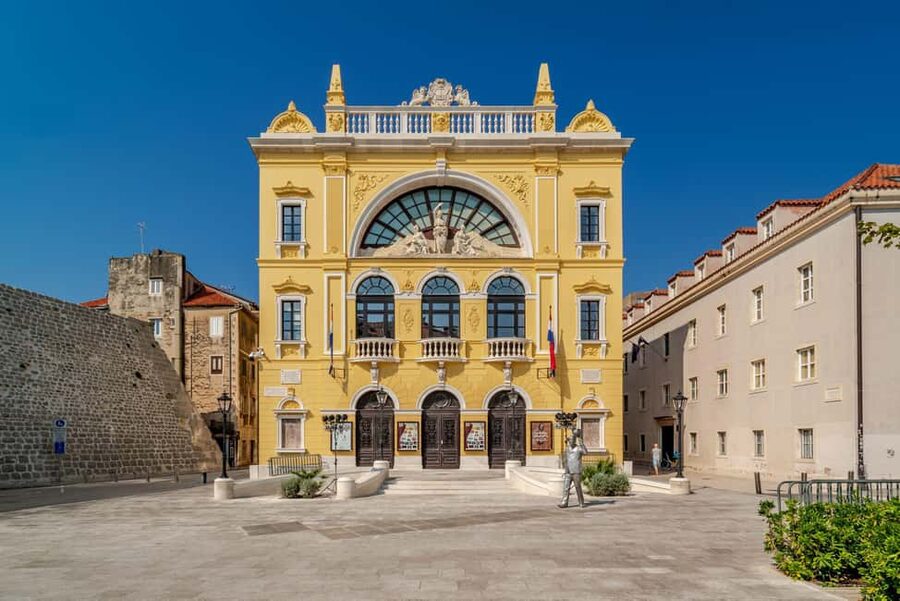
A guide can make the mixed architecture easier to spot. You may see Roman traces, medieval stonework, Venetian influence, and newer construction within a short walk. I find this part valuable because it prevents the common mistake of treating Split as one single historical period.
The tour also gives you a chance to watch ordinary city life. The point is not only to memorize dates. You learn how the old center works as a neighborhood, a meeting place, and a route between the waterfront and inland streets.
Guides have also used this section to explain local customs and current life in Croatia. That personal angle is one of the strongest parts of the experience. Ana, Sandra, Ivan, and Jelena have all been praised for adding stories and opinions instead of delivering a dry list of monuments.
Fruit Square and the old market area
Voćni Trg, or Fruit Square, marks the former fruit market. It is a compact urban space, but it helps explain how trade shaped the old town. A market was not an isolated attraction. It was part of the daily movement of food, people, and news through Split.
This stop also makes a useful contrast with the palace. The Roman imperial center was planned and monumental, while later city life developed around commerce and practical needs. Your guide may point out details that you would otherwise walk past, especially when the square is busy.
The tour does not linger long at each location. Ten minutes at a square is enough for an explanation and photos, but not enough for a slow architectural study. If you want to examine every façade, return later with a map or notes from the walk.
Same base, a different kind of day out:
- Split: Krka Waterfalls Trip with Boat Cruise and Swimming
★ 4.8 · 10,519 reviews - From Split: Krka Waterfalls, Food & Wine Tasting Tour
★ 5.0 · 9,326 reviews - Blue cave, Mamma Mia and Hvar, 5 islands speedboat tour
★ 5.0 · 7,150 reviews - From Split: Krka Waterfalls, Food & Wine Tasting Tour
★ 4.9 · 6,598 reviews
The Riva and views toward Marjan Hill
The route continues to the Riva, Split’s waterfront promenade. This is the tour’s change of pace. After narrow lanes and stone walls, you get open views, sea air, and a clearer sense of how the city faces the water.
From the promenade, you can look toward Marjan Hill. The view gives you a better sense of Split’s setting and offers a natural pause in the historical story. It is also a good place to ask practical questions about restaurants, local food, and things to do after the tour.
One guide, Anna, was especially praised for explaining not only the palace but also the port and its current role. That is the kind of information I value on a first walk. Ancient monuments matter, but knowing how the waterfront fits into present-day Split helps you understand the city as a place where people live, work, and meet.
The Riva is also where heat can become noticeable. There is less shade than in the old lanes, so an early start or evening departure may be more comfortable. One visitor’s guide took special care when a participant was affected by the heat, a reminder to carry water and pace yourself.
Entering the palace and its Roman cellars
The underground cellars are among the tour’s strongest stops. These rooms preserve the lower structure of Diocletian’s Palace and help you understand the plan above ground. The cellars were not simply a storage area in the modern sense. Their layout supported the rooms and halls of the imperial residence above.
This is where a guide’s explanation pays off. Bare stone rooms can look similar to one another, but the proportions, passageways, and relationship to the upper palace become meaningful when someone explains them. You begin to see the palace as a planned Roman complex rather than a collection of disconnected walls.
The cellars are also valuable because they retain a stronger sense of the original Roman construction than some upper-level spaces, which have been altered over time. Expect a visit and a walk rather than a long underground tour with extensive free time.
Entrance fees are not included in the $41 price, so check what you want to enter and budget for those costs separately. The tour gives you the guided framework, but some interior sights may require additional payment.
Peristyle, the palace’s grand central space

Peristyle is the visual centerpiece of the walk. This open square was the ceremonial heart of the palace, and its columns and stonework show the imperial ambition of the project.
The Egyptian sphinx carved from black granite is one of the most unusual details here. It survived from the ancient world and now shares the square with Roman architecture and later Christian buildings. That single object tells you how much history has been folded into Split: Egypt, Rome, Christianity, medieval life, and modern tourism all meet in one place.
This is a good stop for photos, but try not to treat it as a quick backdrop. Look at the scale of the columns, the surrounding walls, and the way later buildings press against the Roman space. Your guide can explain which parts belong to the palace and which came later.
Peristyle is also one of the places where crowds may slow the group. The tour is not designed for a private, empty-palace experience. If you want quieter photographs, return early in the day or later in the evening after learning the layout.
Saint Domnius Cathedral and the old mausoleum
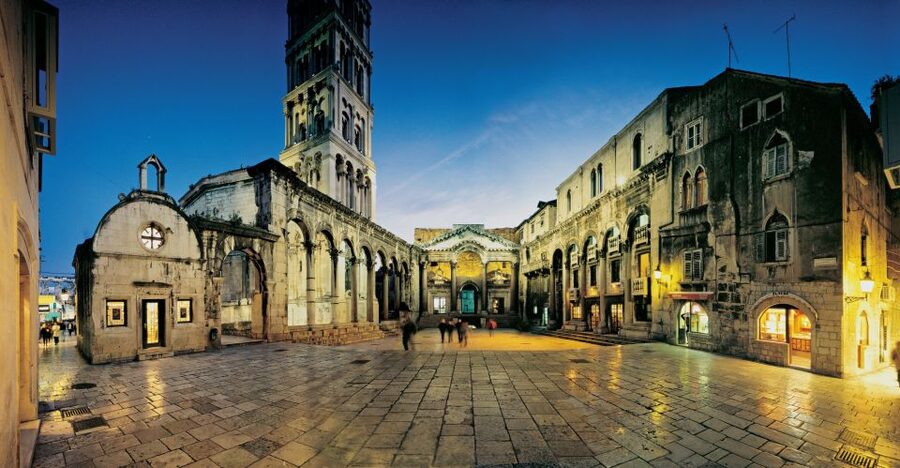
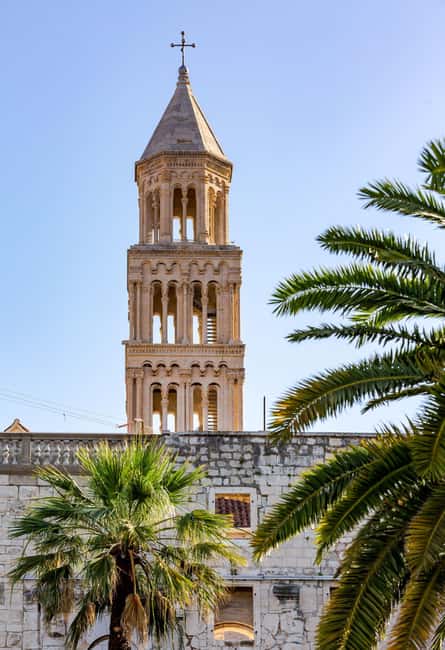
The Cathedral of Saint Domnius is formed from what began as Diocletian’s imperial mausoleum. That change in use is one of the clearest examples of Split’s layered past.
The building is identified as the oldest Catholic cathedral in the world, and its importance is not just a matter of age. A structure created for a Roman emperor was later adapted for Christian worship, showing how the city repurposed the palace instead of abandoning it.
The tour includes a guided look at the cathedral area, but entrance fees are separate. If you want to go inside paid sections, ask your guide about the current arrangements and allow extra time. The short stop gives you essential context, while a separate visit lets you study the interior at your own pace.
This is also a place where the guide’s storytelling matters. The physical building alone cannot explain the political and religious changes that turned a mausoleum into a cathedral. A clear explanation makes the site far more memorable.
Vestibul and the South Gate
The Vestibul is a round, domed entrance space connected to the palace’s ceremonial area. It offers another look at how movement through the imperial complex was organized.
The stop is partly architectural and partly visual. The curved form and strong stone surfaces make it one of the more distinctive photo points on the route. Your guide may also explain how it connected to the emperor’s private and ceremonial spaces.
The South Gate, sometimes called the Bronze Gate, brings the walk back toward the sea. Seeing it after the Riva helps you connect the palace to its waterfront position. The palace was not merely an inland fortress. Its southern side opened toward the water, making the relationship between imperial residence and coast easier to understand.
The tour then returns toward the starting area. By this point, you should have enough orientation to find the palace gates, squares, cathedral, and waterfront without constantly checking a map.
What the $41 price gets you
At $41 per person, this is not the cheapest way to wander Split. You can walk through many of the old-town streets without paying anything. The value comes from the guide’s structure, interpretation, and local advice.
I would consider the price fair if you are visiting Split for the first time, have only a few hours, or want the Roman remains to make sense quickly. The tour covers a lot of ground in 90 minutes to two hours, and several guides have added restaurant suggestions, nearby sights, local shortcuts, and advice on what is worth paying for.
The value is lower if you already know the palace well or prefer to explore slowly on your own. The pace is designed to cover the main sights, not to give you long periods for photography or quiet observation.
The strongest praise has consistently gone to the guides’ delivery. Sandra has been described as energetic and passionate about Split’s past. Ana has combined historical explanation with personal insight into Croatian life. Ivan has brought a warm, relaxed style, while Jelena has been praised for making facts easy to follow. Spanish-language guiding is also available.
One practical concern is language grouping. If English- and Spanish-speaking participants share a departure, the pace may feel less smooth. Ask about the language arrangement when booking if that matters to you.
Timing, walking effort, and who should take it
The official duration ranges from 90 minutes to two hours. That is enough time for an introduction but not enough for every palace room, cathedral detail, and museum stop. Think of it as your first map of Split, not the final word on the city.
Comfortable walking shoes are important. The route includes old streets, palace passages, outdoor squares, and cellar areas. The activity is specifically not recommended for people with mobility impairments.
Heat can affect the experience, especially on the Riva and in exposed squares. An early departure has the advantage of cooler conditions and lighter crowds. An evening departure may also be pleasant, and one 6 p.m. tour was considered a good choice for avoiding the strongest heat.
I would choose this tour for first-time visitors, cruise passengers with limited time, history fans, and anyone who wants a local guide before exploring alone. It also suits people who enjoy learning through stories rather than reading plaques.
I would skip it if you need a fully accessible route, dislike steady walking, or want a slow photography tour. I would also reconsider it if your main goal is an extended visit inside the cathedral or palace cellars, since extra entrance costs and limited stop times may not meet that aim.
Cancellation and booking flexibility
You can cancel up to 24 hours before the start for a full refund. The reserve-now, pay-later option also helps if your schedule in Split depends on a cruise arrival, ferry connection, or changing weather.
The meeting point can vary by booking option, so check the exact location before setting out. The listed starting choices include the South Tours Travel Agency, with the walk returning to that area.
Should you book this Split walking tour?
Book it if you want Split’s Roman core explained by someone who knows the city as a home, not just as an archaeological site. The combination of cellars, gates, Peristyle, cathedral, Fruit Square, and Riva gives you a strong first look at the city in a short time.
I especially recommend it for a first morning or first evening in Split. Take notes on food suggestions and shortcuts, then use the rest of your stay to return to the places that caught your attention.
Skip it if mobility is a concern or if you want a long, detailed interior tour with entrance fees included. For most first-time visitors who can manage the walking, $41 buys a useful orientation, solid Roman history, and the local context that makes Split’s old stones come alive.
FAQ
How long does the Split walking tour last?
The tour lasts about 90 minutes to two hours, depending on the departure and pace of the group.
What languages are available?
Live guiding is available in English and Spanish.
Are entrance fees included?
No. Entrance fees are not included in the tour price, and food and beverages are also separate.
Where does the tour meet?
The meeting point can vary by the option booked. The listed starting location is South Tours Travel Agency, and the tour returns there.
Is the tour suitable for people with limited mobility?
No. The tour is not recommended for people with mobility impairments, and comfortable walking shoes are advised.
Can I cancel the booking?
Yes. You can cancel up to 24 hours in advance for a full refund. A reserve-now, pay-later option is also available.
More Diocletian's Palace tours in Split
- Split & Diocletian’s Palace Walking Tour
★ 5.0 · 1,125 reviews - Split: Diocletian Palace & Old Town Guided Walking Tour
★ 4.7 · 882 reviews - Split: Game of Thrones Tour with Diocletian’s Palace Cellar
★ 4.8 · 545 reviews - Diocletian’s Palace and Old Town SMALL GROUP Walking Tour
★ 5.0 · 502 reviews
Just added in Split
- Discover The Old Town Split 1.5h walking Small group tour★ 4.8 · 93 reviews
- From Split: Zagreb Transfer & Plitvice Lakes Tour★ 4.7 · 131 reviews
- Blue Cave, Komiža, Stiniva Bay, Budikovac, Hvar Split Island Boat Tour★ 5.0 · 53 reviews
- Split to Dubrovnik Private transfer 1-8 pax (Door to Door any location)★ 5.0 · 118 reviews
- Sinj: Panoramic Flight over Peruca Lake and Dinara mountain★ 5.0 · 9 reviews
- The Diocletian route – Panoramic Flight over Split★ 5.0 · 9 reviews
- Split Cooking Class★ 5.0 · 142 reviews
- From Sinj: 1.5-Hour Private Flight over Kornati & Šibenik★ 4.1 · 11 reviews
Diocletian Palace Tours, compared.
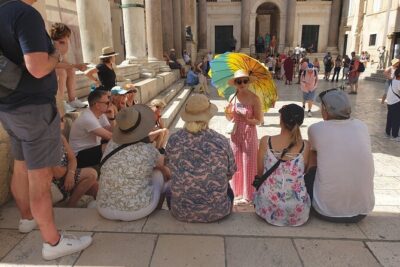
Walking Tour of Split and Diocletian’s Palace
Read our review →
Diocletian Palace & Old Town Guided Walking Tour
Read our review →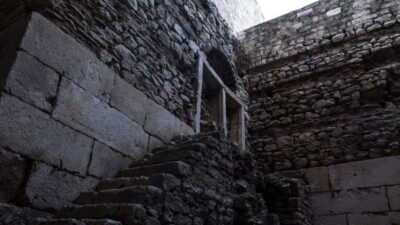
Game of Thrones Tour with Diocletian’s Palace Cellar
Read our review →
Diocletian’s Palace and Old Town SMALL GROUP Walking Tour
Read our review →
Browse the lists this tour appears in