

Reviewed · WALKING TOURS
Split: Guided Walking Tour in English
Diocletian’s Palace is not a quiet ruin behind a fence. It is the living heart of Split, with ancient columns, medieval buildings, shops, cafés, and homes packed into the old Roman complex. This 90-minute walking tour gives you a useful first look at how the palace shaped the city around it.
I like the focus on local history and daily life, not just dates and stones. I also like that guides such as Petra and Gabrijela have been praised for answering questions and sharing tips about food and local customs. The main drawback is that entrance tickets to churches and museums are not included, and the route is not wheelchair accessible.
Key points at a glance

- Diocletian’s Palace remains a living neighborhood: People still live within the ancient walls, so you see a real city rather than a preserved exhibit.
- The Peristyle is the major architectural moment: This monumental court once led toward the emperor’s private apartments and mausoleum.
- Local guides add useful context: Petra and Gabrijela have been singled out for clear English, friendly help, and practical advice about Split.
- The tour covers 1,700 years in 90 minutes: You get a strong orientation, though the pace leaves little time for long stops inside paid sites.
- The route begins and ends by the Riva: Meet at the Gray Line office at Obala Hrvatskog Narodnog Preporoda 21, a convenient point near Split’s waterfront.
- Tickets are separate: Your guide can explain where to buy admission for churches and museums, but those visits happen at your own pace after the tour.
Why Diocletian’s Palace is Split’s best starting point
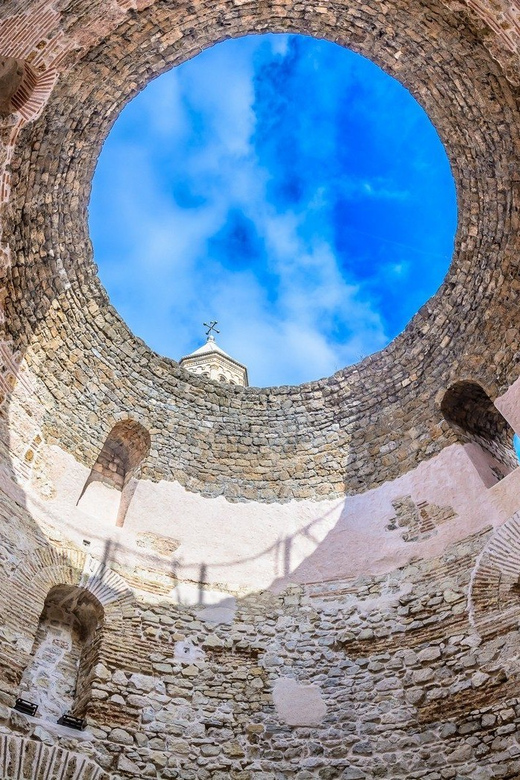
If you have only one short introduction to Split, the palace makes sense. The old center grew around a Roman emperor’s retirement residence, and the palace still sets the shape of the city. Its walls are not simply an old attraction you visit for an hour. They form the framework of streets, squares, businesses, and homes used every day.
Diocletian ordered the palace in the early fourth century. The result was part imperial residence, part military complex, and part ceremonial center. Over the centuries, later residents altered the site, added medieval buildings, and adapted Roman spaces for new uses.
That mix is what makes the walk worthwhile. You are not looking at one clean period of architecture. You are reading layers of Split, from the Roman foundations to medieval additions and modern life inside the walls.
The guide helps you make sense of a place that can otherwise feel like a maze. Without context, a column or stone arch may look attractive but disconnected. With an explanation of how the palace worked, the streets begin to feel like parts of one enormous home and public complex.
Other guided walks in Split:
- Split: Old Town and Diocletian Palace Walking Tour
★ 4.9 · 4,727 reviews - Walking Tour of Split and Diocletian’s Palace
★ 5.0 · 2,588 reviews - Krka Waterfalls tour with Trogir Walking tour and Krka panoramic boat cruise
★ 5.0 · 1,659 reviews
Meeting at the Riva and getting oriented
The tour starts at the Gray Line office at Obala Hrvatskog narodnog preporoda 21. This address is on Split’s waterfront promenade, known locally as the Riva, and the walk returns to the same place after about an hour and a half.
That arrangement is useful if you are arriving in Split by boat, staying near the center, or using the tour to get your bearings on your first day. You do not need a separate transfer to reach the old town. The activity is entirely on foot, so wear comfortable shoes and expect stone paving and narrow lanes.
The group size is not specified, and it may vary by date. One past booking had only three people, which created an especially personal experience with guide Gabrijela. You should not count on a private tour, but a smaller group can make it easier to ask questions and hear explanations in busy parts of the center.
The guide leads in English. Guides have included Petra and Gabrijela, both praised for friendly conversation, clear English, and a willingness to answer questions. The exact guide is not guaranteed, but the local focus is central to the experience.
Walking the narrow streets of the old center
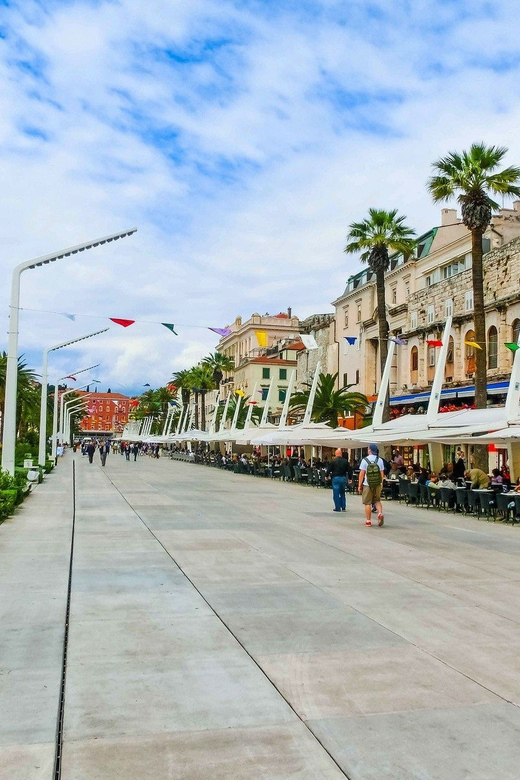
Once you leave the waterfront, Split’s old center quickly becomes a network of narrow stone lanes. These streets can feel confusing at first, especially when several passages appear to lead in different directions. That is one reason a guided walk has real value here.
The route introduces the way the modern city grew within and around the palace. You see Roman remains beside later medieval buildings, with ordinary homes and businesses filling spaces that once served imperial purposes.
I like this part of the tour because it keeps Split from becoming a simple checklist of monuments. The important question is not only what a structure was built for, but how the city continued to use it. Ancient walls gained new purposes. Old spaces were divided, rebuilt, and folded into everyday life.
The guide also covers local customs and traditions. The information is not limited to emperors and construction dates. You hear about the culture of Split and how the city developed as a place where people still live, work, and meet.
Because the full walk lasts 90 minutes, expect an overview rather than a slow architectural study. You will have time to understand the main sites and ask questions, but you will not explore every corner or spend long inside each church or museum.
The Peristyle, where the palace becomes grand
The Peristyle is the main visual payoff. This monumental court provided access to the imperial apartments and the emperor’s mausoleum. It gives you a better sense of the palace as a place of ceremony and power.
Here, the scale changes. The narrow lanes open into a more formal space, and the surviving Roman elements make the original design easier to imagine. Your guide explains how this area functioned and how later changes altered the palace without erasing its Roman core.
For many people, this is the point when Split’s history clicks into place. The palace was not an isolated residence hidden from the city. It was a planned complex with public, ceremonial, and private areas, all connected by carefully designed routes.
The Peristyle is also a good example of why a guide matters. You can admire the stonework on your own, but the meaning of the court, its connection to the imperial apartments, and its role in the palace plan are harder to grasp without explanation.
The tour does not include entrance fees to churches or museums. Your guide can point out where tickets are sold and explain how to visit these places after the walk. This gives you flexibility, but you should budget separately if you want to go inside paid sites.
Same base, a different kind of day out:
- Split: Krka Waterfalls Trip with Boat Cruise and Swimming
★ 4.8 · 10,519 reviews - From Split: Krka Waterfalls, Food & Wine Tasting Tour
★ 5.0 · 9,326 reviews - Blue cave, Mamma Mia and Hvar, 5 islands speedboat tour
★ 5.0 · 7,150 reviews - From Split: Krka Waterfalls, Food & Wine Tasting Tour
★ 4.9 · 6,598 reviews
Roman remains beside medieval life
The palace is most interesting when Roman and medieval details appear side by side. You may see ancient construction incorporated into buildings that took shape much later. The result is not perfectly polished, and that is part of its appeal.
The guide explains how Split grew around Diocletian’s Palace rather than abandoning it. Over many centuries, people built into the existing complex and changed its purpose. Medieval extensions became part of the urban fabric, while Roman structures remained useful foundations and landmarks.
This is also where the experience feels most authentic. You are not simply walking through a staged historical setting. People still live within the walls, and daily life continues alongside old stonework. A doorway or apartment entrance may be part of a much older structure than its present use suggests.
I would pay attention to these transitions rather than rushing from one famous monument to the next. The power of the tour is in seeing how a Roman palace became a Croatian city center.
A useful introduction to Split’s culture
The tour also gives space to local customs, traditions, and food recommendations. This is a practical bonus, especially if Split is your base for several days. You can ask your guide for ideas after the formal history portion, as previous guides have been willing to discuss local food and places to consider.
Do not expect a full food tour or a long cultural workshop. The activity remains a historical walking tour. Still, those local details can help you understand that Split is more than its Roman past.
The strongest guide feedback has focused on personal communication. Petra was praised for taking questions and explaining the history of the region. Gabrijela was described as a local with strong English and useful advice about food and culture. That suggests the tour works best when you take part in the conversation rather than simply following silently.
Bring questions. Ask how the city changed, how people use the palace today, or what to see after the tour. A 90-minute walk goes further when you use the guide’s local perspective.
Is $29 a fair price?
At $29 per person, the tour is reasonably priced if you want a clear introduction to Split without committing to a longer excursion. The value comes from having the palace explained in context and getting an orientation to the old center in one compact walk.
The price includes the 1.5-hour walking tour, an English-speaking guide, and taxes. It does not include admission to churches or museums. If you plan to visit paid sites afterward, add those costs to your budget.
For a first visit, I think the price makes sense because the palace can be difficult to read independently. You are paying for structure, local knowledge, and the chance to ask questions. If you already know Split well or prefer to wander without a set route, the value will be lower.
The tour also has free cancellation up to 24 hours before the start time, with a full refund, and you can reserve now and pay later. Those policies help if your schedule depends on ferry connections, weather, or changing plans.
Who should book this walking tour?
I would recommend it to first-time visitors who want to understand Split before exploring on their own. It suits couples, families with older children, and solo visitors who enjoy asking questions and getting local suggestions.
It is also a good fit if you have limited time. Ninety minutes is long enough to introduce the key monuments without taking over your whole day. Afterward, you can return to the sites that interest you most and buy tickets for churches or museums separately.
The tour is less suitable if you need step-free access. It is not wheelchair accessible, and the old center includes narrow stone streets. Children must be accompanied by an adult, and unaccompanied minors are not allowed. Pets are not permitted.
You should also choose another activity if you want extensive interior visits. This walk concentrates on the historic center, explanations, and major landmarks. Paid attractions are left for you to visit later.
What to know before you go
Wear shoes that are comfortable on stone streets. The route is outdoors and on foot, so a small bottle of water may be useful, especially during warm weather.
Arrive at the Gray Line office at Obala Hrvatskog Narodnog Preporoda 21. Since the tour begins and ends there, you can plan another activity in the center afterward without arranging transport.
Keep some flexibility after the tour if you want to enter a church or museum. Your guide can show you where to buy tickets and explain the options, but admission is not part of the $29 price.
The walk is in English only. If you prefer an intimate experience, group size may matter to you, but it is not fixed in the available information. A past booking had a very small group, while other dates may be larger.
My take: a smart first walk in Split
Book this tour if you want the palace to make sense, not just look old and photogenic. The combination of Roman remains, medieval additions, and homes still inside the walls gives you a useful way to read Split for the rest of your stay.
The best reasons to choose it are the local English-speaking guide, the focus on culture as well as history, and the compact 90-minute format. Guides such as Petra and Gabrijela have been praised for friendly explanations and practical answers, which is exactly what you want from an introductory city walk.
Skip it if you dislike guided pacing, require wheelchair access, or mainly want included entry to monuments. For most first-time visitors, though, $29 is a fair price for a well-focused introduction to Diocletian’s Palace and the city that grew around it.
FAQ
How long is the Split walking tour?
The tour lasts 90 minutes, or 1.5 hours.
What language is the tour in?
The tour is conducted in English by a live English-speaking guide.
Where does the tour meet?
Meet at the Gray Line office at Obala Hrvatskog Narodnog Preporoda 21 in Split.
Does the tour include entrance tickets?
No. Entrance fees for churches and museums are not included. The guide can explain where to buy tickets, and you can visit those sites at your own pace after the tour.
Is the tour wheelchair accessible?
No. The tour is not wheelchair accessible and is not suitable for wheelchair users.
Can children join the tour?
Yes, but children must be accompanied by an adult. Unaccompanied minors are not allowed.
Just added in Split
- From Trogir, Seget, Okrug: Krka Waterfalls & Šibenik Culture Tour★ 5.0 · 10 reviews
- Krka Waterfalls & Primošten from Trogir, Seget, Čiovo & Kaštela★ 5.0 · 18 reviews
- Slatine – Island Hopping Excursion (Trogir/Blue Lagoon/Shipwreck)★ 4.0 · 24 reviews
- Island Hopping Boat Excursion with Lunch (Trogir,Blue Lagoon, Šolta)★ 3.5 · 6 reviews
- From Split & Trogir: ATV Quad Tour on Island Čiovo★ 5.0 · 21 reviews
- Split: Sunset Guided Kayaking Tour★ 4.8 · 71 reviews
- Split Sunset Stand Up Paddle Tour★ 5.0 · 16 reviews
- Stand Up Paddle Tour in Split★ 4.7 · 17 reviews
Walking Tours, compared.
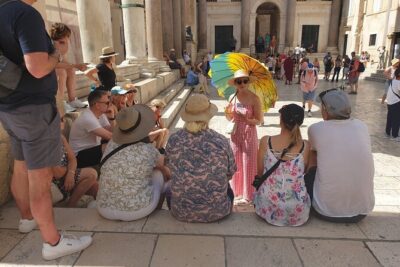
Walking Tour of Split and Diocletian’s Palace
Read our review →

Krka Waterfalls tour with Trogir Walking tour and Krka panoramic boat cruise
Read our review →
City Walls Early Morning or Sunset Walking Tour
Read our review →
Browse the lists this tour appears in