
Reviewed · WALKING TOURS
Split; Private Morning Walking Tour in Split
Split’s old town is not a museum behind glass. It is a living city built inside a 1700-year-old palace, with homes, shops, cafés, lanes, and market stalls fitted into Roman walls. This private morning walk helps you understand that unusual mix before the day gets crowded. Diocletian’s Palace and its underground cellars are the main event, but the tour also connects them to Split’s daily life.
I like the early timing, which gives you a calmer start, and the private format, which lets your group ask questions about both history and modern Split. The visit to Pazar market is another strong point because it brings you from emperors and stonework to the food and produce of Dalmatia. The main consideration is pace: two hours covers many stops, so this is an introduction rather than a long, detailed visit inside every monument.
Key points at a glance
- Roman palace turned city center: Walk through Diocletian’s Palace while learning how ancient walls still shape everyday Split.
- Morning timing: Start early to avoid much of the crowd and enjoy a less hurried walk.
- Private group of up to 10: Your party has its own licensed guide rather than joining a large public group.
- Cellars and cathedral: See the preserved substructures and the Cathedral of Saint Domnius, originally built as Diocletian’s mausoleum.
- Pazar market stop: Visit the green market where locals buy and sell produce from Dalmatian soil.
- English or German: The tour is offered with a live guide in either language.
Start with Split’s city model
The tour begins at the model of Split’s historical core. That is a useful meeting point because it gives you a quick visual map before you enter the maze of old lanes and palace remains.
I find this sort of opening especially helpful in Split. The old town can feel confusing at first, since Roman, medieval, Venetian, and modern buildings sit close together. Seeing the core represented as a whole helps you understand where the palace walls, squares, cathedral, market, and waterfront fit together.
Bring water, particularly in the warmer months. The tour is on foot, and although the morning is the cooler part of the day, you will still be outside for most of the two hours.
Other guided walks in Split:
- Split: Old Town and Diocletian Palace Walking Tour
★ 4.9 · 4,727 reviews - Walking Tour of Split and Diocletian’s Palace
★ 5.0 · 2,588 reviews - Krka Waterfalls tour with Trogir Walking tour and Krka panoramic boat cruise
★ 5.0 · 1,659 reviews
Diocletian’s Palace, where ancient walls became a neighborhood
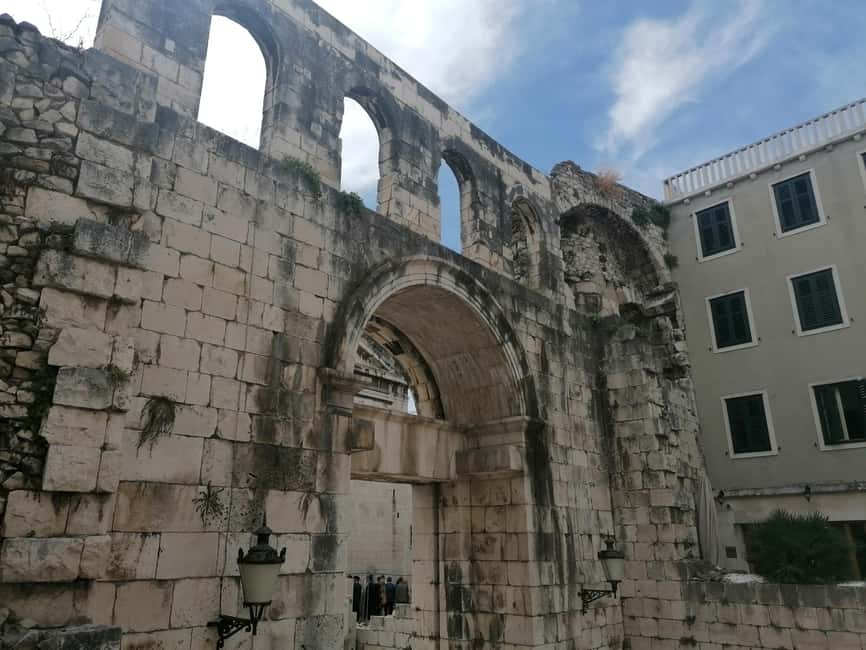
Diocletian’s Palace is the central story of the tour. Emperor Diocletian built the complex at the turn of the fourth century as a retirement residence. Today, it is not an isolated ruin. Streets and buildings occupy the old palace grounds, giving the place a rare sense of continuity.
Your guide explains how the palace worked and how its remains became part of Split’s later city. That makes the visit more useful than simply stopping for photographs. You begin to notice that a narrow lane, a stone arch, or a courtyard may have a much older purpose than its current use suggests.
The tour allows about 10 minutes for the palace stop itself, followed by a guided visit to the cellars. Since the full experience lasts two hours and includes many locations, you should expect a clear overview rather than a lengthy architectural lecture at every corner.
The Diocletian’s Cellars reveal the palace below

The cellars are among the most valuable stops because they show the palace’s original scale and structure from below. Their preserved walls and passages help you picture the rooms that once occupied the level above.
A guided visit matters here. Without context, underground stone corridors can blur into one another. Your guide connects the cellars to Diocletian’s palace plan and explains why these lower spaces are important to understanding the building.
The scheduled visit lasts about 10 minutes, so it is fairly brief. If underground spaces are the reason you are coming to Split, you may want extra time afterward to return independently. For a first visit, though, this stop gives you a strong physical sense of the palace rather than just an abstract date and name.
Saint Domnius and the unusual afterlife of a mausoleum
The Cathedral of Saint Domnius, known locally as Sveti Duje, was originally the mausoleum of Emperor Diocletian. That change in purpose is one of Split’s most striking historical details. A building created for an emperor’s burial became a Christian cathedral, and the Roman structure remains part of the city’s religious life.
The tour allows around 10 minutes for guided sightseeing here. Your guide discusses the building’s past and present, showing how Split’s story is not divided neatly into Roman, medieval, and modern chapters. Each period sits on top of the last.
Because the visit is short, you should not expect a full cathedral study or a long independent pause. The value is in the explanation and the connection to Diocletian’s original complex.
Same base, a different kind of day out:
- Split: Krka Waterfalls Trip with Boat Cruise and Swimming
★ 4.8 · 10,519 reviews - From Split: Krka Waterfalls, Food & Wine Tasting Tour
★ 5.0 · 9,326 reviews - Blue cave, Mamma Mia and Hvar, 5 islands speedboat tour
★ 5.0 · 7,150 reviews - From Split: Krka Waterfalls, Food & Wine Tasting Tour
★ 4.9 · 6,598 reviews
Peristil gives you the palace’s grand public face
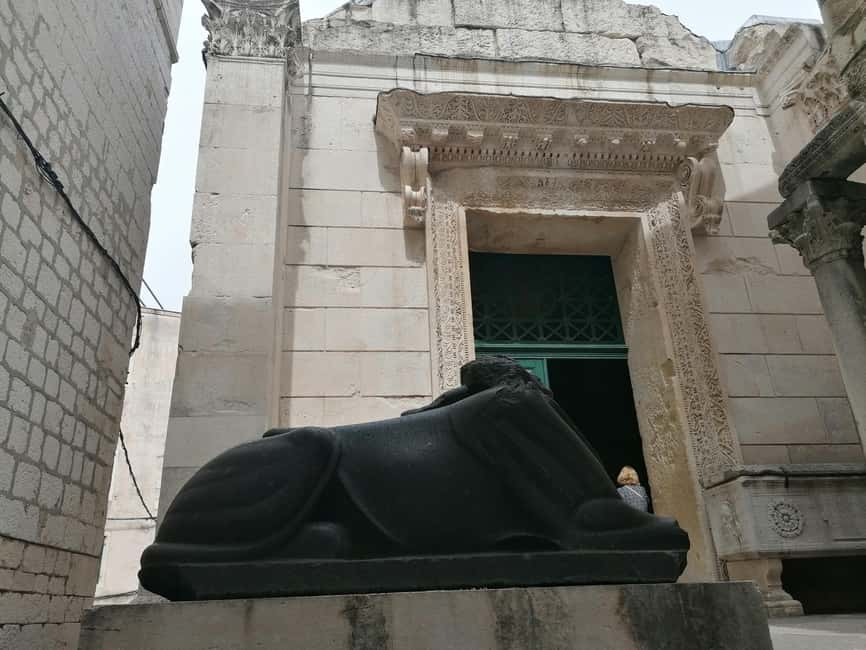
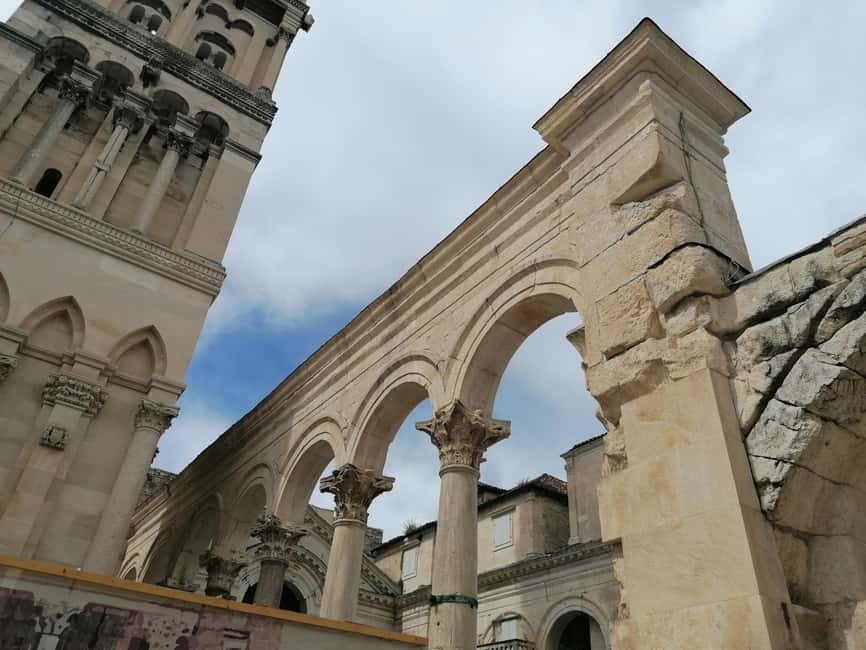
Peristil is one of the key squares inside the old palace. The tour gives it about 15 minutes, enough time to look around, take in the surrounding stonework, and hear about its role in the palace plan.
This is a good place to pause and understand the contrast between formal imperial design and the irregular lanes that developed around it. The square feels monumental, yet it is part of the daily route through the old town.
Your guide also uses the city’s streets and squares to discuss culture and present-day life. That approach suits Split, where historical buildings are not just backdrops. They form the setting for ordinary errands, meals, and conversations.
The Golden Gate and the palace entrances

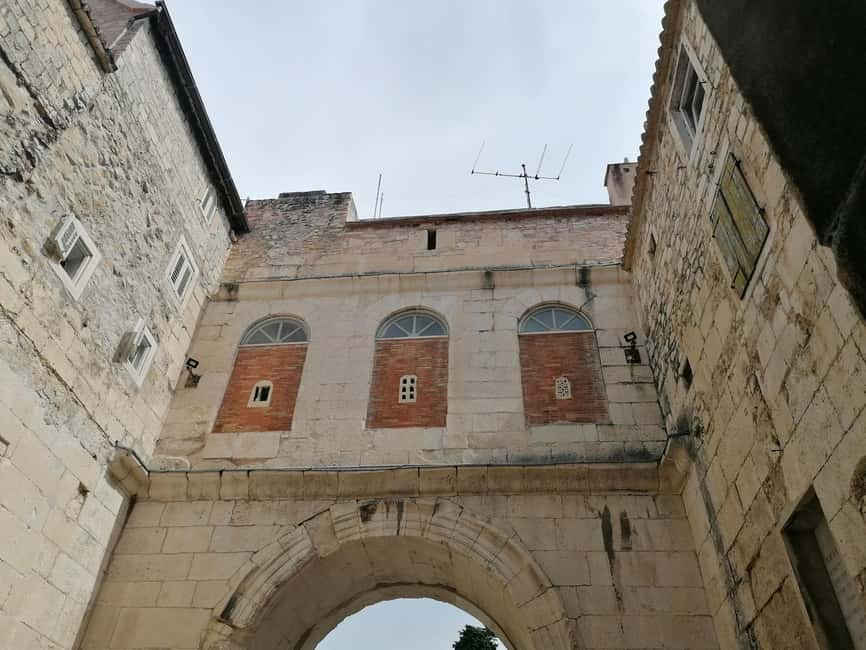
The Golden Gate receives about 15 minutes, including a photo stop. It was one of the main entrances to Diocletian’s Palace, and its scale helps you imagine how the complex presented itself to the outside world.
This stop is useful for orientation. After seeing the interior, you can look back at the palace as a fortified residence with major entrances and a clear relationship to the surrounding city.
Photo time is built into the schedule, but you will want to stay aware of the group’s pace. With several more stops ahead, this is not designed as an extended photography session.
A secret stop adds room for discovery
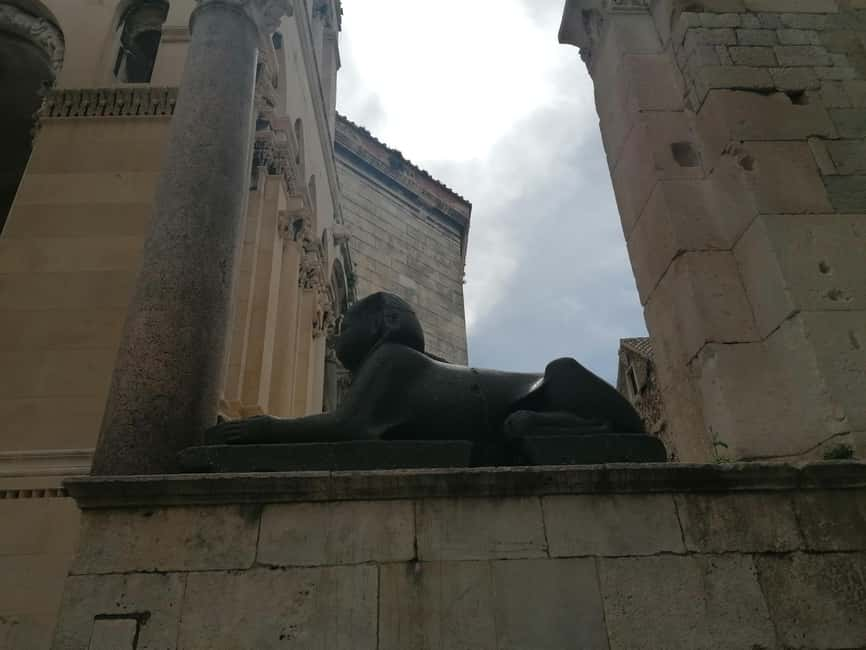
The itinerary includes a secret stop lasting about 20 minutes. Its exact nature is not specified in advance, which is part of the appeal. It gives the guide room to show you an additional place connected to Split’s history or local character.
I would treat this as a flexible bonus rather than the reason to book. The fixed stops already provide the main structure, while the secret stop may make the walk feel more personal. Since it is a private tour, your guide can explain why this particular place belongs in the story of the city.
The lack of a named location also means you should not book expecting a specific monument. Think of it as an extra chapter chosen by the guide.
People’s Square brings the old town into the present
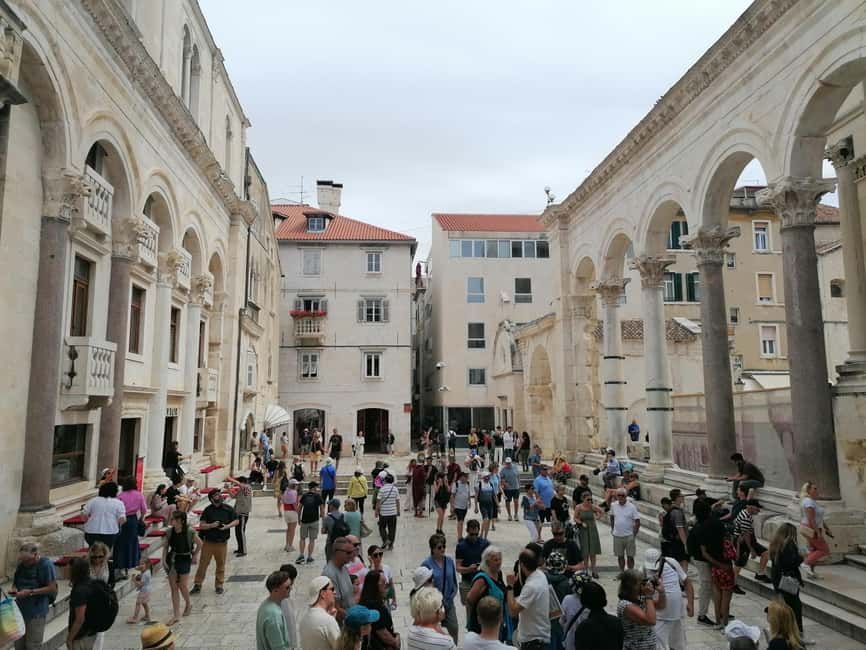
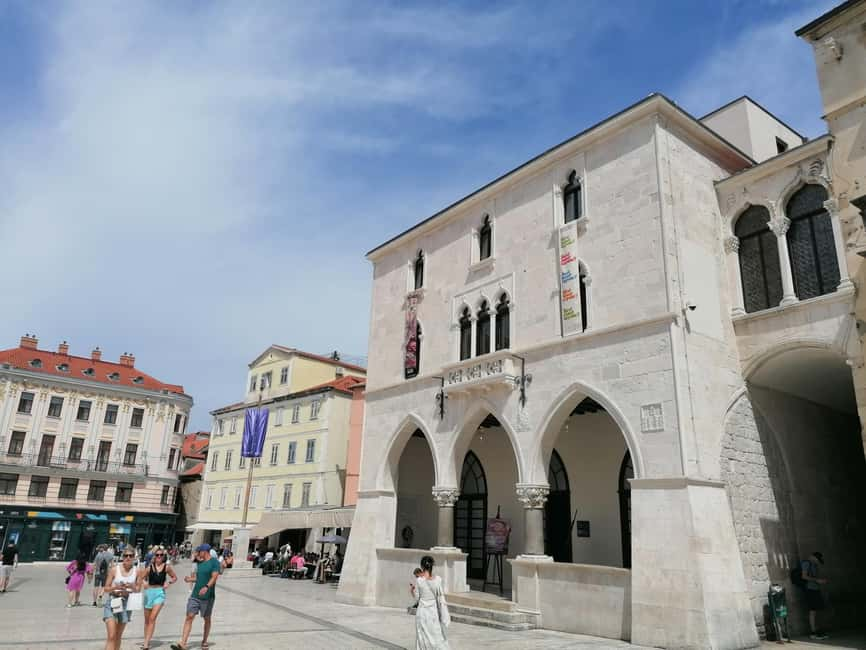
People’s Square is scheduled for about 15 minutes and includes sightseeing and shopping. This is where the walk shifts naturally from imperial remains to the public life of modern Split.
The square helps show how the old town works as a real urban center. You are not simply moving from one archaeological site to another. Shops, streets, and meeting places occupy the same setting as centuries-old buildings.
The tour includes advice on dining, nightlife, and other activities in Split and the surrounding area. That can be valuable early in a stay because you can use the guide’s suggestions to shape the rest of your visit. Keep in mind that personal purchases are not included in the price.
Pazar market shows the local side of Split

The green market, usually called Pazar, is one of the most appealing parts of this walk. It is where local people buy and sell products native to Dalmatian soil, giving you a look at the region beyond monuments and polished waterfront views.
Market visits work best when you pay attention to the ordinary details: what is being sold, how the stalls are arranged, and how the place fits into daily routines. The tour does not turn the market into a formal food tasting, so do not expect included samples or purchases. Instead, you get a guided introduction to one of Split’s practical, local spaces.
This stop also helps balance the palace-heavy first half of the walk. You see how the city breathes now, not just how it functioned under Diocletian.
Riva promenade closes the walk by the water
The Riva is Split’s waterfront promenade and the final major sightseeing stop. The tour allows about 10 minutes for a photo stop before returning to the city model for a break.
The waterfront gives you a different view of Split after the tight lanes and heavy stone of the palace. It is a good place to finish because you can connect the old town to the city’s open public edge.
Do not expect a long waterfront stroll. The Riva portion is short, and the tour has already covered many places. If you want to linger by the water, take photographs, or sit at a café, plan to do that after the guided walk.
What the two-hour format means for you
The listed stops add up to a busy sequence, with roughly 10 to 20 minutes at each location. That structure keeps the walk moving and gives first-time visitors a useful map of central Split.
I would choose this format if you want a strong introduction on your first morning, especially before exploring more on your own. It suits people who prefer stories and orientation over a slow, single-site visit.
You may want a different plan if you want long interior visits, extensive photography, or time to browse every market stall. The guide can cover history, culture, food, nightlife, and nearby activities, but two hours still imposes a firm limit.
Private pricing and who gets the best value
The cost is $129 per group of up to 10 people. For a full group, that works out to about $12.90 per person, which is good value for a private licensed guide and a two-hour introduction to central Split.
For two people, the per-person cost is much higher. The private format still buys privacy, a more personal pace, and the chance to ask questions without a large group, but couples should compare that benefit with a shared walking tour if keeping costs low is the priority.
Families and groups of friends get the strongest value. You can split the fixed price among up to 10 people, and the private setting may be easier for a mixed-age group than a large public walk.
The tour includes the licensed guide. Personal expenses are not included, so budget separately for anything you buy at Pazar, People’s Square, or elsewhere during the day.
The guide style and language choice
The tour is available in English or German with a live guide. Feedback identifies the guide as Kristina, although one note spells the name Christina. The useful point is that the guide’s role goes beyond reciting dates: the walk covers the city’s past and present, dining tips, nightlife, and other things to do.
The strongest praise focuses on information delivered in a personal way. One German-language response describes the walk with Kristina as informative and personal, while another says Christina explains a great deal of knowledge well. That suggests you should expect an explanatory walk rather than a silent route between photo stops.
If you have specific interests, ask about them during the private tour. The format is designed for your group, though the two-hour schedule means the guide still has to keep the route moving.
Practical details before you reserve
The meeting point is the model of Split’s historical core. Check the starting time when you book because the tour is offered at different morning times depending on availability.
The tour lasts two hours and is private for your group. It is available for up to 10 people, with a licensed guide speaking English or German.
You should bring water. Wear shoes suitable for walking on old-town streets and palace floors, though no special equipment is listed as necessary.
You can cancel up to 24 hours in advance for a full refund. You can also reserve now and pay later, which gives you some flexibility if your Split plans are still changing.
Should you book this Split walking tour?
Book it if you want a calm first look at Split, a private guide, and a clear explanation of how Diocletian’s Palace became a working city. It is especially well suited to families, couples traveling with friends, and groups that can share the $129 price.
The strongest reasons to choose it are the early timing, the cellars, the cathedral’s unusual Roman past, and the stop at Pazar market. The walk also gives you useful ideas for meals, nightlife, and later activities.
Skip it if you want a long, highly detailed visit inside each monument or prefer to explore entirely at your own pace. For most first-time visitors, though, this is a sensible way to get your bearings before Split’s streets fill and to understand why the city feels less like an archaeological site than a living neighborhood built into an emperor’s palace.
FAQ
Where does the tour begin?
The meeting point is the model of the historical core of Split.
How long does the walking tour last?
The tour lasts two hours.
How much does the private tour cost?
The price is $129 per group of up to 10 people.
How many people can join the private group?
The private group can include up to 10 people.
Which languages are available?
The live guide is available in English or German.
Is a guide included?
Yes. A licensed tour guide is included.
Does the tour visit Diocletian’s Cellars?
Yes. The cellars are included with a guided visit of about 10 minutes.
Does the tour visit Saint Domnius Cathedral?
Yes. The tour includes guided sightseeing at the Cathedral of Saint Domnius, also called Sveti Duje.
Is Pazar market included?
Yes. The tour visits Split’s Green Market, known as Pazar.
What should you bring?
You should bring water.
Can you cancel for a refund?
Yes. You can cancel up to 24 hours in advance for a full refund.
Can you pay later?
Yes. You can reserve the tour and pay later.
Just added in Split
- From Trogir, Seget, Okrug: Krka Waterfalls & Šibenik Culture Tour★ 5.0 · 10 reviews
- Krka Waterfalls & Primošten from Trogir, Seget, Čiovo & Kaštela★ 5.0 · 18 reviews
- Slatine – Island Hopping Excursion (Trogir/Blue Lagoon/Shipwreck)★ 4.0 · 24 reviews
- Island Hopping Boat Excursion with Lunch (Trogir,Blue Lagoon, Šolta)★ 3.5 · 6 reviews
- From Split & Trogir: ATV Quad Tour on Island Čiovo★ 5.0 · 21 reviews
- Split: Sunset Guided Kayaking Tour★ 4.8 · 71 reviews
- Split Sunset Stand Up Paddle Tour★ 5.0 · 16 reviews
- Stand Up Paddle Tour in Split★ 4.7 · 17 reviews
Walking Tours, compared.
Walking Tour of Split and Diocletian’s Palace
Read our review →

Krka Waterfalls tour with Trogir Walking tour and Krka panoramic boat cruise
Read our review →
City Walls Early Morning or Sunset Walking Tour
Read our review →
Browse the lists this tour appears in