
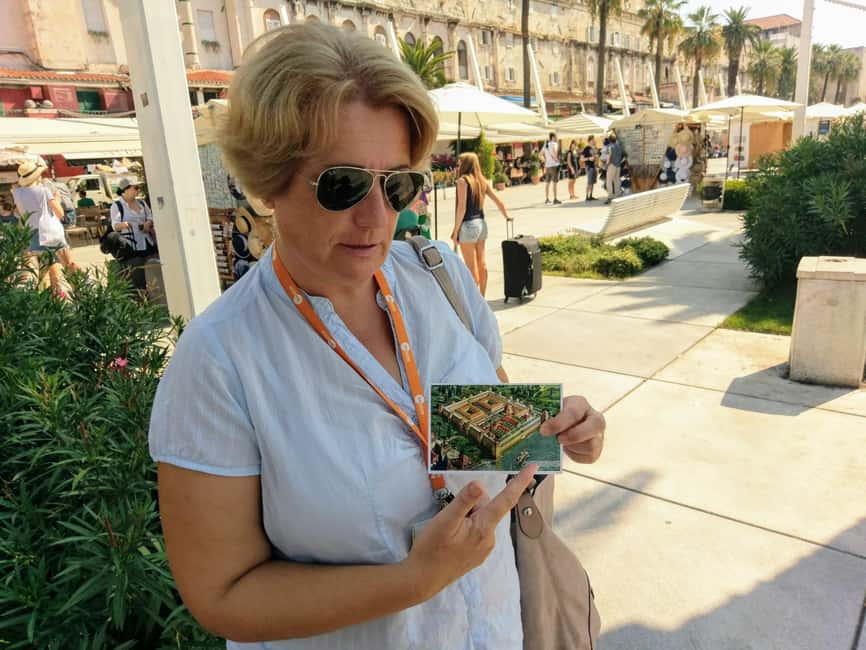
Reviewed · WALKING TOURS
Split: city center private walking tour 2 h
Split’s Diocletian’s Palace is not a lonely ruin behind a fence. It is the working heart of the city, with homes, cafés, shops, squares, and daily life tucked inside Roman walls. This private two-hour walk helps you read the old center as one long story, from Emperor Diocletian to Venetian rule and modern Split.
I like the private format, especially for families or small groups that want to ask questions and slow down at favorite spots. I also like the chance to visit the palace cellars, see the Roman mausoleum now used as the cathedral, and finish along the pleasant Riva waterfront. The main limitation is that some people may find the tour less of a full walking workout than expected, since much of the time is spent explaining key monuments in a compact area.
Key details at a glance
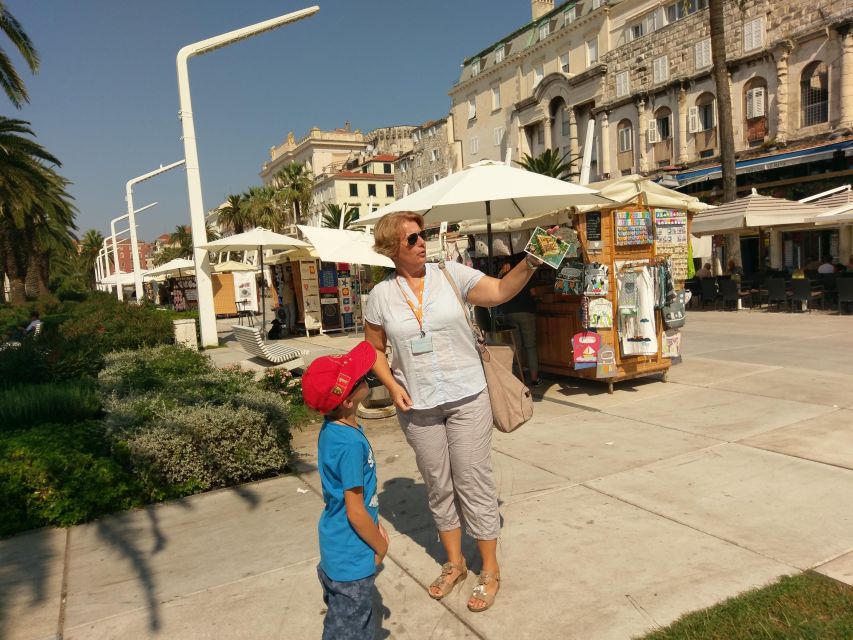
- Roman palace turned city center: Diocletian’s Palace is still part of everyday Split, not just an archaeological site.
- Private group up to 20 people: You can have a more personal pace than on a large shared tour.
- Three guide languages: Tours are offered in English, French, and Croatian.
- A compact but varied route: The walk links Roman remains, medieval squares, food markets, the fish market, and the seafront.
- Cellars and cathedral fees are extra: Plan for separate entrance costs if you want to go inside both paid sights.
- Comfortable shoes matter: Expect uneven surfaces and plenty of standing, even though the route covers a fairly small part of the city.
Why Split’s palace is the right place to start
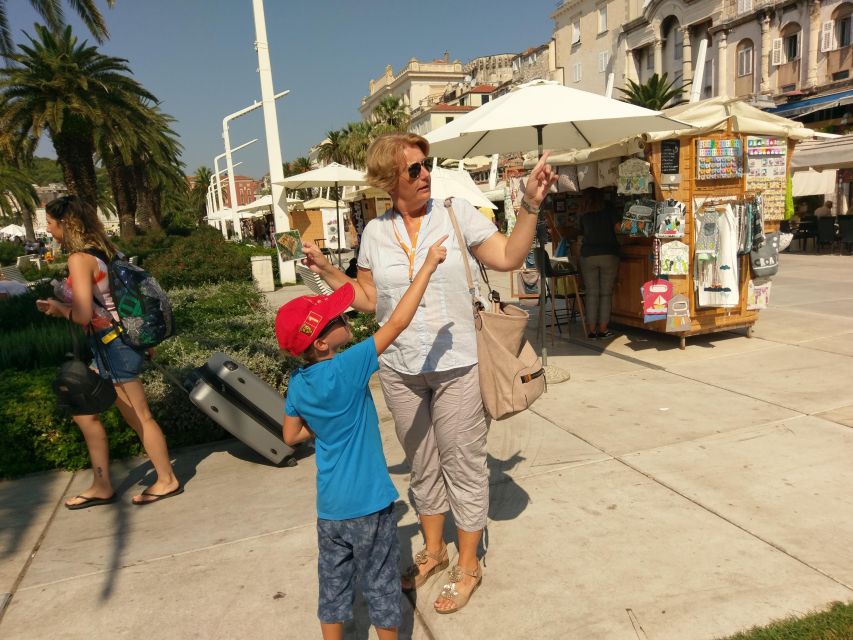
Split grew around the retirement palace of Roman Emperor Diocletian, built roughly 1,700 years ago. The palace is large enough to contain streets and neighborhoods, yet compact enough to explore on foot in a couple of hours.
That combination makes this a useful first introduction. You are not simply looking at isolated columns and guessing what they once meant. You move from the waterfront into the old center, then through Roman and medieval spaces that are still used today.
The meeting point is on Riva, in front of the entrance to the palace cellars at Obala Hrvatskog narodnog preporoda 15b. Look for the model of Split’s historic core nearby. Riva is easy to find, but it can be busy during the summer, so give yourself time to locate the guide.
The tour is led by a licensed guide. Past bookings have included Zrinka, also written as Zinka, and Yvonna. Zrinka has been praised for clear explanations, humor, local advice, and fluent French. Yvonna has been described as warm and enthusiastic about her city. Your guide may be someone else, but these comments suggest that the human side of the experience is a major part of its appeal.
Other guided walks in Split:
- Split: Old Town and Diocletian Palace Walking Tour
★ 4.9 · 4,727 reviews - Walking Tour of Split and Diocletian’s Palace
★ 5.0 · 2,588 reviews - Krka Waterfalls tour with Trogir Walking tour and Krka panoramic boat cruise
★ 5.0 · 1,659 reviews
Riva and the Green Market: modern Split around ancient walls
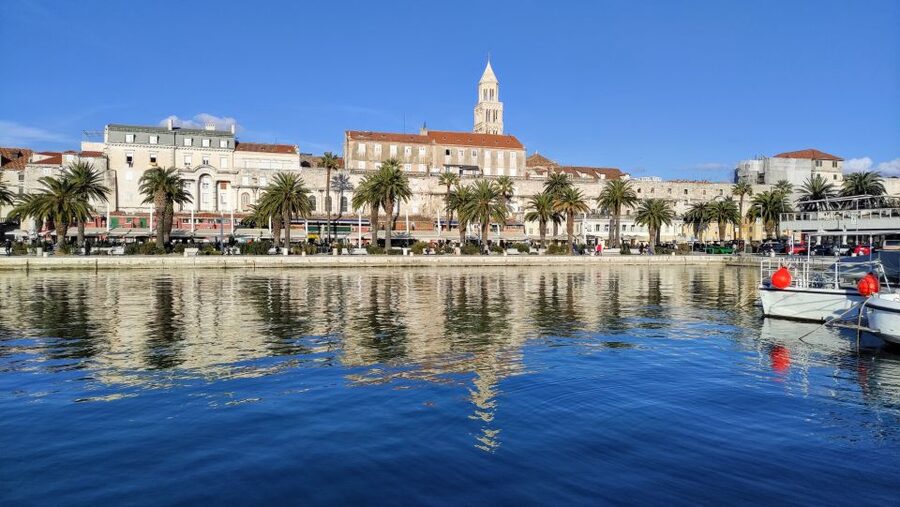
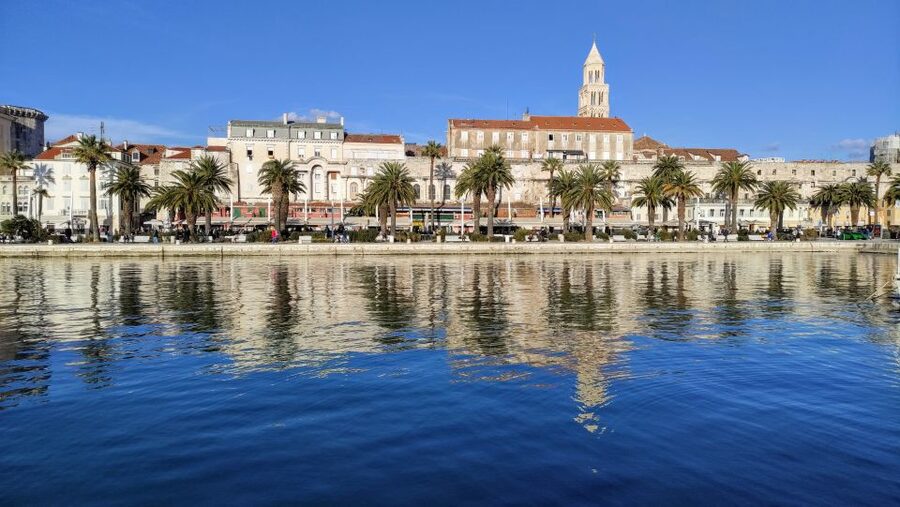
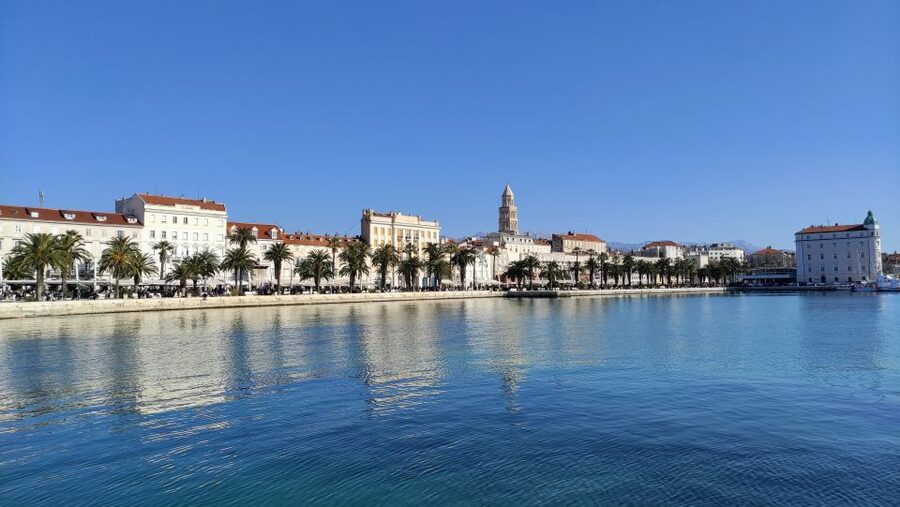
The route begins on Riva, Split’s broad waterfront promenade. This is a good place to get your bearings before entering the old center. Restaurants and cafés line the promenade, and the harbor setting makes it clear that Split is not only an old city but also Dalmatia’s main urban and transport center.
From here, the walk reaches the Green Market. You have about ten minutes to see this lively food market and perhaps shop. The market gives the tour a useful change of pace. After Roman stone and palace walls, you see the everyday business of the city, with local produce and ordinary shopping happening close to major monuments.
The nearby fish market adds another practical glimpse of local life. It is not a grand museum stop, and the visit is brief, but it helps keep the tour connected to present-day Split. I like this balance. A city tour can become too focused on emperors and dates; markets remind you that people still live, eat, work, and shop in the old center.
The palace cellars: Roman engineering beneath the city
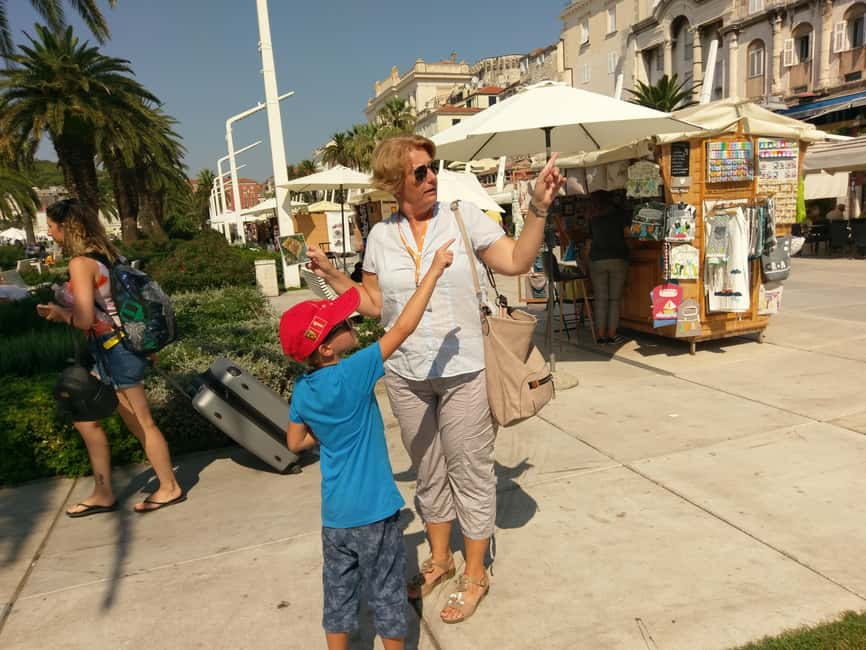
The palace cellars are one of the strongest parts of the route. Their original architectural job was to support and raise the imperial residential area above. That practical purpose gives you a clearer idea of how the palace was designed, rather than leaving you to picture a Roman building from a few surviving walls.
The spaces are well preserved, and the lower level is easier to understand with a guide pointing out its structure and purpose. The cellars also served as a filming location for Game of Thrones, which may interest fans, but the Roman engineering is the more worthwhile reason to visit.
Entrance to the cellars is not included in the tour price. The same applies to entry to the cathedral. Check the current fees before you go, especially if you are comparing this tour with an option that includes admissions.
The cellars can have uneven stone surfaces. Wear shoes with good support, and expect some standing while the guide explains what you are seeing. The tour is listed as wheelchair accessible, but uneven historic surfaces can still affect comfort and ease of movement.
Peristil and the cathedral of St. Duje
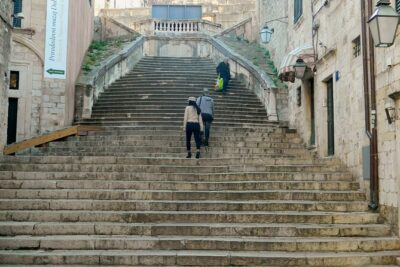
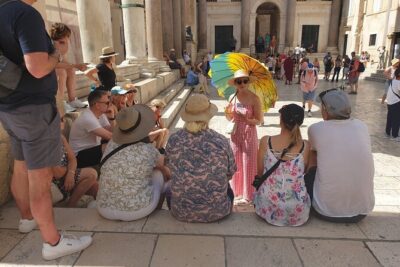
From the cellars, you walk up the stairs to Peristil, the palace’s central ceremonial courtyard. This is the spot where the Roman imperial setting becomes easiest to picture. Diocletian used it in connection with the cult of the living son of Jupiter, and the guide explains how the space related to the emperor’s status and religious role.
Peristil is also one of Split’s most striking open spaces. The surrounding stone, columns, stairs, and monuments create a strong sense of arrival. Your guide can help separate original Roman elements from later additions, which matters in a place that has changed use many times.
The cathedral of St. Duje is especially unusual. It began as Diocletian’s mausoleum and was later converted into a Christian cathedral. St. Duje is the patron saint of Split, and the building is often described as the oldest cathedral in the world.
Cathedral entry is extra. If you plan to go inside, your shoulders and knees must be covered. This is worth remembering in hot weather, when visitors often dress for the coast rather than for a religious building. A light scarf or cover-up can solve the problem.
The itinerary allows about 15 minutes at Peristil and includes a guided visit to the palace for about 45 minutes. That gives you enough time for an informed introduction, but not an exhaustive study of every building or inscription. If Roman archaeology is your main interest, tell the guide early and use the private format to steer the discussion.
Same base, a different kind of day out:
- Split: Krka Waterfalls Trip with Boat Cruise and Swimming
★ 4.8 · 10,519 reviews - From Split: Krka Waterfalls, Food & Wine Tasting Tour
★ 5.0 · 9,326 reviews - Blue cave, Mamma Mia and Hvar, 5 islands speedboat tour
★ 5.0 · 7,150 reviews - From Split: Krka Waterfalls, Food & Wine Tasting Tour
★ 4.9 · 6,598 reviews
Golden Gate and the statue of Gregory of Nin
The Golden Gate is one of the palace’s main entrances and a natural place for a photo stop. Its scale helps you understand how the palace was organized and defended. The guide can also connect the gate to the city streets that developed around it.
Nearby, you see the statue of Gregory of Nin. This medieval bishop is remembered for promoting the use of the Croatian language in worship. The statue is a popular stop, and touching its toe is said to bring good luck, though that tradition is not part of the formal tour description. You can still use the stop to ask about Croatia’s language and religious history.
The route here is fairly compact. This is where the earlier criticism about limited walking becomes relevant. You cover several important sights, but they are close together, and the guide may spend more time explaining than leading you through long stretches of streets and alleyways.
That is a strength if you want a focused introduction and a weakness if you expect a broad neighborhood walk. Tell your guide if you would like more time in side streets, courtyards, or less famous corners of the old center.
People’s Square and Split’s medieval side
People’s Square, known locally as Pjaca, shows how Split changed under Venetian rule. It is a useful contrast to the Roman palace. Instead of an imperial ceremonial courtyard, you get a medieval and later civic space shaped by trade, administration, and urban life.
The stop lasts about 15 minutes and includes time for photos and shopping. The Old Town Hall is another short photo stop, with about five minutes set aside. These pauses are brief, but they help you notice that Split’s story did not end with the Romans.
Fruit Square is another attractive old-center stop. Its name reflects the market activity that once took place there, and it now offers a compact view of the city’s later architectural layers. You get about 15 minutes here for a visit and photos.
I like this part of the route because it prevents the tour from becoming only a Diocletian tour. Split is Roman, medieval, Venetian, and modern all at once. The squares make that sequence easier to see.
What the two hours feel like
Two hours is enough to cover the central sights without turning the walk into a tiring half-day outing. You see Riva, two markets, the palace, Peristil, Golden Gate, Gregory of Nin, People’s Square, the Old Town Hall, Fruit Square, and the fish market before returning to the starting point.
The pace will depend on your guide and your questions. A private group can ask for more detail about architecture, Roman life, Croatian history, food markets, or filming locations. You can also ask for practical suggestions for the rest of your time in Split, something past participants especially appreciated from Zrinka.
Do not expect a long-distance walk through every part of the old town. The route is dense with sights, and several stops are close together. You will spend time listening, looking up at buildings, and standing on uneven stone as much as you spend moving from one district to another.
Comfortable shoes are essential. Knees and shoulders must be covered for the cathedral, and the old surfaces can be awkward in sandals or smooth-soled shoes.
Price, group size, and what you receive
The price is $141 per private group of up to 20 people. That can be good value for a larger family or group of friends, since the price is divided among the group rather than charged per person. For two people, it is a more expensive choice than a shared walking tour, but you are paying for privacy, a licensed guide, and the ability to shape the pace and questions around your interests.
The price does not include transfers or entrance fees to the cathedral and palace cellars. Since the meeting point is central and the experience is a walking tour, most people do not need a transfer. You should budget separately for admissions if you want to enter both paid sights.
The activity offers reserve-now-and-pay-later booking, and the stated cancellation information includes free cancellation up to 24 hours in advance. Another part of the supplied terms says cancellation is free up to 14 days before the tour, with no refund after that point. Because those terms conflict, check the exact conditions shown at payment before confirming.
Who will get the most from this tour
I would choose this tour if you are visiting Split for the first time and want the old center explained in a clear order. It also suits families, couples, and groups with different interests, since a private guide can adjust the discussion and tempo.
French speakers have a particularly good reason to consider it, based on the strong feedback about fluent French from Zrinka and another French-speaking guide. English and Croatian are also available.
The tour works well for anyone who wants history tied to real city life. The markets, cafés, squares, and Riva make the experience feel less like a museum visit. It is also a sensible choice for visitors who want to identify the main sights before exploring on their own.
I would hesitate if your priority is a long, exploratory walk through side streets and hidden corners. One person found that there was not as much walking as expected. You can raise that preference with the guide, but the published route remains centered on major landmarks in a compact area.
Should you book the Split private walking tour?
Book it if you value a personal guide, want to understand Diocletian’s Palace rather than simply photograph it, and like the idea of connecting Roman remains with markets, Venetian squares, and modern Riva. The best value comes when several people share the $141 group price.
Treat it as a focused orientation to central Split, not a full-day archaeology tour or a long wandering walk. Add the cellar and cathedral entrance fees, wear sensible shoes, and confirm the cancellation terms before paying. For a first look at the city with room for questions, it is a practical and well-rounded choice.
FAQ
Where does the tour meet?
The meeting point is on Riva in front of the entrance to the cellars of Diocletian’s Palace, at Obala Hrvatskog narodnog preporoda 15b, 21000 Split, Croatia.
How long does the tour last?
The tour lasts two hours.
What is the price?
The price is $141 per private group of up to 20 people.
Is the tour private?
Yes. It is offered as a private group experience.
Which languages are available?
The tour is available in English, French, and Croatian.
Are palace cellar tickets included?
No. Entrance fees to the palace cellars are not included.
Is cathedral admission included?
No. Entrance to the cathedral is not included.
Do I need to cover my shoulders and knees?
Yes. Shoulders and knees must be covered to enter the cathedral.
Is the tour wheelchair accessible?
The activity is listed as wheelchair accessible. You should still consider that the historic route includes uneven surfaces.
What should I wear?
Wear comfortable shoes because the tour involves walking and standing on uneven historic surfaces.
Just added in Split
- From Trogir, Seget, Okrug: Krka Waterfalls & Šibenik Culture Tour★ 5.0 · 10 reviews
- Krka Waterfalls & Primošten from Trogir, Seget, Čiovo & Kaštela★ 5.0 · 18 reviews
- Island Hopping Boat Excursion with Lunch (Trogir,Blue Lagoon, Šolta)★ 3.5 · 6 reviews
- Slatine – Island Hopping Excursion (Trogir/Blue Lagoon/Shipwreck)★ 4.0 · 24 reviews
- From Split & Trogir: ATV Quad Tour on Island Čiovo★ 5.0 · 21 reviews
- Split: Sunset Guided Kayaking Tour★ 4.8 · 71 reviews
- Split Sunset Stand Up Paddle Tour★ 5.0 · 16 reviews
- Stand Up Paddle Tour in Split★ 4.7 · 17 reviews
Walking Tours, compared.
Walking Tour of Split and Diocletian’s Palace
Read our review →

Krka Waterfalls tour with Trogir Walking tour and Krka panoramic boat cruise
Read our review →
City Walls Early Morning or Sunset Walking Tour
Read our review →
Browse the lists this tour appears in