
Reviewed · WALKING TOURS
Trogir walking tour with a local guide
Trogir packs centuries of Roman, medieval, and Venetian history into a small island town, and this tour gives you a useful first look without turning the morning into a marathon. The best part is the local voice: guides such as Daniela, Kristina, Blanka, and Mihaela bring in family stories, school memories, and personal knowledge of Trogir’s recent past.
I like the small maximum group of 15, which should make it easier to hear the guide in narrow lanes. I also like the route’s mix of major sights and everyday spaces, from Radovan’s Portal and the Town Hall to the cafe-filled central square and the palm-lined Riva. The main caution is timing: the tour is advertised at about 90 minutes, but one account describes a 60-minute finish, so ask your guide how much time is planned.
Key points at a glance
- Radovan’s Portal: See one of Croatia’s finest medieval stone carvings at the entrance to St. Lawrence Cathedral.
- Personal local storytelling: Guides often connect Trogir’s monuments with family history, childhood memories, and Croatia’s recent past.
- Compact but full route: Cover the cathedral, central square, Town Hall, loggia, Cipiko Palace, Riva, and Kamerlengo Castle.
- Good orientation walk: The maze of Trogir’s Old Town becomes easier to understand after a guided circuit.
- Strong value at $18.14: The price is modest for a local introduction, especially since the main sights are viewed from outside.
- Weather matters: The experience is non-refundable unless poor weather causes the operator to cancel it.
Why Trogir makes a good walking-tour town
Trogir is small enough to explore on foot but layered enough to confuse you at first. Its Old Town occupies a tiny island, connected to the mainland and close to Čiovo, with lanes that twist between Romanesque churches, Venetian palaces, courtyards, and waterfront promenades.
That compact scale is exactly why a 90-minute introduction works. You are not spending half the day crossing town. Instead, you move from one important building to the next, learning how the pieces fit together. I would use this tour early in a stay, then return to the places that catch your interest.
The route also helps you see Trogir as more than a pretty collection of old stone. You hear about plague, medieval government, Venetian rule, local trade, religion, family life, and Croatia’s modern past. The strongest guides appear to be those who connect dates and architecture with stories about growing up in the area.
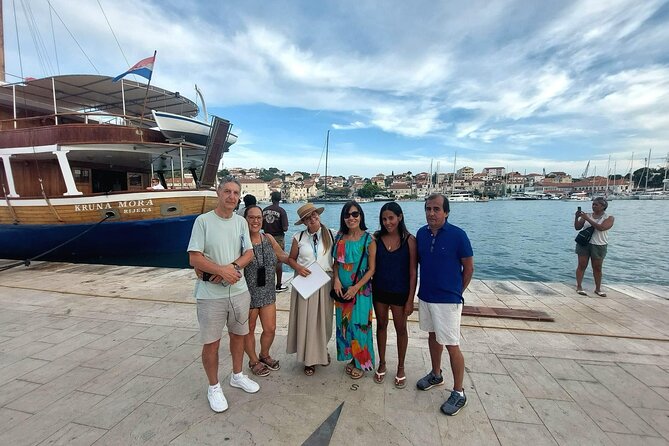
The tour is offered in English and takes up to 15 people. That is not a private walk, but it is small enough to remain fairly personal. The starting point is at Ul. Gradska vrata 5, near the Old Town entrance. The walk ends on Obala bana Berislavića, close to the waterfront.
Other guided walks in Trogir:
- Trogir: City Highlights Guided Walking Tour
★ 4.9 · 199 reviews - Trogir: Old Town Guided Walking Tour
★ 4.6 · 76 reviews - Split Old Town Walking Tour
★ 5.0 · 25 reviews
St. Lawrence Cathedral and Radovan’s Portal
The cathedral is the natural opening point. Construction began in 1213 and continued for five centuries, which explains its mixture of Romanesque and Gothic forms. Its broad stone body has three naves, giving the building a solid, almost fortress-like presence.
At the main entrance, you see Radovan’s Portal, carved by the medieval Trogir master Radovan. It dates from the first half of the 13th century and is much more than a decorated doorway. The carvings present religious scenes, people, animals, and daily life in a way that rewards a close look.
Your guide can help you read the portal rather than simply photograph it. Allow about 10 minutes here. The listed stop has no separate admission charge, though you should not assume that every interior area or the cathedral bell tower is included in the walking tour.
The bell tower is one of the city’s best high points. From it, you can look over the roofs of Trogir, across to Čiovo, back toward the mainland, and out over the Adriatic. The tour description mentions these views, but it does not clearly promise a bell tower climb, so confirm this if the panorama is a major reason for booking.
John Paul II Square, Trogir’s social center
From the cathedral, the walk continues to John Paul II Square, called Trg Ivana Pavla II in Croatian. This is the kind of place where Trogir’s history and present-day life meet without much fuss.
Important buildings ring the square, while cafes place tables and umbrellas across much of the open space. I like this stop because it shows how historic centers actually function. People do not come here only to admire old stone. They sit with coffee, meet friends, eat ice cream, and let the day pass.
The planned stop lasts about 15 minutes, but this is also the place to return after the tour. If you have time, sit here later and look back at the buildings with a better sense of what you are seeing. The square can feel crowded with cafe furniture, so photography is sometimes easier from the edges than from the middle.
Town Hall and the Venetian side of Trogir
The 15th-century Town Hall brings you into the civic story of Trogir. Its stone courtyard is decorated with coats of arms, and the outside staircase is a fine example of Venetian design.
This stop is brief, about 10 minutes, but the guide can explain how a town governed itself during the centuries when Venice shaped much of the eastern Adriatic. Look for the details rather than expecting a grand palace interior. The courtyard and staircase do most of the visual work.
Next comes St. Sebastian’s Church and Clock Tower. The church was built in 1476 after the citizens of Trogir were spared from the plague. Its architect was Niccolò di Giovanni Fiorentino, also known in English as Nicolas of Florence.
That origin gives the small church an immediate human meaning. It was not built simply to decorate the square. It reflected fear, relief, and public gratitude after a serious disease outbreak. You get around 10 minutes here, enough for the guide to explain the connection between religious buildings and town life.
Same base, a different kind of day out:
- Blue cave, Mama Mia and Hvar, 5 island speedboat tour from Trogir
★ 5.0 · 2,861 reviews - From Trogir: Three Islands Half-Day Speedboat Tour
★ 4.8 · 804 reviews - From Trogir or Split: Full-Day Blue Cave & Hvar Island Tour
★ 4.7 · 413 reviews - Half Day Speedboat Tour to Three Islands from Trogir
★ 5.0 · 401 reviews
The Town Loggia and the Kairos story

Beside the clock tower is the Town Loggia, a covered 13th-century meeting place. Citizens gathered here to discuss public matters, and the local court used it on certain days to announce laws and hear cases.
This is one of the most useful stops for understanding medieval Trogir. A church tells you about belief, and a palace tells you about wealth. The loggia shows how the town handled public business.
Nearby, you may see the bas-relief of Kairos, the Greek figure associated with the right moment. He is shown standing on tiptoe, with wings, scales, a bald crown, and a long lock of hair falling over his forehead. The idea is simple and memorable: seize the right moment by the lock of hair before Kairos flies away.
This small image is easy to miss on your own. It is exactly the kind of detail that makes a local guide useful. The stop also gives your guide room to move beyond dates and explain how an old symbol still carries a practical lesson.
Cipiko Palace and Trogir’s grand families
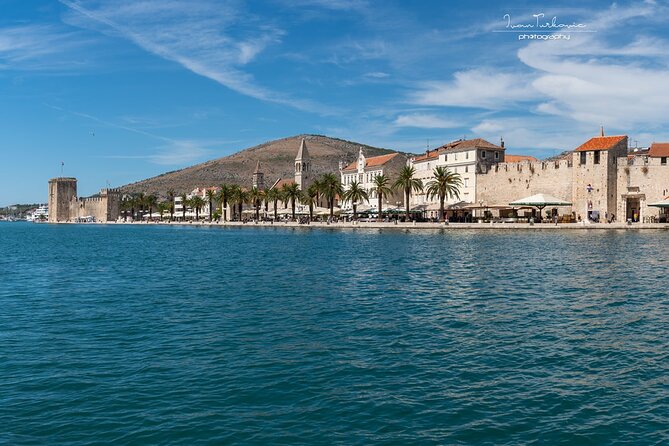
The Great Cipiko Palace is not a single building in the simple sense. It grew from a group of Romanesque structures and was reshaped between the 15th and 17th centuries into a Venetian Renaissance residence.
Niccolò di Giovanni Fiorentino also worked here, including on the south portal. The palace shows how wealthy Trogir families adapted older buildings instead of starting from scratch. In a town this old, layers remain visible if you know how to spot them.
The planned visit is only about five minutes, so expect an exterior explanation rather than a long palace tour. That is enough to place the Cipiko family within Trogir’s political and artistic life, but it may feel short if you want to study architectural details.
The North Gate, Garagnin-Fonfogna Museum, and local religious life

Another part of the route brings you through the North Gate, one of the two main historic entrances to the formerly walled town. Just inside, you see the museum housed in a series of palaces once owned by the Venetian Garagnin-Fonfogna family.
The setting matters as much as the collection. You are not entering a modern museum building dropped into the Old Town. The museum occupies historic residences, so the architecture continues the story begun in the streets.
The route also includes the Church of Our Lady of Mount Carmel, just off the waterfront promenade in the western part of the Old Town. Founded in the Middle Ages, it was historically connected with Trogir’s fishermen, craftsmen, and laborers.
That working-town connection balances the grand palaces and civic buildings. Trogir was not only a place of bishops and wealthy families. Ordinary people lived, worked, worshipped, and depended on the sea here.
If you are in Trogir on July 16, the church has a special seasonal connection. An evening procession with the statue of Our Lady takes place then. The walking tour itself is not presented as that procession, but the guide can point out the church so you know where to return.
Riva promenade and views toward Čiovo

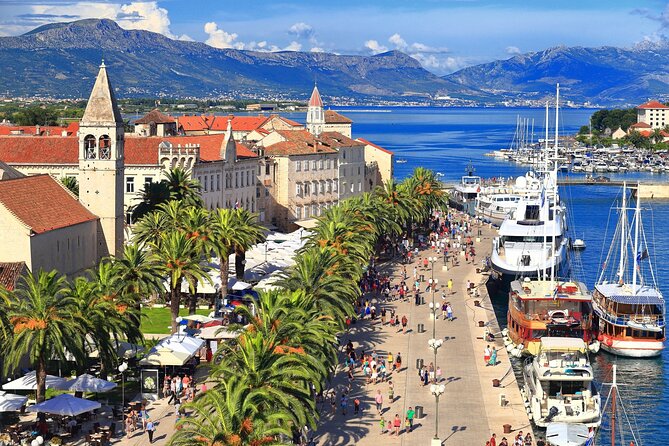
The Riva is Trogir’s wide waterfront promenade. Palm trees line the route, and the flat, straight walkway opens views across the channel to Čiovo.
After the narrow lanes, this is a welcome change. You can see how the town sits in relation to the water, which is not always clear when you are inside the Old Town’s maze. The 10-minute stop is short, but it gives you a chance to pause, take photographs, and understand the town’s setting.
The Riva is also a practical end-of-tour area. You finish near Obala bana Berislavića, with the waterfront close at hand. If you want a meal, a drink, or more time by the water, you can continue at your own pace after the guide departs.
Kamerlengo Castle closes the story
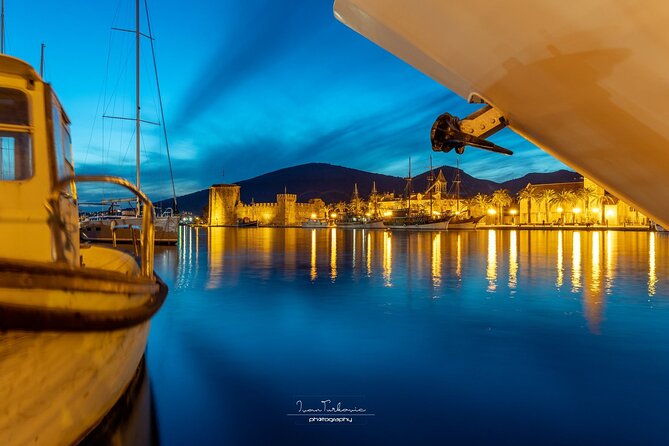
At the end of the promenade, Kamerlengo Castle occupies the corner of the small island that holds the Old Town. This early 15th-century fortress gives the walking route a strong finish.
Its position makes sense once you have seen Trogir from the water. The castle guarded the town’s edge and formed part of the defensive system during the Venetian period. Beside it are a local football pitch, a children’s playground, and stalls used by local tour operators.
That mix is useful. You see a historic fortress in the middle of an ordinary modern neighborhood, not a preserved monument cut off from daily life. It also gives you a practical sense of where the Old Town ends and the local town begins.
The information provided does not say that castle entry is included. Treat this part as an exterior stop unless your guide confirms otherwise.
Local guides make the difference
The strongest part of this experience is the guide, and the quality may vary with the person assigned that day. Daniela is repeatedly praised for calm, engaging storytelling and for connecting Trogir’s past with her own family background. She has spoken about growing up in the town and living through the Homeland War, giving the recent past a personal dimension.
Kristina is described as energetic and especially good at mixing town history with stories from her own life, including memories connected to her elementary school. Blanka has been noted for her enthusiasm, clear explanations, and practical local suggestions, including a beach recommendation for after the walk.
Mihaela and Michaela have also led the tour, with an emphasis on local history, Roman history, anecdotes, and the transition between older and newer periods. One guide hopes to become a history professor, which fits the teaching style described by several people who found the tour easy to follow and engaging.
These names are useful, but you should not book assuming a particular guide is guaranteed unless the operator confirms it. The common thread is local connection. You are not simply getting a list of monuments. You may hear how the town feels to someone raised there.
Is $18.14 a fair price?
At $18.14 per person, this is a good-value introduction to Trogir. The walk covers a large share of the Old Town’s main sights, uses an English-speaking local guide, and limits the group to 15 people.
The value is strongest if you are visiting for a short time or want help finding your way around before exploring alone. The price is less compelling if you prefer to wander silently, already know the town, or want long interior visits at each monument.
Most stops are listed without an admission charge, which keeps the price straightforward. Still, the experience appears focused on guided exterior sightseeing. Confirm the treatment of cathedral interiors, the bell tower, the museum, and Kamerlengo Castle if you want to go inside any of them.
The tour is booked, on average, 16 days ahead. That suggests planning early, especially during the busiest summer period. It is also non-refundable and cannot be changed for personal reasons. If poor weather causes the operator to cancel, you are offered another date or a full refund.
Timing, heat, and practical comfort
The walk lasts approximately 90 minutes, with stops ranging from five to 15 minutes. That is long enough for a clear introduction but short enough to fit before lunch, a beach visit, or another activity.
One important qualification is the duration. A report describes the walk ending after exactly 60 minutes, despite an advertised time closer to 80 or 90 minutes. This may have been a guide, group, or day-specific difference, but it is worth asking at the start how long the route will take.
Trogir can be very hot, especially when you are standing in open squares and on the waterfront. Wear comfortable shoes, bring water, and consider booking earlier or later in the day if you have a choice. The walk requires good weather, and the provider may cancel for poor conditions.
The Old Town is close to public transportation, and most people can take part. The tour is not presented as a private or fully customized walk, so anyone needing a specific pace or route should ask before booking.
Who should book this Trogir walk?
I would choose this tour if you are visiting Trogir for the first time, staying only briefly, or arriving without a clear plan. It is also a good fit if you enjoy history more when it comes through personal stories rather than a dry list of dates.
Families and mixed-age groups should find the format manageable. The route is short, the main sights are close together, and stories about plague, castles, local schools, and family life can hold attention better than a long lecture.
I would be more cautious if you want extensive museum time, detailed architectural study, or guaranteed access to the bell tower and castle. The tour is an orientation walk, not a full archaeological or interior sightseeing program.
Should you book the Trogir walking tour?
Yes, if you want a friendly and efficient introduction to a small town with a surprisingly large story. The strongest reason to book is the chance to hear Trogir explained by someone with local roots, particularly if your guide is Daniela, Kristina, Blanka, Mihaela, or Michaela.
At $18.14, the price is reasonable for a small-group walk through the cathedral area, central square, civic buildings, palaces, waterfront, and fortress. Just confirm the expected duration and ask which interiors, if any, are included.
Book it near the start of your stay if possible. You will leave with a better map of Trogir in your head and a short list of places worth revisiting at your own speed.
FAQ
Where does the Trogir walking tour start?
The meeting point is Ul. Gradska vrata 5, 21220 Trogir, Croatia.
Where does the tour end?
The tour ends on Obala bana Berislavića, 21218 Trogir, Croatia, near the waterfront.
How long does the tour last?
The stated duration is approximately 1 hour and 30 minutes. One account describes a 60-minute finish, so you should confirm the expected timing with your guide.
Is the tour offered in English?
Yes. The experience is offered in English.
How large is the group?
The tour has a maximum of 15 participants.
Is the tour suitable for most people?
Yes. The activity information says most people can participate, and the meeting point is near public transportation.
What happens if bad weather cancels the tour?
If the provider cancels because of poor weather, you are offered a different date or a full refund. Personal cancellations or changes are non-refundable.
Just added in Trogir
- Split Old Town Walking Tour★ 5.0 · 25 reviews
- Trogir: Old Town Guided Walking Tour★ 4.6 · 76 reviews
- Split to Zagreb Group Transfer with Plitvice Lakes guided tour★ 4.5 · 119 reviews
- Private transfer Split airport to Split (any location) up to 8 passengers★ 5.0 · 57 reviews
- Bespoke private boat tour from Split & Trogir with a local expert★ 4.5 · 75 reviews
- Trogir: Blue Lagoon, Maslinica, and Solinska Bay Boat Tour★ 4.9 · 88 reviews
- From Trogir: Blue Lagoon & Šolta Cruise with Lunch & Drinks★ 4.1 · 178 reviews
- Off road Quad Adventure Tour on Island Čiovo★ 5.0 · 219 reviews
Walking Tours, compared.
Walking Tour of Split and Diocletian’s Palace
Read our review →
Krka Waterfalls tour with Trogir Walking tour and Krka panoramic boat cruise
Read our review →
City Walls Early Morning or Sunset Walking Tour
Read our review →
Browse the lists this tour appears in