
Reviewed · WALKING TOURS
Dubrovnik Old Town Walking Tour
Dubrovnik’s Old Town is easy to admire and surprisingly easy to misunderstand. This compact walking tour gives you the city’s basic story while leading you from Pile Gate along the Stradun to fountains, churches, palaces, and the Cathedral. The best guides, including Elvis, Sara, Toni, and Natalia, add local details that turn handsome stone buildings into places with a human past.
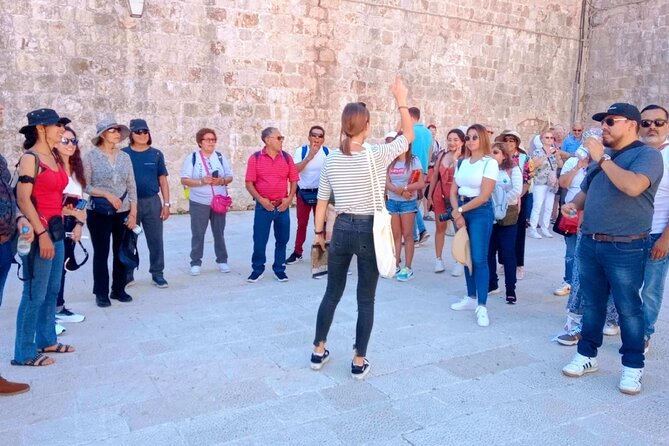
I like the short 90-minute format and the gentle route. You see the main sights without climbing Dubrovnik’s famous walls or tackling endless stairs, then have the rest of the day to return to the places that catch your eye. I also like the small maximum group of 16, which makes questions easier and can feel almost private when numbers are low.
The main drawback is that this is an overview, not a full exploration. Entry to the listed sights is not included, the tour can be harder to hear if the guide is far ahead, and one description refers to a two-hour walk while the advertised duration is about 90 minutes. Plan for the shorter time.
Key points to know before you book
- Begin at Pile Gate: Meet Elite Travel at Brsalje ul. 1 at 10:30 in the morning, then enter Dubrovnik’s walled Old Town from its western gate.
- Follow the main historic route: See Onofrio’s Fountain, the Franciscan Monastery, Stradun, Sponza Palace, Orlando Column, the Bell Tower, Rector’s Palace, St. Blaise’s Church, and the Cathedral.
- Local guides make the difference: Elvis is often praised for history, customs, and modern local life, while Toni, Sara, Sarah, Natalia, and Tihomir have also led highly rated walks.
- Good for a first morning: The tour gives you a useful map of the Old Town before you decide where to spend more time.
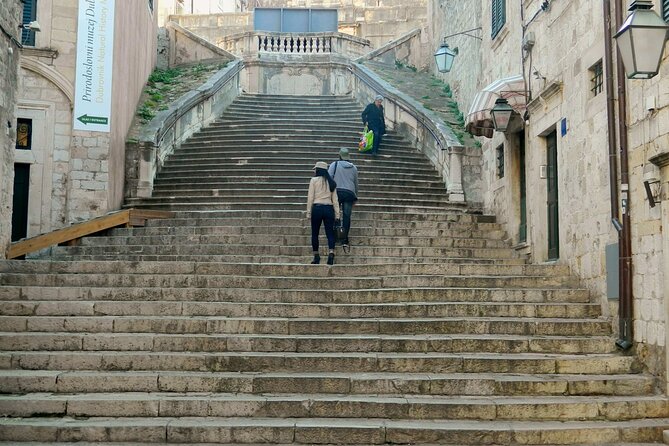
- No wall walk is included: This route stays at street level and focuses on the city’s buildings, squares, stories, and daily life.
- Allow for extras: Food, drinks, hotel transport, and museum or interior admission are not included in the $31.46 price.
Why this short walk works in Dubrovnik
Dubrovnik can feel like a stage set at first: pale limestone, polished streets, heavy walls, and grand buildings packed into a small area. A guide helps you get past the pretty surface. In a short time, you learn how water reached the city, why the main street is so broad and straight, and how the medieval republic expressed its power through churches, archives, palaces, and public monuments.
I see this as a getting-oriented tour, not a daylong history course. You will hear important dates and stories, but the larger value is knowing what you are looking at. Afterward, Sponza Palace is no longer just an attractive façade, and the clock tower is no longer just a place to photograph.
The group limit of 16 is sensible for a walking tour in narrow lanes. It is small enough for the guide to answer questions, although you should still stay close, especially around busy squares. One negative experience involved difficulty hearing a guide and finding the commentary dull, so your enjoyment will depend partly on the guide assigned that day.
Other guided walks in Dubrovnik:
- Dubrovnik: Old Town Walking Tour
★ 4.8 · 5,174 reviews - Dubrovnik Discovery Old Town Walking Tour
★ 5.0 · 4,458 reviews - Dubrovnik: Game of Thrones Walking Tour
★ 5.0 · 1,732 reviews
Starting at Pile Gate and Onofrio’s Fountain
The meeting point is Elite Travel Walking Tours at Brsalje ul. 1, beside Pile Gate. The tour begins at 10:30, a useful time because you can make the walk your first Old Town activity and still have much of the day left afterward.
Pile Gate is the western entrance to Stari Grad, Dubrovnik’s Old Town. It is more than a convenient meeting place. The gate introduces the city’s defensive character and gives you a clear sense of passing from the modern approach into a tightly controlled historic center.
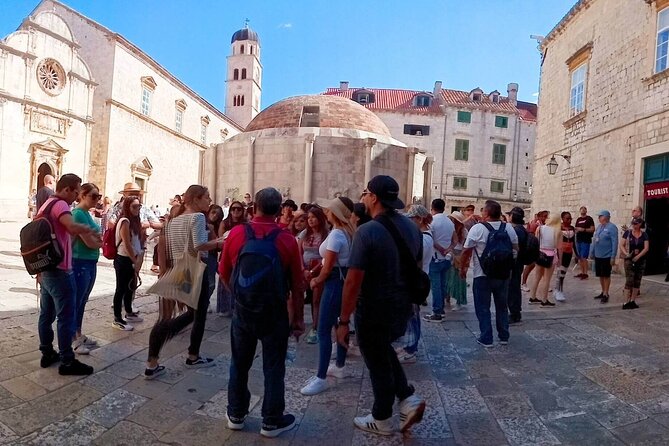
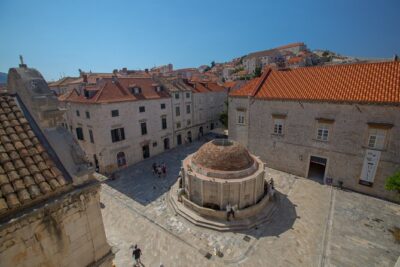
A few steps inside, you reach Onofrio’s Fountain, one of the tour’s most practical sights. Its many taps are connected to an aqueduct that carried drinking water from a spring about 7.5 miles, or 12 kilometers, away. That detail helps you picture what life in a stone-walled city required. Water was not simply a utility hidden underground. Its arrival was a major public achievement.
The fountain is also a useful first stop because the guide can explain how Dubrovnik functioned as a self-governing maritime city. Listen for the link between public works and city survival. The walk becomes more interesting when you see Dubrovnik not just as a beautiful place, but as a city that had to protect, supply, and govern itself.
The Franciscan Monastery and its old pharmacy
The Franciscan Monastery sits close to the fountain, so the route moves quickly from public engineering to religious and medical history. The complex includes a 14th-century Gothic cloister, artwork, and one of Europe’s oldest still-functioning pharmacies.
The cloister is one of the better places to slow down and look closely. Its columns and arches provide a calmer counterpoint to the open street. Your guide may point out details you would pass without noticing, while the monastery gives context for the role of religious institutions in education, medicine, and community life.
The pharmacy is an especially useful detail for visitors who like social history. It connects a beautiful historic building with ordinary needs: medicine, care, and the practical work of keeping a city healthy. If the tour does not include enough time inside, make a note to return. The walking tour’s schedule is tight, and the main purpose is to introduce the site rather than give every interior a long visit.
Walking the Stradun, Dubrovnik’s main street
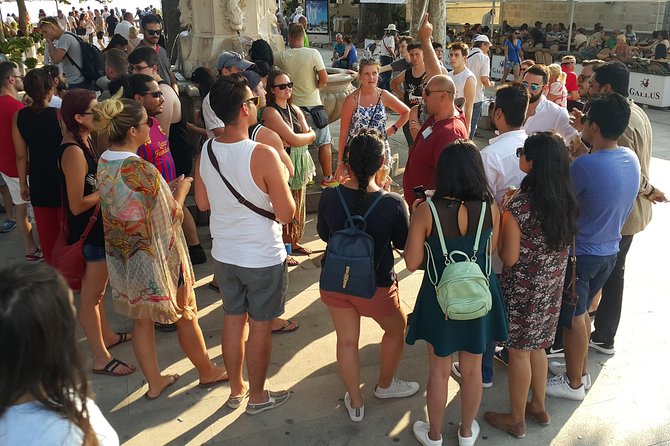
From the monastery, you continue onto the Stradun, the Old Town’s broad limestone-covered pedestrian street. This is the central spine of Dubrovnik, and the tour uses it well. Rather than wandering without a plan, you move along the city’s most important public route and branch toward major buildings.
The Stradun is handsome, but its real value is how clearly it shows the city’s layout. Side streets lead away toward quieter corners and stairways, while the main street draws people across the Old Town. Your guide can help explain how the street relates to Dubrovnik’s growth and rebuilding.
The limestone surface can be hard underfoot, especially in warm weather, so wear shoes with a firm sole. The walk is not described as strenuous, and it avoids the climb along the city walls, but you are still walking on stone. Bring water, particularly in summer.
A morning start also helps with comfort. The walk takes place outdoors, and one guide was specifically praised for seeking out shade when stopping to talk. That kind of small judgment matters in Dubrovnik, where sun can make a short history talk feel much longer.
Same base, a different kind of day out:
- Blue Cave Small-Group Boat Tour from Dubrovnik
★ 5.0 · 9,360 reviews - Full-Day Dubrovnik Elaphite Islands Cruise with Lunch and Drinks
★ 5.0 · 8,823 reviews - Dubrovnik: Epic Game of Thrones Tour + Lokrum & Saver Option
★ 4.9 · 5,995 reviews - Dubrovnik: Elaphiti Islands Full-Day Cruise with Lunch
★ 5.0 · 5,938 reviews
Sponza Palace and the city’s civic memory

Sponza Palace is the Renaissance highlight of the route. It now houses the State Archives, which gives the building a useful connection to Dubrovnik’s written record. This is not only a grand palace to admire from the street. It represents the paperwork, laws, trade records, and decisions that allowed the republic to operate.
I like this stop because it adds substance to the usual church-and-fountain itinerary. Dubrovnik’s past was not made only by rulers or soldiers. It also depended on merchants, officials, contracts, records, and a city administration that kept track of business.
The walk does not promise a full archival visit, and admission is not included. Treat Sponza as an interpreted exterior stop unless your guide tells you that an interior visit is part of the day’s plan. If documents and museum rooms interest you, the Dubrovnik Museums Multipass may be worth considering separately. It includes the Cultural-History Museum in Rector’s Palace, along with the Maritime Museum, Ethnographic Museum, Archaeological Exhibitions at Fort Revelin, the House of Marin Držić, the Museum of Modern Art, the Natural History Museum, Dulčić-Masle-Pulitika Gallery, and the Pulitika Studio.
Orlando Column, the Bell Tower, and St. Blaise
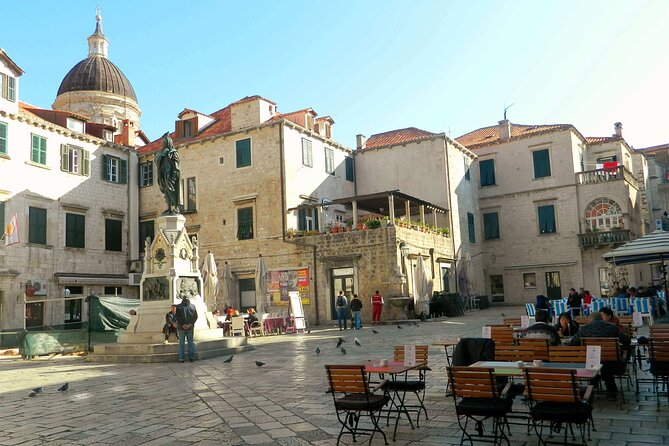
The route next brings you to several of Dubrovnik’s most recognizable civic and religious markers. Orlando Column recalls the medieval hero Orlando and occupies an important place in the main square. It is easy to photograph, but the guide’s explanation gives it more meaning as a symbol of authority and public identity.
Nearby, the City Bell Tower has an odd detail worth remembering: its clock displays the time in both Arabic and Latin numerals, and the display changes only every five minutes. Small facts like this are where a good guide earns the tour price. You may not remember every date, but you are likely to remember a clock that behaves differently from the one at home.
The Church of St. Blaise honors Dubrovnik’s patron saint. Its location near the main square makes it part of the city’s public face, not an isolated religious building. The church also shows how Dubrovnik used architecture to express civic pride and devotion.
The tour’s strength here is the sequence. You see monuments close together, but the guide links them into a story about religion, government, defense, and public life. Without that explanation, you may simply collect photographs.
Rector’s Palace and the Cathedral of the Assumption
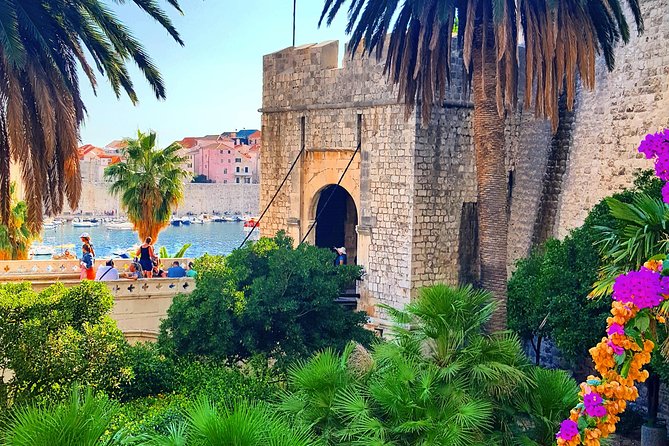
Rector’s Palace is another major stop. Its name points to Dubrovnik’s former political structure, and its setting helps explain how government operated within the Old Town. The building now houses the Cultural-History Museum, part of the Museums Multipass.
If you want more than a quick exterior explanation, plan a separate visit. The walking tour is designed to keep moving, and the palace deserves more time than a brief stop can provide. The guide can tell you why it matters, then you can return when the group has finished.
Across the square, you visit the Cathedral of the Assumption. The present Baroque cathedral was built in the 18th century after an earthquake destroyed the earlier church. That rebuilding story is important because Dubrovnik’s appearance is shaped not only by medieval survival, but also by disaster, repair, and later architectural styles.
The Cathedral Treasury is listed among the stops, but the tour information does not specify separate admission or how long you spend inside. Ask your guide at the start if the Treasury visit is included in the walking route that day. The cathedral itself provides a strong ending because it brings together faith, art, earthquake history, and the city’s long process of rebuilding.
What the guides add to the experience
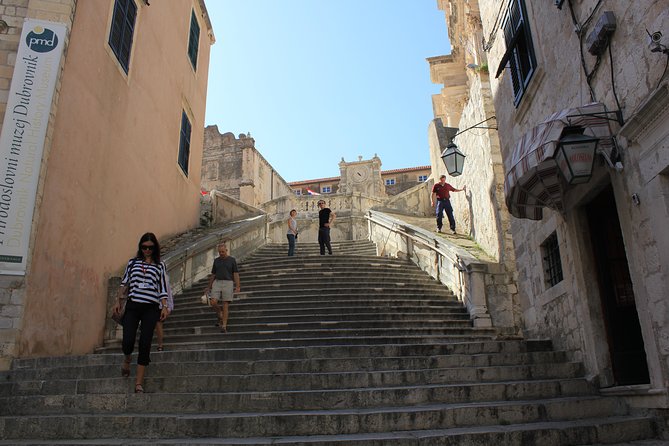
The strongest part of this tour is the human explanation. Elvis is repeatedly praised for combining historical facts with customs, local life, and personal insight. He is also described as friendly and willing to answer questions, which is useful in a city where basic history can quickly lead to modern topics.
Toni has been praised for speaking more than eight languages and for using anecdotes alongside facts. Sara and Sarah have also led engaging walks, while Natalia has been noted for her friendly style and for briefly pointing out features near the walls after the main tour. Tihomir received especially warm praise, with the kind of presentation that makes visitors wish the walk lasted all day.
These names do not guarantee who will lead your tour. The booking information identifies the provider, Elite Travel Ltd, but not a fixed guide. That is worth understanding before you book. The experience can be excellent when your guide is clear, lively, and attentive, but one poor account describes a heavy accent, difficulty hearing, and an early departure from the walk.
If you have a question, ask it. The smaller group makes that possible, and several guides are praised for giving personal recommendations for food and additional places to visit. Use the tour to build a conversation, not just to stand and listen.
Price, pace, and what is not included
At $31.46 per person, the tour offers reasonable value if you want a clear introduction to Dubrovnik without committing to a half-day program. You are paying for a local guide, a planned route, and context at several of the city’s most important sights.
The value is lower if you only want photographs or already know the Old Town well. You can walk the public streets on your own, and admission to the main route’s historic interiors is not included. The price makes the most sense for a first visit, a short stay, or anyone who prefers to understand a city before choosing which museums and churches deserve more time.
The published duration is approximately 1 hour 30 minutes. Another description calls it a two-hour walking tour, so allow some flexibility, but do not build your whole day around a full two-hour program. The tour ends back at the meeting point, and hotel pickup and drop-off are not provided.
Food and drinks are also not included. Carry water and plan a separate stop for lunch or coffee after the walk. Since the tour starts at 10:30, you can easily follow it with a longer Old Town visit.
Who should book this Old Town walk
I would choose this tour if you are visiting Dubrovnik for the first time and want the main story quickly. It is also a good fit for anyone who would rather stay at street level than walk the city walls, and for families or mixed-age groups that benefit from a gentle pace.
It suits history-minded visitors who want more than attractive streets, especially if you enjoy details about water systems, pharmacies, archives, clocks, civic buildings, and rebuilding after an earthquake. The local perspective can also help you understand modern Dubrovnik, not just its medieval monuments.
You may want something else if your priority is the city walls, extensive museum time, food tasting, or a private tour with a guaranteed guide. This walk does not include those features. It is a compact introduction with a strong list of landmarks, not a complete Dubrovnik program.
The tour is free to cancel up to 24 hours before the start time for a full refund. Poor weather or failure to reach the minimum number of participants can lead to a new date, another experience, or a refund. Most people can participate, but remember that the route uses historic stone streets.
Should you book the Dubrovnik Old Town Walking Tour?
Book it if you want a well-priced first look at Dubrovnik and value a local guide’s stories more than a long list of included admissions. The route covers the city’s essential central sights, the group size is limited to 16, and the morning timing leaves room for your own exploring.
I would especially book it near the start of your stay. You can then return to the Franciscan Monastery, Rector’s Palace, the Cathedral, or another museum with a better sense of why it matters. Just keep your expectations in the right place: this is a short orientation walk, and the guide you receive will shape the experience.
FAQ
How long does the Dubrovnik Old Town Walking Tour last?
The advertised duration is approximately 1 hour 30 minutes. One description refers to a two-hour walking tour, so allow some flexibility, but plan around the 90-minute duration.
Where does the tour begin?
The meeting point is Elite Travel Walking Tours, Brsalje ul. 1, 20000 Dubrovnik, Croatia. The route begins at Pile Gate.
What time does the tour start?
The scheduled start time is 10:30 am.
What sights are included on the walking route?
The route includes Pile Gate, Onofrio’s Fountain, the Franciscan Church and Monastery, Stradun, Sponza Palace, Orlando Column, the Bell Tower, Rector’s Palace, the Church of St. Blaise, the Cathedral of the Assumption, and the Dubrovnik Cathedral Treasury.
Is admission to the attractions included?
The local guide is included, but the tour information does not list museum or interior admission as an inclusion. Food, drinks, and hotel transportation are also not included.
Is the tour offered in English?
Yes. The experience is offered in English.
How large is the group?
The maximum group size is 16 participants. If fewer people book, the walk may be much smaller and can feel close to a private tour.
Can I cancel for a refund?
You can cancel at least 24 hours before the experience start time for a full refund. Cancellations or changes made less than 24 hours in advance are not accepted for a refund. If poor weather or insufficient participation causes the provider to cancel, you will be offered another date or experience, or a full refund.
More walking tours in Dubrovnik
- Dubrovnik Old Town History Walking Tour
★ 5.0 · 1,684 reviews - Dubrovnik: City Walls Early Morning or Sunset Walking Tour
★ 4.8 · 1,523 reviews - Dubrovnik: Ancient City Walls & Wars Walking Tour
★ 5.0 · 1,270 reviews - Dubrovnik: Game of Thrones Walking Tour
★ 4.9 · 981 reviews
Just added in Dubrovnik
- Explore Mostar, Ston and Kravice Waterfalls ( Small Group )★ 4.5 · 166 reviews
- Wine Lover’s Tour of Peljesac Peninsula★ 5.0 · 150 reviews
- From Dubrovnik: Split Day Trip and City Tour with Transfers★ 4.5 · 70 reviews
- Dubrovnik airport transfer★ 5.0 · 116 reviews
- Dubrovnik to Split Private transfer up to 8 pax (Door to Door any location)★ 5.0 · 151 reviews
- Jet Ski Rent 1h★ 5.0 · 147 reviews
- Luxury private transfer: Dubrovnik airport to Dubrovnik★ 5.0 · 111 reviews
- Traditional Cooking Class in Dubrovnik Countryside★ 5.0 · 168 reviews
Walking Tours, compared.
Walking Tour of Split and Diocletian’s Palace
Read our review →

Krka Waterfalls tour with Trogir Walking tour and Krka panoramic boat cruise
Read our review →
City Walls Early Morning or Sunset Walking Tour
Read our review →
Browse the lists this tour appears in