
Reviewed · BIKE & E-BIKE TOURS
Classic Zagreb Bike Tour
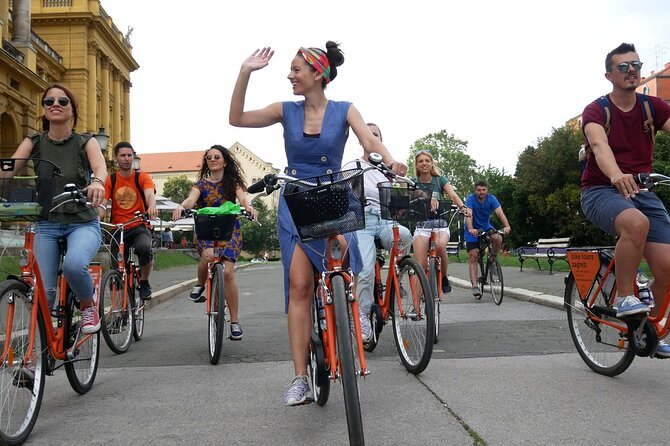
Zagreb makes good sense from a bicycle seat. In about three hours, you can cover the cathedral, Dolac Market, Upper Town, grand lower-city squares, and the Croatian National Theatre without spending the whole day on foot. Filip, Iva, Eva, Sandro, and Željka are among the guides praised for lively stories, humor, and useful local advice.
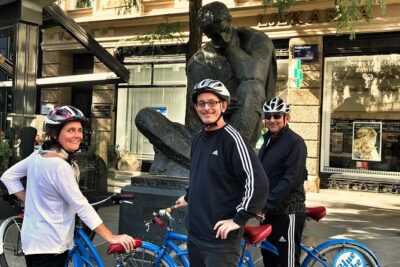
I like the relaxed pace and the short break for coffee, a cold drink, or ice cream. I also like the small maximum group of 12, which gives your guide room to answer questions and keep the ride personal. The main caution is the equipment and traffic: most bikes work well, but some riders have found older bikes or worn helmets, and Zagreb’s cobblestones, pedestrians, trams, and one uphill stretch call for steady cycling skills.
Key points to know before you book
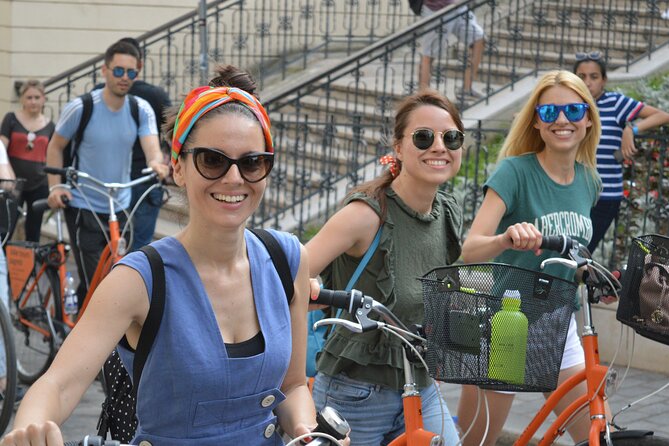
- A smart first look at Zagreb: The route links the Upper and Lower Town, so you get your bearings quickly.
- Mostly easy riding: The route is largely flat, though cobblestones, crowded pedestrian areas, and one steeper hill require care.
- Local stories make the stops matter: Your guide connects places such as Bloody Bridge and the Stone Gate with Zagreb’s past.
- A useful mid-tour pause: Coffee, a soft drink, or ice cream is included, giving you a chance to rest and chat.
- Small-group format: The group is limited to 12 people, with a local guide leading and navigating.
- Good value for active sightseers: The $54.44 price includes the bicycle, helmet, refreshment, and tour photo.
Why a bicycle works so well in Zagreb
Zagreb’s center is compact, but its sights are spread between two distinct areas. The Upper Town has old lanes, churches, gates, and steep history. The Lower Town has broad squares, formal parks, public buildings, and long views along planned avenues.
Walking between all of this is possible, but a bicycle saves time and gives you a stronger sense of how the city fits together. You can move from the market to Tkalčićeva Street, then climb toward St. Mark’s Church before crossing back toward the theatre and Zrinjevac.
This is not a race. The route is described by several riders as easy or relaxed, with frequent stops. Much of it uses pedestrian areas, pavement, or gravel paths. You should still be comfortable steering around people and handling uneven surfaces. One rider with children found the route manageable for confident 10-year-old cyclists, while another pointed out that it is not ideal for someone who rarely rides a bike.
The tour begins and ends at Jurišićeva ul. 19. It lasts about three hours, though several descriptions put the actual ride just under that mark. The group limit is 12, and the guide handles navigation, so you can pay attention to the city instead of a map.
More rides around Zagreb:
- Zagreb Highlights Bike Tour
★ 5.0 · 208 reviews - Zagreb: 3–Hour Classic Bike Tour
★ 4.6 · 139 reviews - All of Zagreb Bike Tour
★ 5.0 · 97 reviews
Cathedral of Zagreb and Dolac Market
The first stop is Zagreb Cathedral, where the city’s church story reaches back to 1093. That was the year the Hungarian king Ladislav founded the Diocese of Zagreb in the Kaptol area and raised the church to cathedral rank.
You get about 10 minutes here. That is enough for an exterior look and a short explanation, not a full architectural visit. Since admission is free, you do not need to budget an entry fee, but the tour does not promise extended indoor time.
From the cathedral, the route heads to Dolac Market, known as the city’s belly. This is Zagreb’s main farmers market, and it gives you a quick look at everyday city life rather than only grand monuments. The stop lasts about 10 minutes, so treat it as an introduction. If the market interests you, return later with more time to browse.
This early section is useful because it places you in Kaptol, one of the historic parts of central Zagreb, before the group moves into the streets and squares that connect it with Gradec.
Tkalčićeva Street and Bloody Bridge
Tkalčićeva Street is one of the best places to see how Zagreb has changed. From the late 19th century through the 1930s, it served as the city’s red-light district. Today, it is lined with cafés, restaurants, and nightlife.
Your guide has about 15 minutes here to explain that change. The street is also a practical place to ask for food or evening suggestions. Several guides, including Filip and Željka, are praised for giving restaurant advice, so keep a small list in your phone.
The next stop is Krvavi Most, or Bloody Bridge. The name refers to the old border between Gradec and Kaptol, once divided by the Medveščak stream. The two communities often clashed, giving this otherwise modest passage a memorable story.
You spend about 10 minutes here. The value is not a grand view or a long visit. It is the context. Zagreb’s old divisions become easier to understand when you see how close these areas are and learn that rivalry once marked the boundary.
Stone Gate and St. Mark’s Church
Petrini Pyli, better known as the Stone Gate, contains one of Zagreb’s most important religious shrines. The image of Our Lady of the Stone Gate has been honored there for centuries, and she is the city’s patron saint.
The stop lasts around 10 minutes. This is a place for quiet attention, not a quick photo alone. You may find the contrast striking: a narrow historic gateway still serves as a living place of devotion in the middle of the Upper Town.
St. Mark’s Church follows, with about 15 minutes for the guide’s explanation. It is one of Zagreb’s oldest buildings and one of its best-known symbols. The church appears in the 1334 Kaptol Statute, giving it a documented place in the city’s medieval story.
The colorful roof is the obvious visual draw, but your guide adds more value by explaining the church’s role in Zagreb’s identity. The stop is mainly external and interpretive, so do not expect the schedule to include a full interior visit.
This is also where the cycling may feel more demanding. The Upper Town includes uneven paving and an uphill section. One rider described a single steeper climb and simply walked the bike up. That is a sensible choice, not a failure. The tour is meant to help you see Zagreb, not test your legs.
Same base, a different kind of day out:
- From Zagreb: Plitvice & Rastoke Guided Day Trip with Ticket
★ 4.9 · 2,955 reviews - Zagreb: Rastoke & Plitvice Lakes Guided Tour with Ticket
★ 4.9 · 1,897 reviews - Communism & Croatian Homeland War Tour
★ 5.0 · 1,355 reviews - Best of Zagreb with the WW2 Tunnels
★ 5.0 · 973 reviews
The funicular and the link between Zagreb’s levels
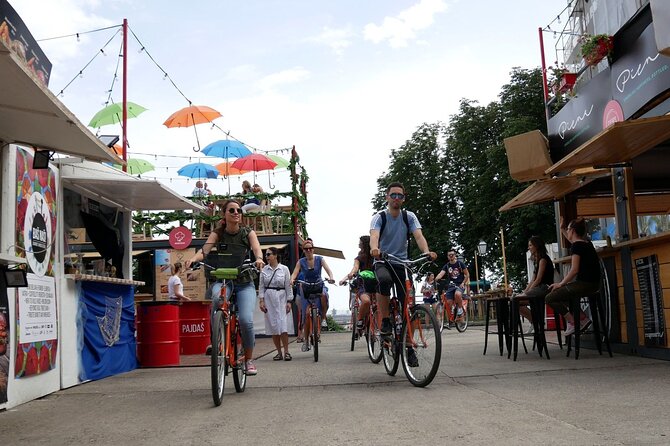
The Upper Town funicular dates from 1892 and is considered Zagreb’s oldest passenger public transport. The tour allows about 15 minutes for this part of the route.
The funicular ticket is not included, so carry money for it if your guide plans to use the railway rather than only explain it. The supplied details identify the stop but do not promise a ride for every group, so ask your guide at the start how this part will work.
The funicular matters because it shows how Zagreb solves the problem of its two levels. It is not just a transport detail. It helps you understand the connection between the older Upper Town and the more orderly Lower Town below.
You should expect some pedestrian movement in this area. Keep your speed low, follow the guide, and be ready to stop. The cycling is generally gentle, but it is not isolated from city life.
The Croatian National Theatre and King Tomislav Square
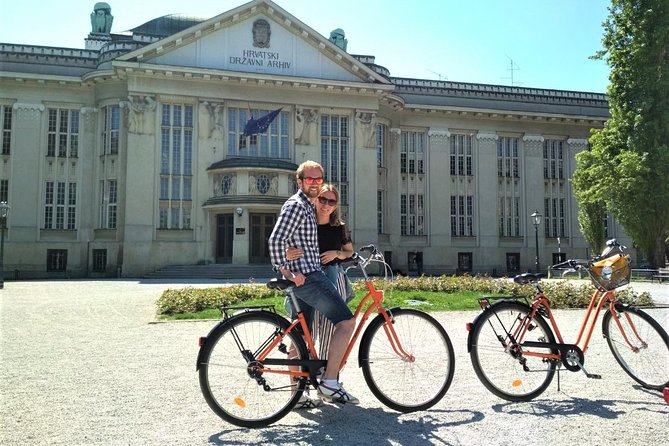
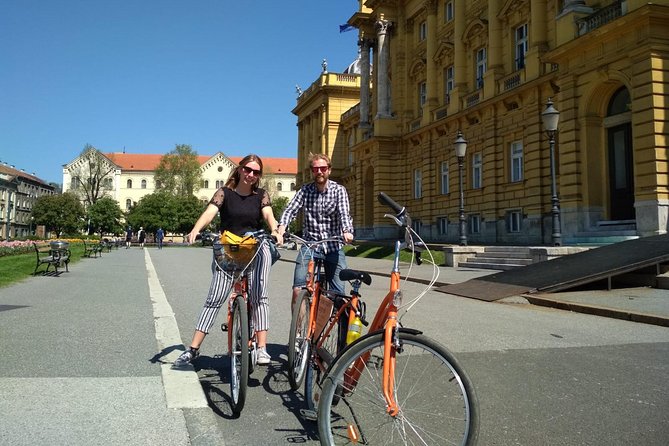
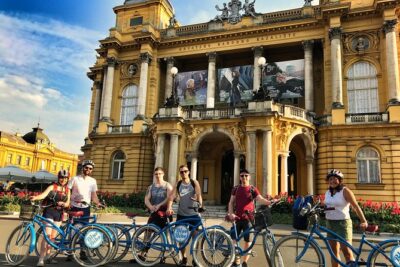
After the Upper Town, the route shifts to Zagreb’s grander Lower Town. The Croatian National Theatre was founded in 1860, fulfilling a long-held wish for a Croatian theatre operating in the Croatian language.
The stop lasts about 20 minutes, one of the longer pauses on the route. That gives your guide time to explain the building’s cultural role and the political hopes tied to its creation. Even if you are not planning to attend a performance, the theatre helps explain Zagreb as a national capital, not simply a historic town.
Next comes King Tomislav Square, named for Croatia’s first king, who ruled from 925 to 928 after previously governing the Croatian principality. The square forms part of the Lower Town’s broad civic setting.
This is a good point to notice the change in urban design. The Upper Town feels close and irregular. Here, space opens up, and the city’s public buildings and squares create a more formal sequence.
Zrinjevac and the final ride back
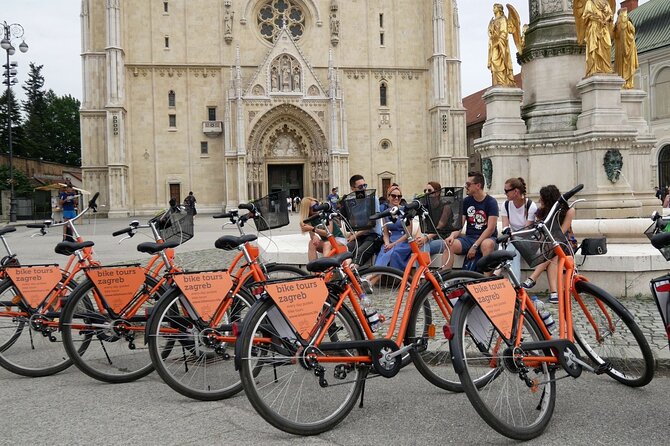
Zrinjevac receives about 20 minutes, another generous stop. In 1876, an urban plan was adopted to shape the Lower Town by linking its squares into one connected framework.
That planning idea is easier to grasp from a bicycle than from a single sidewalk. You can see the relationship between the squares as you move through them, rather than treating each one as a separate address.
The route ends back at the starting point on Jurišićeva ul. 19. A tour photo is included, along with the bicycle, helmet, and your choice of coffee, refreshing drink, or ice cream. Alcoholic drinks are not included.
The scheduled stops add up to more than two hours, leaving the rest of the three-hour duration for cycling, transitions, commentary, and the break. The timing is useful: you see a lot without signing up for a full-day activity.
Guides, pace, and the personal touch
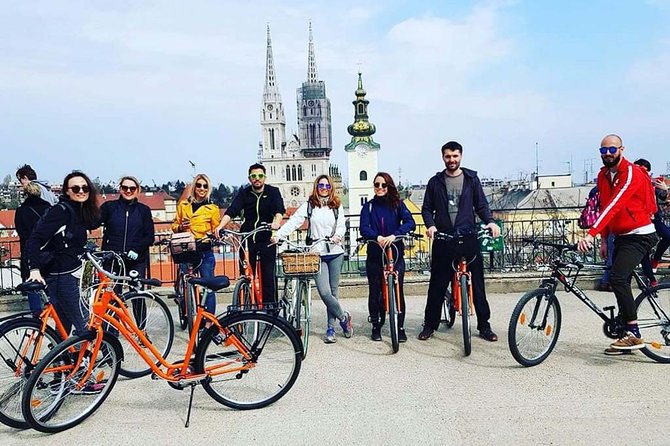
The strongest part of this tour is the guide. Filip is repeatedly praised for combining history with humor and for answering questions without making the ride feel like a lecture. Iva and Eva are described as warm, engaging, and willing to adjust the pace or explanation to the group. Sandro is noted for easy conversation and comic timing, while Željka is praised for making the city’s story clear and offering food suggestions.
Guide quality can vary from one departure to another, but the pattern here is encouraging. You should expect local commentary rather than a memorized list of dates. Guides also give practical advice about restaurants and things to do after the tour, which can make this a useful first activity in Zagreb.
The coffee, drink, or ice-cream stop adds to that feeling. It breaks up the ride and lets you get to know the other people in the group. For a city introduction, that pause is more useful than squeezing in another monument.
Bikes, helmets, and road comfort
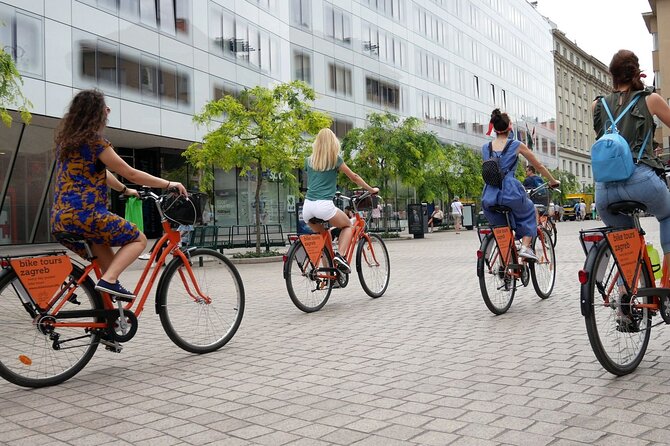
The equipment is the main area where I would keep expectations realistic. Some riders found the bikes comfortable, including an eight-speed model, while others felt the bikes were dated. One rider reported a missing kickstand, another raised concerns about helmet condition, and one person said there were no small bikes for shorter women.
There are also conflicting accounts about safety and organization. One serious complaint described a bike with a missing brake and a group that felt too large. The operator replied that bikes are checked before departure, that every bicycle has working brakes, and that the group stayed within the stated maximum. Another rider hit a bump early in the ride and received a replacement bike quickly.
The practical lesson is simple. Check both brakes, the saddle height, and the helmet before setting off. If something feels wrong, say so immediately and ask for a replacement. Also, do not expect a completely traffic-free ride. You may steer around pedestrians, pass over cobbles, and deal with trams or buses near busy streets.
Is $54.44 a fair price?
At $54.44 per person, this is not the cheapest way to see Zagreb’s center, especially since most stops have no admission charge. You are paying for the bicycle, helmet, guide, navigation, local interpretation, a refreshment, and a photo.
I think the value is good if you want an efficient introduction and would otherwise pay for a separate walking tour and bike rental. The three-hour length also makes it easier to fit into a short stay. You can use the tour to mark places for a later return, such as Dolac Market, Tkalčićeva Street, or the museums around the Upper Town.
The value is weaker if you already know central Zagreb well, dislike cycling near pedestrians, or want long visits inside churches and museums. This is an overview by bike, not an admission-based cultural tour.
Free cancellation is available until 24 hours before the start time for a full refund. Changes or cancellations inside that window are not accepted for a refund. Confirmation is provided when you book, and service animals are allowed.
Who should book the Classic Zagreb Bike Tour?
I would choose this tour early in a Zagreb stay. It gives you a useful map of the city, introduces both Upper and Lower Town, and leaves you with ideas for meals and further sightseeing.
It suits adults, active families, and anyone who finds a three-hour walk tiring. Children can manage it if they ride confidently. You should be comfortable with cobblestones, pedestrian areas, and a short uphill section, though walking the bike is fine.
I would skip it if you are not confident on a bicycle, need a very small frame, or expect immaculate new equipment. Ask for a bike and helmet check before departure. If the equipment feels right and you want to cover a lot of central Zagreb in one morning or afternoon, this is a strong choice.
FAQ
How long does the Classic Zagreb Bike Tour last?
The tour lasts approximately three hours, with some descriptions placing the actual ride just under three hours.
How much does the tour cost?
The listed price is $54.44 per person.
Where does the tour start and finish?
It starts at Jurišićeva ul. 19, 10000 Zagreb, Croatia, and finishes back at the same meeting point.
What is included in the price?
The price includes use of a bicycle and helmet, a local guide, coffee, a refreshing drink or ice cream during the break, and a photo from the tour.
Is the funicular ticket included?
No. Admission for the funicular railway is not included.
How large is the group?
The maximum group size is 12 people.
Is the tour suitable for children?
Children can take part if they are able to ride a bicycle confidently. One reported family completed the route with three 10-year-olds.
Is the ride difficult?
The route is largely flat and is often described as relaxed, but you should expect cobblestones, pedestrian areas, busy streets, and one steeper uphill section.
Can I cancel for a full refund?
Yes. You can cancel at least 24 hours before the local start time for a full refund. Cancellations or changes made less than 24 hours before the tour are not refunded.
More bike tours in Zagreb
- City Bike Tour of Split
★ 5.0 · 331 reviews - Hvar Island Self-Guided E-Bike Tour
★ 5.0 · 144 reviews
Just added in Zagreb
- Private Wine Road Day Tour from Zagreb★ 4.5 · 11 reviews
- Private Wine Tour from Zagreb: Two Local Wineries & Samobor★ 5.0 · 18 reviews
- Painting party at Art Bottega – Paint & Wine Studio in Zagreb★ 5.0 · 23 reviews
- Fairytale Castle & Wine Tasting & Lunch★ 5.0 · 19 reviews
- From Zagreb: Transfer to Split & Plitvice Lakes Guided Tour★ 4.7 · 463 reviews
- Private Transfer: Zagreb Airport (ZAG) to Zagreb Hotel★ 5.0 · 52 reviews
- Zagreb Airport One Way Private Transfer To or From Airport★ 5.0 · 132 reviews
- Zagreb BIG Tour – Our Signature Walking & Panoramic Tour★ 5.0 · 106 reviews
Bike & E-Bike Tours, compared.
Browse the lists this tour appears in